Veronese: Logistics of Illusion
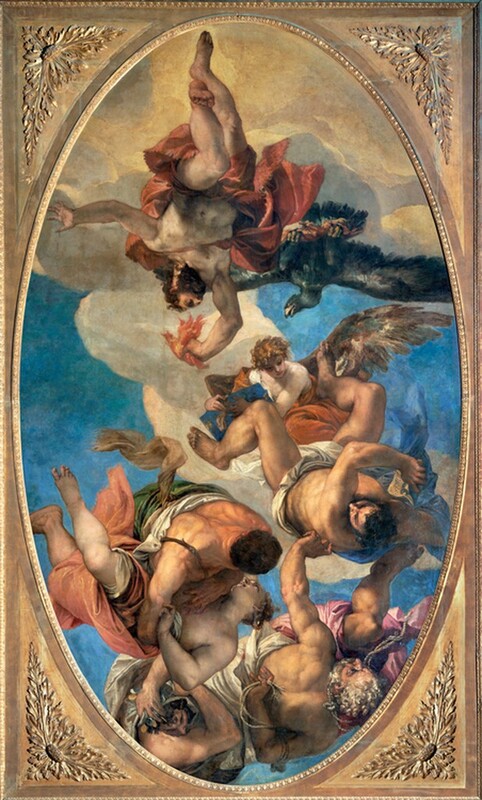
Jupiter Punishing the Vices
The ceiling paintings of Paolo Veronese (1528-1588) are ideal examples for demonstrating some of the technical elements of the emerging Baroque style of overhead imagery. Jupiter Punishing the Vices depicts Jupiter, accompanied by his characteristic eagle, hurling thunderbolts at the personified Vices as all appear to fly or free fall through an open sky. The strongly foreshortened, active figures pose an illusory threat as they seem to be falling directly onto the viewer [1]. The falling figures have no grounding in a fictive architectural space or on the frame of the painting, so there are few alternatives for the interpretation that the figures are forcefully entering into the viewer’s space.
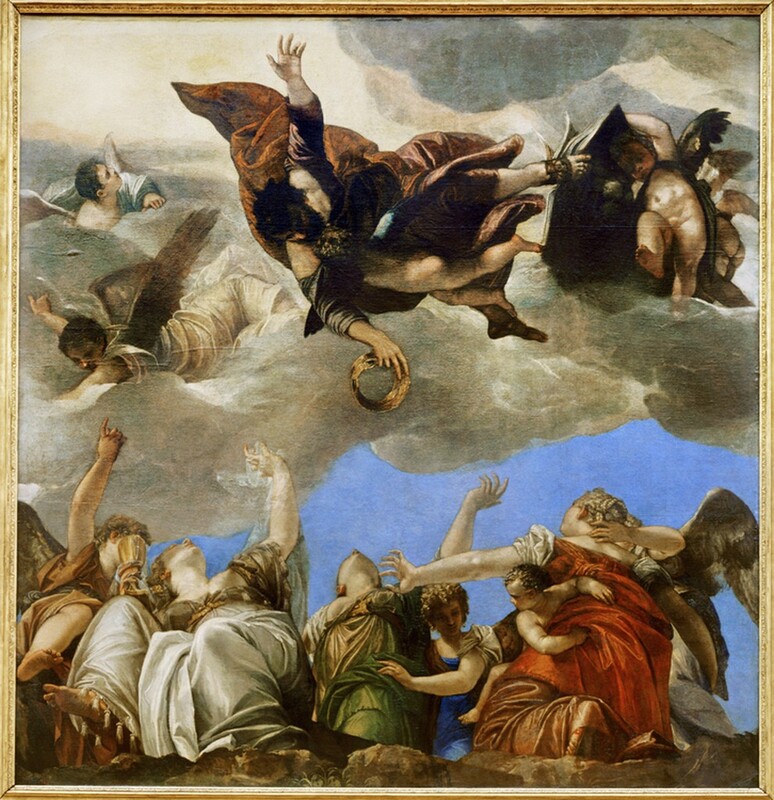
St. Mark Rewarding the Theological Virtues
St. Mark Rewarding the Theological Virtues takes a slightly different approach to di sotto in su imagery. St. Mark, similar to Jupiter, is floating in the clouds, free of any concrete support or grounding as he reaches down towards the Virtues. The Virtues, on the other hand, are perched on the edge of the image, as if standing on the frame [1]. They are not in free fall, nor are the angels attending St. Mark, as they appear to be at least partially supported by the clouds of the background. This contrast between the two “levels” of depiction creates two separate experiences for the viewer. On one hand, St. Mark is free to enter the viewer’s plane if he falls far enough. On the other, the Virtues are confined in their higher plane, distinctly separated from the viewer’s space.
Analysis
These two images highlight the practices of painting figures con termine, or grounded, and senza termine, or without grounding. Jupiter, the Vices, and St. Mark are all composed senza termine; they lack a concrete foundation on which to anchor their figures, so they effectively sit suspended in the air with no elements defining their exact position in space [1]. The Virtues and the angels are positioned con termine, with a defined relationship to the space above and below them marked by visible contact with other “concrete” elements of the painting. The Virtues are anchored by their stance on the groundline, the depiction of the ground within the painting; Veronese includes a small piece of “land” peeking over the edge of the frame to establish that the Virtues inhabit that fixed position [1].
The significant differences in effect of con termine and senza termine composition are twofold here. The first is the effect of the upward opening of space created by the painting’s fictive environment. The lack of restraining elements in senza termine images hypothetically affords the environment within a painting an infinite amount of upward mobility, since the visual cues of proportionality from architectural features or other vertical elements do not necessarily hinder the potential distance to be achieved by a free-floating figure. Con termine images’ upward thrust is limited by the artist’s illusionistic painting abilities, specifically in terms of rendering vertical proportion; a poorly done quadratura could serve merely to enclose the space of a fictive open ceiling instead of extending it into the limitless heavens.
The second important effect is that of separation, or lack thereof, from the viewer. The senza termine Jupiter and St. Mark are figuratively part of the viewer’s environment due to the lack of grounding elements or obstacles, lending a sense of unity between the painted scene and the viewer’s real space. The viewer, in a sense, is experiencing the painting as part of the painted environment. More separation is evident in the con termine Virtues, who inhabit a literal higher plane and therefore have less direct interaction with the viewer. The viewer is reduced to witnessing the scene from the outside, even though the space of the painting maintains its open-ceiling format.
References
1. Paula Carabell. “Framing and Fiction in the Work of Paolo Veronese: A Study in the Structure and Meaning of the Image Di Sotto in Su.” RES: Anthropology and Aesthetics, no. 36 (1999): 166–85. http://www.jstor.org/stable/20167481.