Cortona: The Prototype
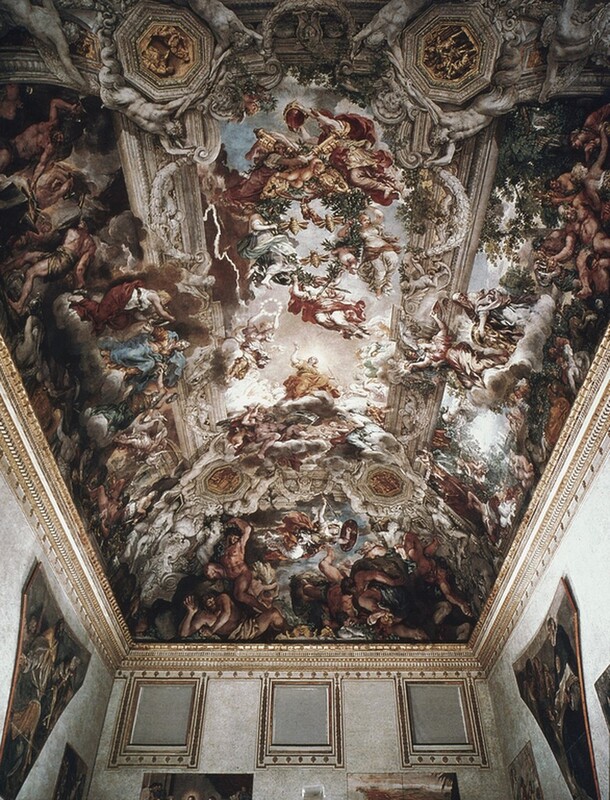
Divine Providence: Glorification of the Reign of Urban VIII
Pietro da Cortona (1596-1669) is regarded as a master of the Baroque ceiling fresco, especially in the development of illusionistic technique. His Divine Providence: Glorification of the Reign of Urban VIII within the Palazzo Barberini in Rome is often referenced as a prototypical illusionistic ceiling, making use of intricate quadratura and busy allegorical figures depicted di sotto in su as a grand gesture of praise of the Barberini family. Divine Providence gestures upwards to the Barberini coat of arms, the three bees, as she is borne up by a cloud to join the flying figures in the “open sky” of the center of the fresco [1]. The illusion of the image is bolstered by the interaction of the figures with the painted architectural elements; they overlap with and obscure the fictive “stucco” as if they are confined within the boundaries of the room with the viewer [2].
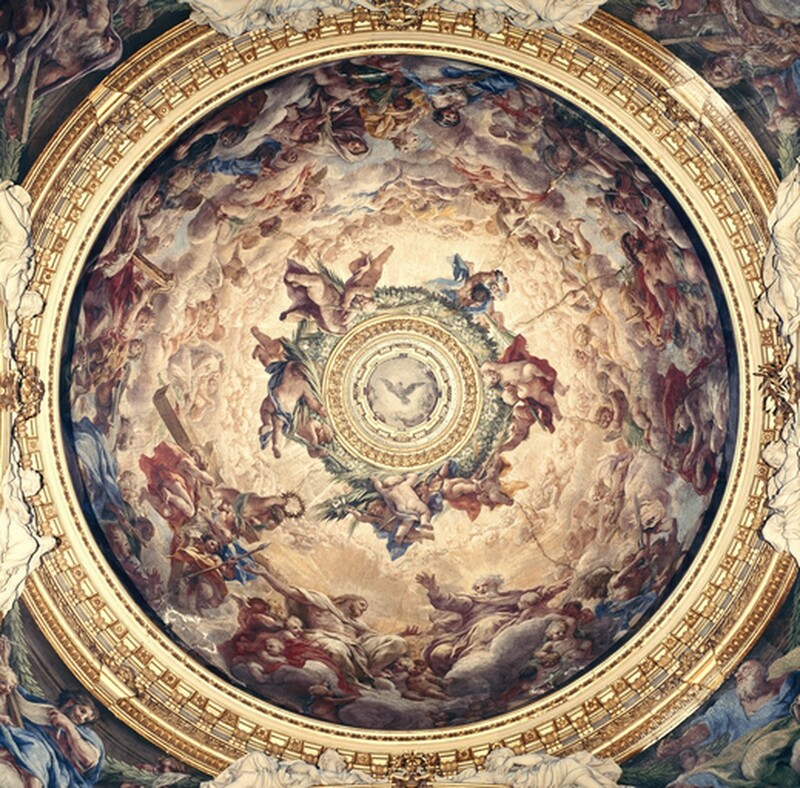
Trinity in Glory
Cortona’s emblematic Trinity in Glory in S. Maria in Valicella is an exercise in technical illusion, constructed to meet the needs of a divine event made physically accessible [2]. The view of heaven from below is accentuated by the concentric layers of angels and saints ascending into light and obscurity. The Father and the Son reside on the periphery, standing on clouds lining the golden frame of the main image. The dove of the Spirit is visible through the central golden ring, which is itself made into an element of the full image as it is wreathed with flowers and supported by angels. The painted and stuccoed figures outside of the main frame serve to extend the illusion outwards onto the rest of the ceiling, as they are painted and formed in the same di sotto in su style.
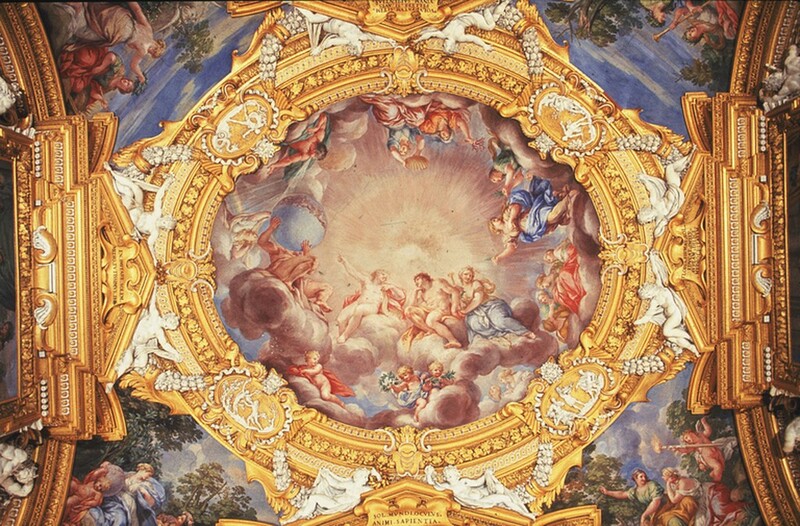
Sala di Apollo
The Sala di Apollo in the Palazzo Pitti is yet another example of Cortona’s mastery of mixed media in ceiling decoration. Fresco and stucco work in harmony to represent a young prince being guided by Hercules and the gods, specifically Apollo and his Muses here [1]. The existing architecture of the ceiling, the stucco sculptures of the framework, and the painting of the fresco itself work together to serve the illusion of the image, that of the figures supported by clouds and set against an unlimited expanse of sky.
Analysis
In terms of previously mentioned illusionistic techniques, Cortona appears to favor the illusion con termine; with the exception of the flying supporters of the Barberini arms and the angels holding the wreathed frame of the Spirit, his figures are supported, whether by clouds or by painted architecture. He has the technical prowess to execute a proper quadratura as a foundation, so the choice of con termine imagery does not detract from the sense of upward expansion.
Between them, these three pieces demonstrate varying intentions in terms of spatial manipulation. One goal is the effective illusion of infinite, unbounded space above the limits of the ceiling’s frame. This is especially evident in Trinity in Glory and the Sala di Apollo, where the fading of color and diminution of figures approaching the “upper limits” of the visible scene give the sense of endless upward potential: an eternity made somewhat comprehensible to the imagination. The other goal is the elimination of the figurative separation between the viewer and the painted scene [2]. This purpose moves the image downwards instead of upwards, seeking to make the environment of the painting and the room one and the same. All three pieces achieve unity with the viewer through the placement of human figures in front of the “architecture” of the ceiling, whether fictive or real; the figures inhabit the interior space, confined by the same walls that confine the people looking up at them. The two purposes can coexist, perhaps in separate parts of the painting in some cases, to extend the reach of the painting both upwards and downwards. Central, senza termine figures move a single vanishing point up into the heavens, while peripheral figures interact with the frame and the grounded viewer, a middle ground between the fantasy of the center and the reality of the rest of the room. The viewer is therefore incorporated into the scene itself, and the figures are incorporated into the universe of the room, or at least those who are confined by the illusory architecture.
References
- Jörg Martin Merz. Pietro da Cortona and Roman Baroque Architecture. (New Haven and London: Yale University Press, 2008), 27-29, 99-106, 119-126.
- Ebria Feinblatt. “Jesuit Ceiling Decoration.” Art Quarterly 10 (1947): 237-253.