Origins of Illusionism
The emergence of illusionistic ceiling painting in Italy can be traced back to Paolo Uccello’s work in S. Maria Maggiore in Florence in the mid-1400s; his vault in the Chapel of the Annunciation includes fictive columns projecting upwards into the curved ceiling, an early manifestation of quadratura [1]. This motif was not widespread at the time and did not reappear prominently until well into the 1500s in works by Pellegrino Tibaldi and the brothers Cristoforo and Stefano Rosa.
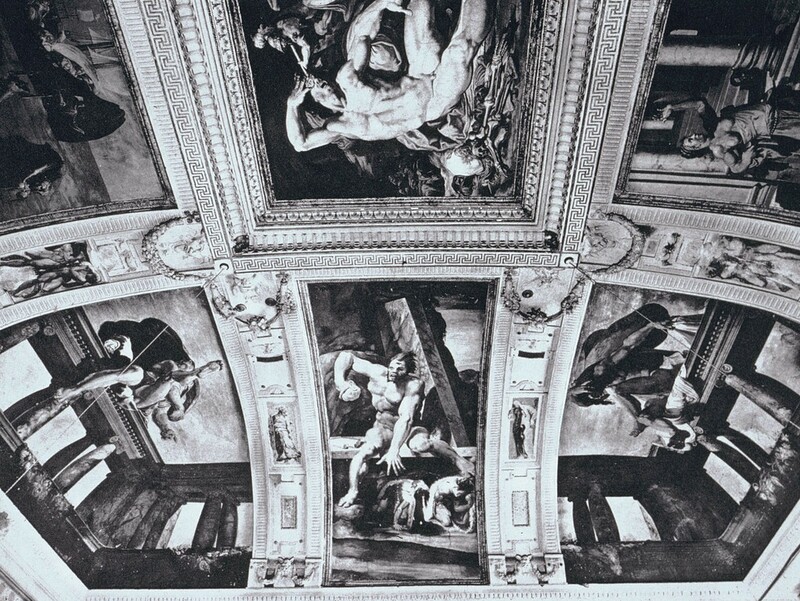
Pellegrino Tibaldi (1527-1596) executed a series of frescoes in the Palazzo Poggi in Bologna between 1554 and 1555, using a distinct forerunner to the quadratura techniques seen in the Baroque [2]. As seen above, his ceiling includes a row of columns painted to appear grounded at the top edge of the room’s walls. The columns defy the curved surface of the ceiling, rising vertically into the expanded space and giving the sense of a partially opened roof. The illusionistic space is only maintained at the corners of the room; it is broken up by the panels of non-illusionistic, figure-centric frescoes in the central positions along the top edge of the wall.
While Tibaldi worked primarily in Bologna, the Rosa brothers spread the popularity of illusionism in Venice, as well as exerting some influence in Bologna and Rome [1]. Although the majority of their work has been lost, Vasari and other art historians note their contribution in the ceiling of S. Maria dell’Orto. According to Vasari’s description, S. Maria dell’Orto was one of the closest iterations of quadratura painting to the Baroque style preceding the Baroque, until the building’s unfortunate destruction in 1864 [1].
References
- Juergen Schulz. “A Forgotten Chapter in the Early History of Quadratura Painting: The Fratelli Rosa.” The Burlington Magazine 103, no. 696 (1961): 90–102. http://www.jstor.org/stable/873277.
- Britannica. Editors of Encyclopaedia. "Pellegrino Tibaldi." Encyclopedia Britannica, April 23, 2021. https://www.britannica.com/biography/Pellegrino-Tibaldi.