Gaulli: Blending Boundaries
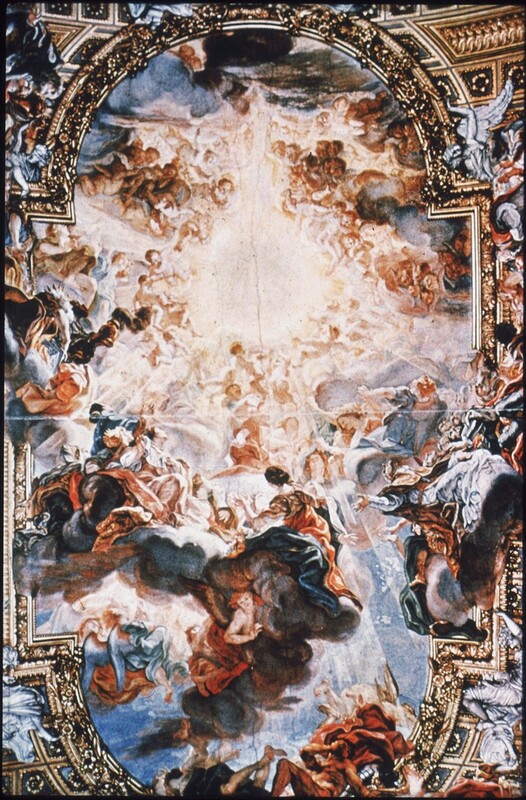
Triumph in the Name of Jesus
Giovanni Battista Gaulli (1639-1709) was one of the foremost figures in illusionistic ceiling art, following yet breaking away from Cortona’s established template. His Triumph in the Name of Jesus dominates the ceiling of the Jesuits' Il Gesù in Rome, embodying the adventurous spirit of pushing illusionistic imagery to new heights. Brilliant light bursts forth from a barely-visible, glowing Jesuit monogram at the center of the image; around it, layers of saints and angels gaze upwards in adoration while sinners tumble down, away from heaven. Gaulli also exploits mixed media to great effect. The figures are even less confined to the limits of the frame because Gaulli extends the area needed for the painted figures with layers of stucco, smoothing over the surfaces and providing a three-dimensional element to the figures who seem to tangibly exist underneath the golden framework. Additionally, the figures are made more solid by Gaulli’s inclusion of shading on the areas of the vault where the figures would conceivably cast shadows; he uses a dark glaze to create the optical “proof” of the figures’ obstruction of the beaming light [1].
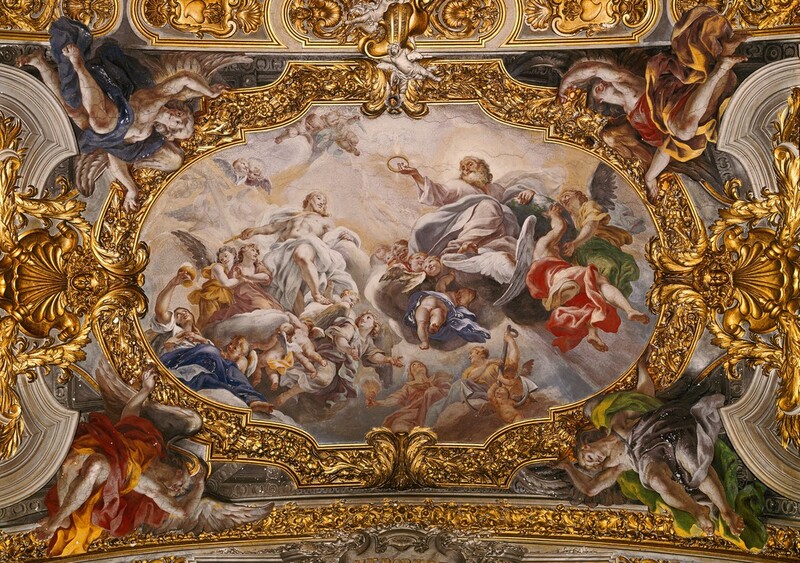
Paradise Singing the Praises of Jesus
Much less scholarship is devoted to Gaulli’s Paradise Singing the Praises of Jesus, another fresco within Il Gesù, likely because Triumph in the Name of Jesus commands the majority of focus. This smaller fresco also features cloud-borne, senza termine angels supporting Jesus and God the Father, who reaches out with a crown towards Jesus. Not as much emphasis is placed on the upward immensities of the sky, although some amount of divine light still appears to radiate down onto the figures and cast the lower regions of the fresco into shadow. Gaulli incorporates his technique from Triumph in the figures of the angels who appear to hold up the golden frame: a layer of stucco over the goldwork makes for a smooth fresco surface and a more impactful entrance of the angels into the space of the room rather than the space of the painted scene.
Analysis
One of the striking differences between Gaulli and his predecessor Cortona is the absence of quadratura as part of the main illusory technique. His composition is based less on the construction of upward perspective and more on the distinctly Baroque emphasis on light and shadow as a way of logically structuring an image [2]. The light source in both cases is the light of heaven, the brightest and most central area, which creates strong contrasts with the shadows on both the figures and the periphery of the image; by default, they must be darker than the center with any inclusion of color. By distributing light and shadow to the different main areas of the composition, Gaulli’s Triumph creates order in a crowd of figures as dense as in Cortona’s Divine Providence.
The other dominant upward perspective shift occurs as a result of the primarily senza termine depiction of Gaulli’s figures. Although the clouds in various layers form grounding elements for the human bodies, the clouds themselves enter the viewer’s plane through their lack of affixation to some out-of-frame foundation, and therefore the figure’s space and the viewer’s space are united. In the other direction, the ungrounded figures also freely recede upwards into the sky; this movement is indicated mostly by the diminution in size and fading in color as the figures approach the central light source. The dominance of senza termine is again seen, as in Canuti’s work, suggesting a trend towards departure from con termine imagery as ceiling illusionism evolved.
References
- Robert Enggass. “Bernini, Gaulli, and the Frescoes of the Gesù.” The Art Bulletin 39, no. 4 (1957): 303–5. https://doi.org/10.2307/3047734.
- Arnauld Brejon de Lavergnee. "The great illusionists." UNESCO Courier, September 1987, 30+. Gale OneFile: CPI.Q (accessed October 12, 2021). https://link.gale.com/apps/doc/A6133957/CPI?u=duke_perkins&sid=summon&xid=e32d1bb3.