Tiepolo: Last of the Illusionists
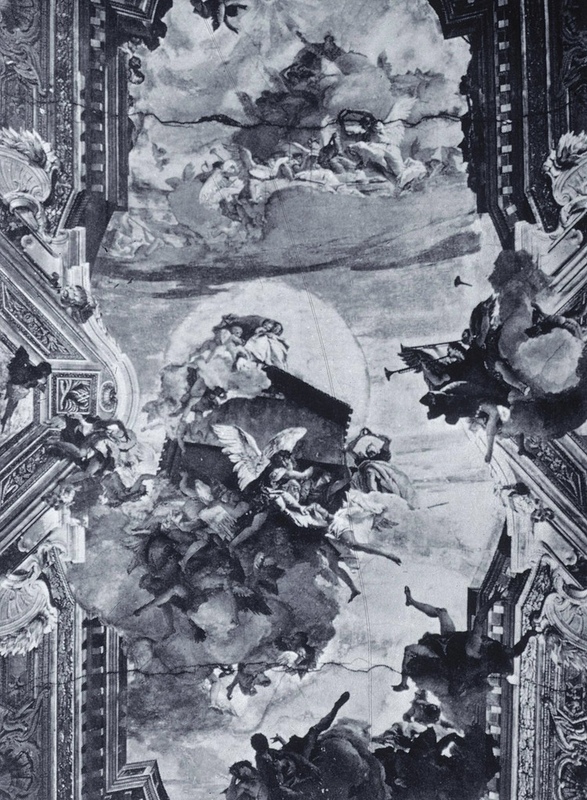
Translation of the Holy House to Loreto
Giovanni Battista Tiepolo (1696-1770) painted during the later years of the Baroque, and his work demonstrates the appropriate culmination of styles accumulated during the period. His Translation of the Holy House to Loreto in Venice’s church of S. Maria di Nazareth is no longer extant, as it was destroyed in a 1915 bombing, but the surviving images support the fresco’s claim as the last true illusionistic ceiling of the Italian Baroque style [1]. The ceiling depicts the miraculous transportation of the house of the Virgin Mary by a group of angels, while God the Father observes the scene from above and sinners tumble downwards. The composition separates the three groupings--the Father, the Holy House, and the sinners--into upper, middle, and lower levels of perspectival distance, creating an illusion not only between the viewer and the ceiling but also between the ceiling’s divided parts and their respective figures [1]. Distinct di sotto in su perspective is applied throughout, recalling ceiling fresco traditions established by Veronese and other proponents of earlier illusionism [1].
Analysis
Tiepolo’s composition follows up on the tier-based illusionistic technique seen in Gaulli’s Triumph in the Name of Jesus in that its three sections create different relationships with the viewer. The falling sinners bypass the boundaries of the frame and are seen from directly below, echoing Veronese’s Vices in their downward movement into the viewer’s plane of existence. The Holy House is the middle ground, actively being carried upwards but still solidly within the viewer’s sight; spectators bear witness to the miracle, although they may not be participating. God the Father is at the highest physical point in the sky, residing on a senza termine body of clouds and comparatively small in size, highlighting both physical and spiritual distance. If Tiepolo carries over the same trends seen in Gaulli and Pozzo, he too expresses the dual purpose of subordinating and unifying with the grounded spectator. The bodies of the sinners bear the most relatable position and size in comparison to the viewer, extending the scene down into the room and thereby incorporating the viewer. The visual “height” of the Father is similar in effect to Pozzo’s St. Ignatius: lofty, rising, and too far removed from the earthly plane to be of the same physical status.
References
- William Barcham. "Giambattista Tiepolo's Ceiling for S. Maria Di Nazareth in Venice: Legend, Traditions, and Devotions." The Art Bulletin 61, no. 3 (Sep 01, 1979): 430. https://login.proxy.lib.duke.edu/login?url=https://www.proquest.com/scholarly-journals/giambattista-tiepolos-ceiling-s-maria-di-nazareth/docview/1296208918/se-2?accountid=10598.