Pozzo: Fictive Architect
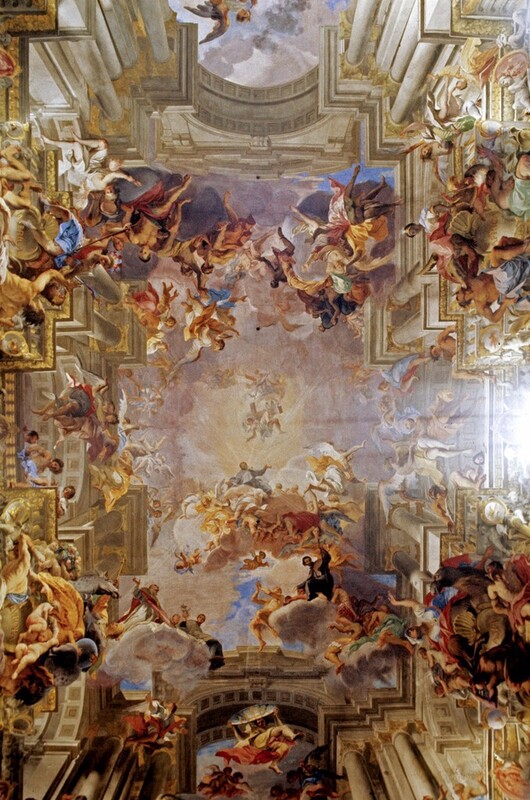
Glory of Saint Ignatius Loyola
Andrea Pozzo (1642-1709), a contemporary of Gaulli, was the other dominant ceiling illusionist of his time, yet his fresco Glory of Saint Ignatius Loyola within the Jesuit church of Sant’Ignazio in Rome is stylistically quite different from any of Gaulli’s ceiling work. One of the primary features of Pozzo’s vault fresco is the bold, calculated quadratura that visually extends the existing architecture of Sant’Ignazio’s inner walls; the fictive continuation of the walls becomes the horizontal boundaries for the illusory upward motion of the image [1]. In the central “opening” of the painted columns and arches, the distant St. Ignatius rises towards Jesus carrying the cross, almost lost among the multitude of other human figures yet emphasized by the space of the bright focal point of the fresco. Constructed around a central vanishing point, this fresco’s complex perspectival architecture serves a singular purpose of upward depth, emphasizing the great distance between the land-bound viewer and the lofty St. Ignatius [2].
Analysis
The comparison between Gaulli’s and Pozzo’s illusionistic ceilings is particularly dramatic because in each, a key element of one is absent in the other. The dominating quadratura of Pozzo’s St. Ignatius is the defining feature of the ceiling, whereas Gaulli makes no indication of quadratura in his work in Il Gesù. On the other hand, Gaulli’s use of stucco, both for extending his painting space and creating sculptured figures to interact with the painted ones, is not seen at all in Pozzo’s frescoes. The separation makes sense in context; Gaulli was well-versed in sculpture, while Pozzo was a skilled architect [3], to the point of publishing writings on architectural perspective [2]. Gaulli and Pozzo face a split in judgement here, even though both seek to amplify the effects of ceiling illusionism. Presumably the two techniques, stucco and quadratura, could be used simultaneously, but the choice of technique may inform viewers about the more detailed motive behind the two artists’ compositions.
Pozzo’s quadratura has the primary effect of magnifying upward distance. The sharp technicality of his one-point perspective serves the image of a vast heavenly infinity towards which St. Ignatius is rising; the painted walls narrow proportionally to support the visual logic of the great height of the raised figures. Despite St. Ignatius’s position on a senza termine cloud, the viewer faces the illusion of a great separation between their position and Ignatius, rather than getting the sense that Ignatius is within the same earthly plane [1]. The effect is the opposite of that of Gaulli’s stucco work, which serves to bring the figures over the lower boundaries of the fresco and into a space relatable to the observing eye. The purpose of distancing rather than connecting the painted figures to the viewer suggests an existential separation as well as a physical one; the viewer cannot relate to the figures in the high heavens because they are grander and more powerful beings than mere humans. The grandiosity of Pozzo’s composition contrasts with an interpretation of immediacy in Gaulli, whose heavenly figures extend downwards to emphasize the closeness and attainability of the higher realm.
References
- Ebria Feinblatt. “Jesuit Ceiling Decoration.” Art Quarterly 10 (1947): 237-253.
- Katherine Wheeler. “Fictive and Real Architecture: A Preliminary Drawing for Andrea Pozzo’s Vault Fresco at Sant’Ignazio, Rome.” Thresholds, no. 28 (2005): 100–153. http://www.jstor.org/stable/43876210.
- Arnauld Brejon de Lavergnee. "The great illusionists." UNESCO Courier, September 1987, 30+. Gale OneFile: CPI.Q (accessed October 12, 2021). https://link.gale.com/apps/doc/A6133957/CPI?u=duke_perkins&sid=summon&xid=e32d1bb3.