The Archangel Michael Defeating Satan
Description
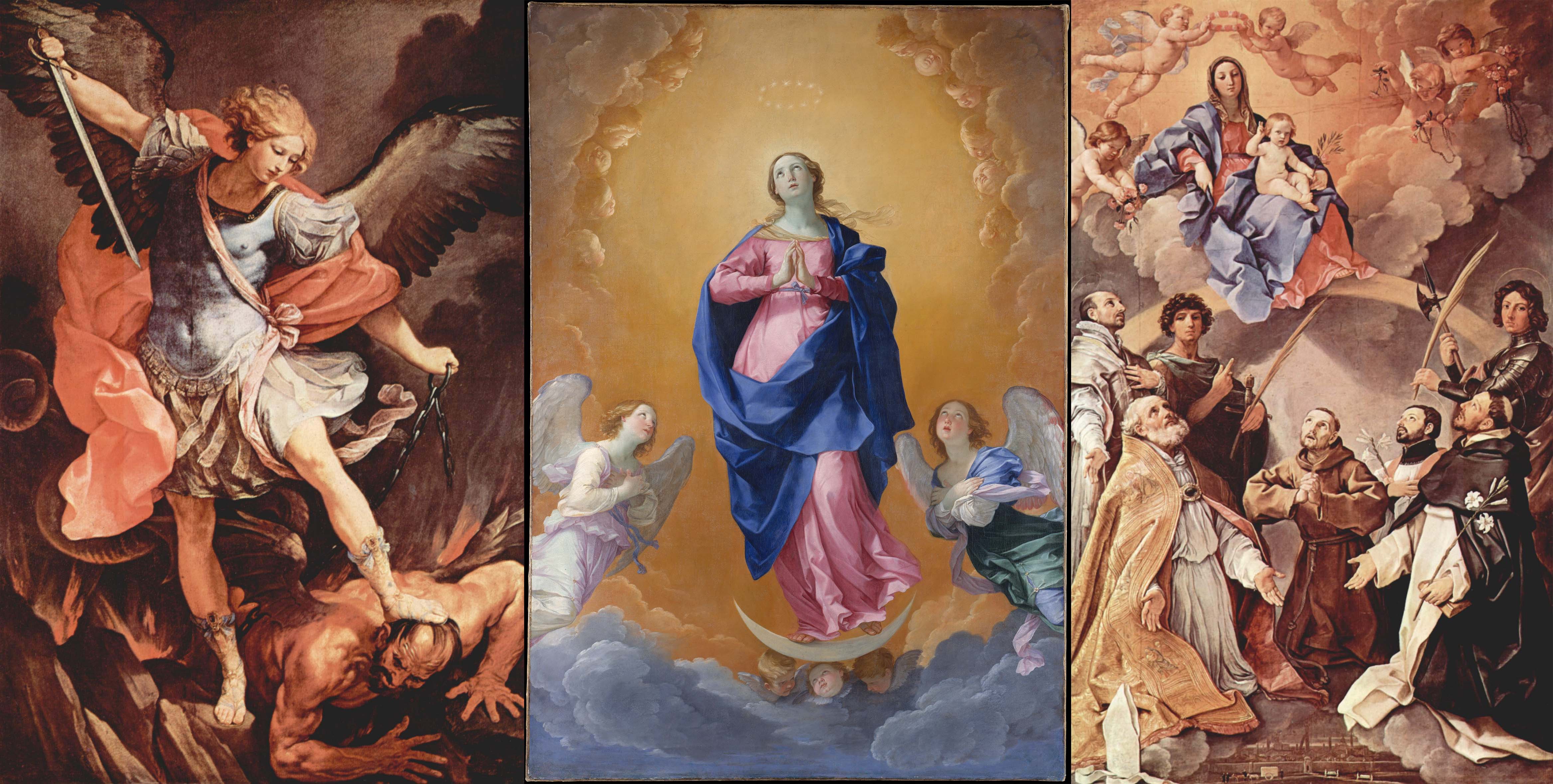
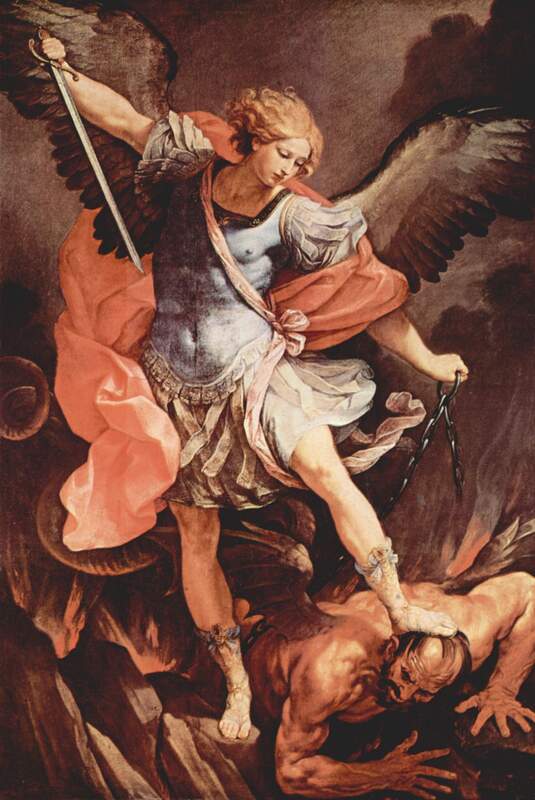
“The Archangel Michael Defeating Satan” is one of Guido’s most famous works painted in his second manner when he was strongly under Raphael’s influence. The single devotional figures of the Archangel Michael usually depict him as combining the characters of the captain of the heavenly host and conqueror of the powers of hell. According to Jameson, this piece by Guido is the only similar representation of St. Michael that can be compared with that by Raphael in the Louvre[1].
In this work, the Archangel in blue cuirass, red mantle, and violet scarf is poised on out-spread wings, placing his foot on the head of Lucifer. The archangel holds a sword in one hand and a chain in the other, with which he is about to hit the demon into the bottomless pit. The Archangel’s head has blended masculine and feminine graces, with the serene purity of brow and flow of the golden hair surely suggesting divinity.
Comparative Work: Raphael's St. Michael Vanquishing Satan
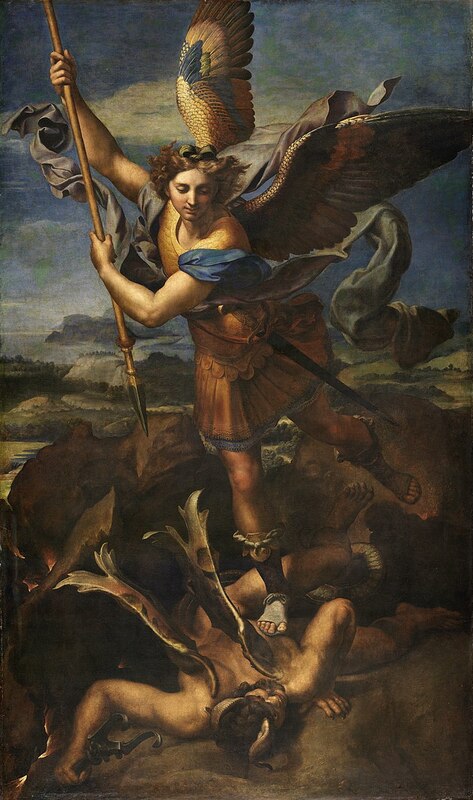
St. Michael Vanquishing Satan is created by the Italian High Renaissance artist Raphael. The painting was commissioned by Pope Leo X. In the painting, the archangel Michael standing on top of Satan's back with his right foot while holding a spear in his hands. It is a large-scale and mature version of a subject he had earlier treated in the youthful miniature called St. Michael. Both works have been located in the Louvre in Paris since 1667.
This painting has symbolic meaning within the Christian religion as it symbolizes God triumphing over evil. Raphael had a gift for creating images that evoked divinity in a subtle way. He was known to be skillful at creating space within his compositions as well as movement captured at a stand still[2].
In the painting, Michael stands on top of the devil with one leg while holding up his spear to deliver a strike to his head. His wings are depicted open while the devil's are closed signifying defeat. The ideal figures that he would create were done so not to overpower the image, but with grace and reservation. According to author George B. Rose, "Even though the color wasn’t his expertise, Raphael always used it appropriately. His use of lines was masterful and had a decorative quality to them. Raphael had great skill in portraying space through his compositions and it wasn’t always tied to having a distant background. Regardless of the sense of space created, Raphael had the ability to juxtapose the vastness of nature with man’s dominion over it. Man is always dominant, and the land is subservient to man's will[3]." Here man is portrayed as the master through the image of Michael and Satan is the subservient creature.
Comparison
Compared with Raphael’s Saint Michael Vanquishing Satan of 1518, both works have similar compositions in that they both place the subjects in a diagonal position to create a certain thrust in the scene. The Archangels in both paintings share similar appearances and clothes. In Reni’s work, the Archangel’s attitude is the first to strike the audience and is criticized because the grace is somewhat mannered, while Raphael’s Archangel does not invoke the audience to think about the attitude[4]. Although both works create dynamic feelings of movement through the depiction of the flying cloaks and hair, Reni boldly uses large areas of pink and red to create a visual clue that guides the viewers’ eyes. Reni also simplified the background into unified brown and black, which creates contrast with the highlight on the Archangel. Moreover, while Raphael’s Lucifer is obviously non-human shown by the horns, hair, and strange facial features, Reni’s depiction of Lucifer is less demonized and more humanized with a head that is almost indistinguishable from a human adult. As a result, Raphael’s Lucifer seems to be hopelessly resisting, while Reni’s Lucifer seems to be suffering in deep pain and even sympathetic.
References
[1]Motuzas, Alfonsas (2016). "The Folk Piety of Saints Archangels Michael, Gabriel and Raphael in Lithuania". LOGOS-VILNIUS (0868-7692), (86), p. 138.
[2]Anderson-Riedel, Susanne. “A French Raphael: Alexandre Tardieu’s Engraving after Raphael’s St. Michael Vanquishing Satan (1806).” Art in Print 6, no. 1 (2016): 27–30. https://www.jstor.org/stable/26408644.
[3]Vasari, Giorgio, and Jill Burke. The Life of Raphael. The J. Paul Getty Museum, 2018.
[4]Masters in Art: A Series of Illustrated Monographs. Boston: Bates & Guild, 1903.