The Separation of Night from Day
Description
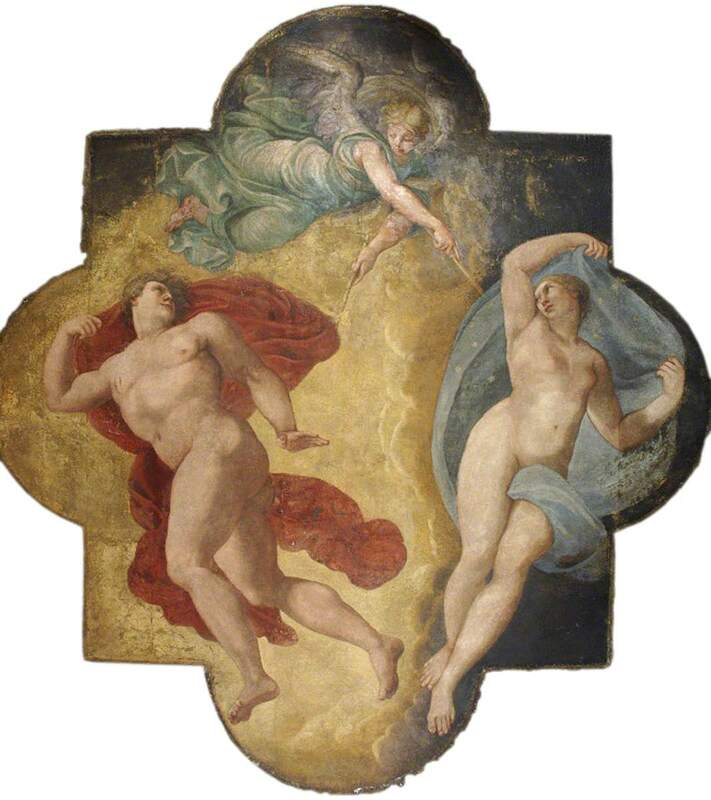
The Separation of Night from Day happens in the story of the Creation. A winged celestial being or spirit, who has variously been called Dawn or Twilight, separates two figures with two wands. Day, a scantily clad young man, moves swiftly towards the light, holding aloft a flaming red cloak, and looking back over his shoulder in the direction of Night from whom he has just withdrawn. Night, a woman, partially enveloped in clouds, raises her star-studded mantle as if to cover her nakedness, and gazes in the direction of retreating Day[1].
This detached fresco is one of the earliest works by Reni and one of very few by him in that medium. It was originally on a curved ceiling in the main saloon in Palazzo Zani, 56 via Santo Stefano, in Bologna, but was taken down, using a novel technique, strappo, or detaching the paint-infused plaster from the plaster behind, and reapplying it to canvas[2].
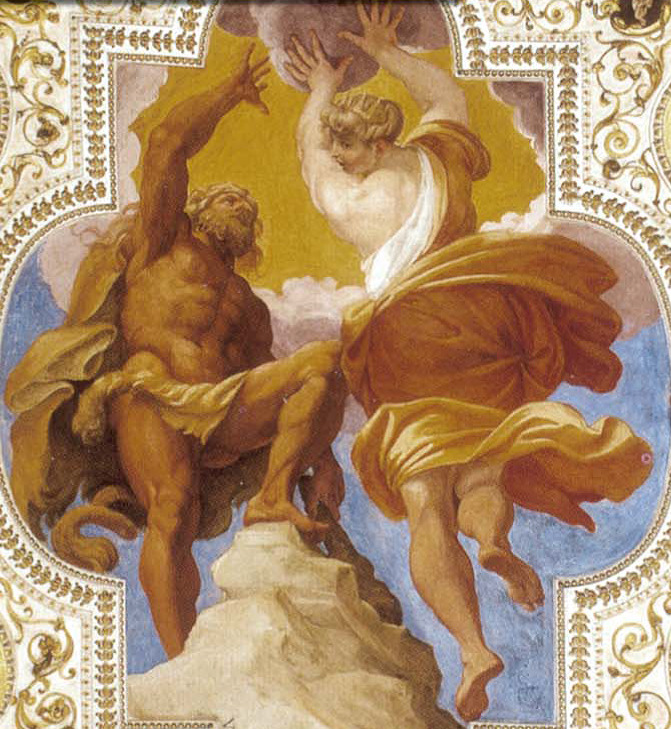
In organizing the airy, cloudy space within a quadrilobe frame, and in showing a heroic male nude with a female figure caught in a swirl of drapery, Reni seems to have been emulating Annibale Carracci's Hercules guided by Virtue painted on a ceiling in Palazzo Zampieri, Bologna in 1593. The idea of representing time in movement while seizing on just one recurs magisterially in his 1614 decoration The Aurora in the Palazzo Pallavicini. This work demonstrates that Reni was working out a composition of simple, eloquent precision, where no figure overlaps another, and where the protagonists, rather than filling the space in depth, operate firmly on the surface plane. He was to exploit this technique of dynamic narrative - opting for lateral movement rather than recession - in many of the great works of his maturity, including Hippomenes and Atalanta.
References
[1]Cordellier, Dominique. “Guido Reni’s ‘Separation of Day and Night.’” The Burlington Magazine 129, no. 1007 (1987): 81–82. http://www.jstor.org/stable/882779.
[2]Sitwell, Christine. "The reinstatement of the separation of night and day by Guido Reni in the library at Kingston Lacy". ICON news (London) (1749-8988), (4), p. 53.