Hippomenes and Atalanta
Description
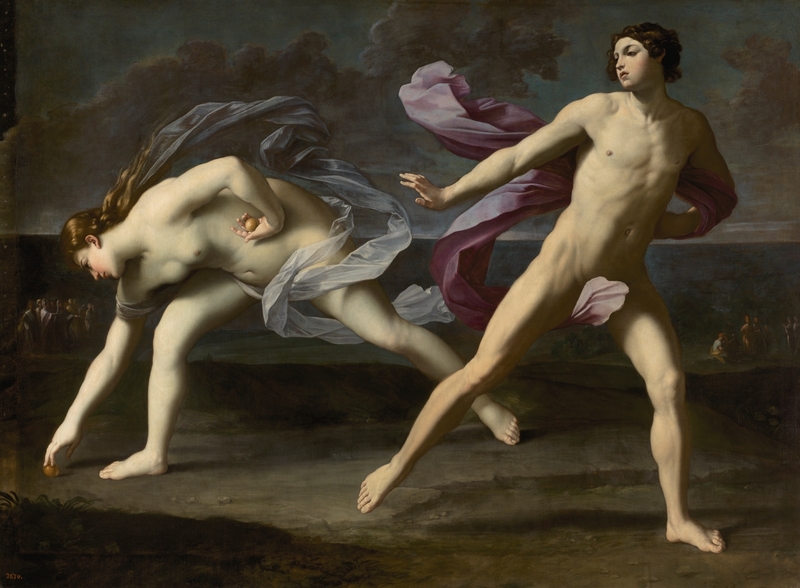
This work features two naked bodies in a basically sideways motion, and its subject is the race between the man-resisting girl Atalanta and her ardent suitor, Hippomenes; he has thrown a golden apple to distract her, and she is stooping to pick it up. Reni's trick is to make one figure the next stage of the other: Atalanta will soon rejoin the race[1].
This is a scene of pure human action. It's composed of little more than two naked bodies in motion. But the action is complicated. The subject of the picture is a girl-taming story from Ovid. The wild, chaste, boyish Atalanta is a champion runner and man-refuser. She will only marry a husband who can out-race her. Many try, and the losers die. But Hippomenes prays to Venus, and the love goddess gives him three golden apples, which he tosses behind him whenever Atalanta overtakes. She retains apparently a feminine weakness for shiny things, and each time she drops back to pick up the apple. Hippomenes wins[2].
The race runs across the picture. Its onward direction is left to right. There's a suggestion (mainly in Hippomenes' forward leg) that they're also running somewhat towards us. The idea is presumably to moderate the impression of a frieze, which might have felt a bit naive to Reni. But it's a token gesture: the dominant sense of movement in both figures is definitely sideways, and the picture probably needs the simplicity and clarity of a frieze layout, to bring off its elegant complications.
Hippomenes' mixed action is handled neatly. The straight sloping length of his right leg and side press him onward. His backward-casting right arm works at the same time as a speed-trail, flying behind him, picking up on the fluttering drapery - and with both figures, the drapery has a dynamic function. Atalanta's temporary backtrack is a virtuoso accomplishment. It's partly a matter of balance. Unlike Hippomenes, her stride is without forwarding momentum. She stoops low towards the left, but her left leg keeps its footing on the ground behind her. Having picked up the apple, she won't continue leftward, her weight will fall back onto this leg, which establishes a counterweight and a counter- direction. She may have suspended her racing, but this left foot stays pointing the other way, indicating her intended and imminent turn, pulling her back into the race.
References
[1]Lubbock, Tom. "Atalanta and Hippomenes (c.1612)." Independent (2007): 30. https://login.proxy.lib.duke.edu/login?url=https://www.proquest.com/scholarly-journals/atalanta-hippomenes-c-1612/docview/1035856264/se-2?accountid=10598.
[2]Pepper, D. Stephen. Guido Reni: a complete catalogue of his works with an introductory text. New York: New York University Press, 1984.