Penitent Magdalene
Description
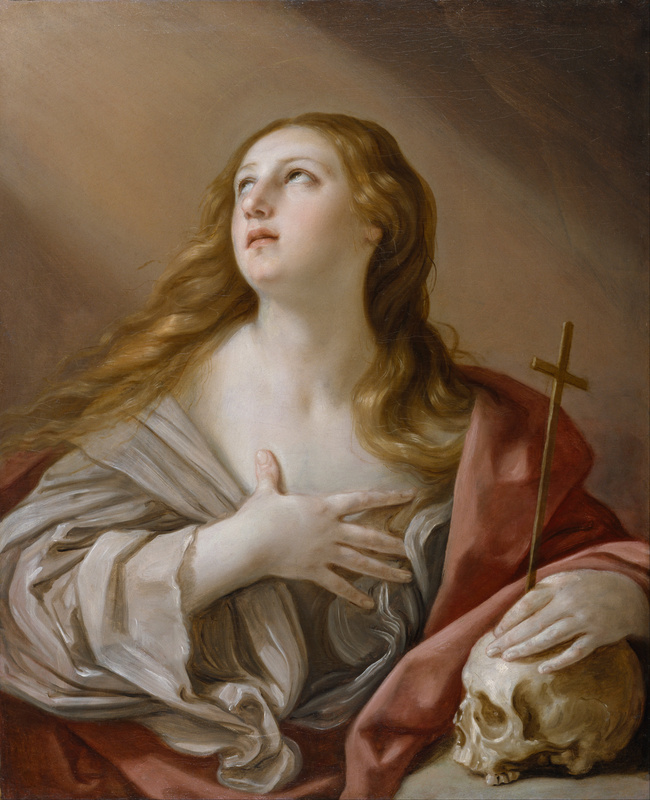
According to Christian tradition, after meeting Christ, Mary Magdalene regretted her former sinful ways. The claims that Mary Magdalene was a prostitute leading a promiscuous way of life before meeting Jesus and repenting of her sinful ways, are completely unfounded, and not supported by the canonical gospels. Nevertheless, the idea of a strong woman offering redemption was a powerful image, and the revival of the cult of Mary Magdalene during the late 16th-17th centuries was accompanied by numerous depictions in a variety of styles, of which, Guido Reni's is a personal favorite[1].
In the painting, the beautiful Magdalene with her ivory skin and long golden hair turns her gaze toward heaven. Her cross and the skull suggest that she is meditating on the brevity of life and the salvation made possible by Christ's death. Reni’s idealized and classical style was influenced by ancient sculpture and by the Renaissance artist Raphael (1483-1520). This influence is visible in Magdalene's rounded and even features[2]. They are painted so smoothly that the strokes seem to disappear. In contrast, the drapery is depicted with broad and energetic strokes, which are more typical of 17th-century painting. Images of female saints, sometimes depicted in a seductive manner, were very popular among some artists and patrons in the 17th century.
Reni painted many versions of this composition. The composition is simple, striking, and powerful. Magdalene lifts her soft face toward the heavens, illuminated by a divine shaft of light. Her hair flows with power over her right shoulder. She clutches a hand to her breast in a show of humility as her robes drape and swirl. Depicting the cross above the skull could be a symbolic representation of the triumph of the divine over death. Placing the erect cross between her fingers could be a nod to her supposed lascivious former life which she is now turning away from, fixing her gaze toward god in the opposite direction. Reni's depiction is a masterpiece and a subtle show of the power of both Christianity and the Baroque.
References
[1]Brady, Aoife. “The Studio of Guido Reni from 1620 to 1630: Formulating Compositions.” Getty Research Journal, no. 12 (2020): 1–28.
https://www.journals.uchicago.edu/doi/pdf/10.1086/708313.
[2]Mahon, Denis, and Stephen Pepper. “Guercino and Reni: Reflections on the Interpretation of Documents and Paintings.” The Burlington Magazine 139, no. 1128 (1997): 178–87. http://www.jstor.org/stable/887393.