A History Borromini's Scientific Influences
Nature and Perfection
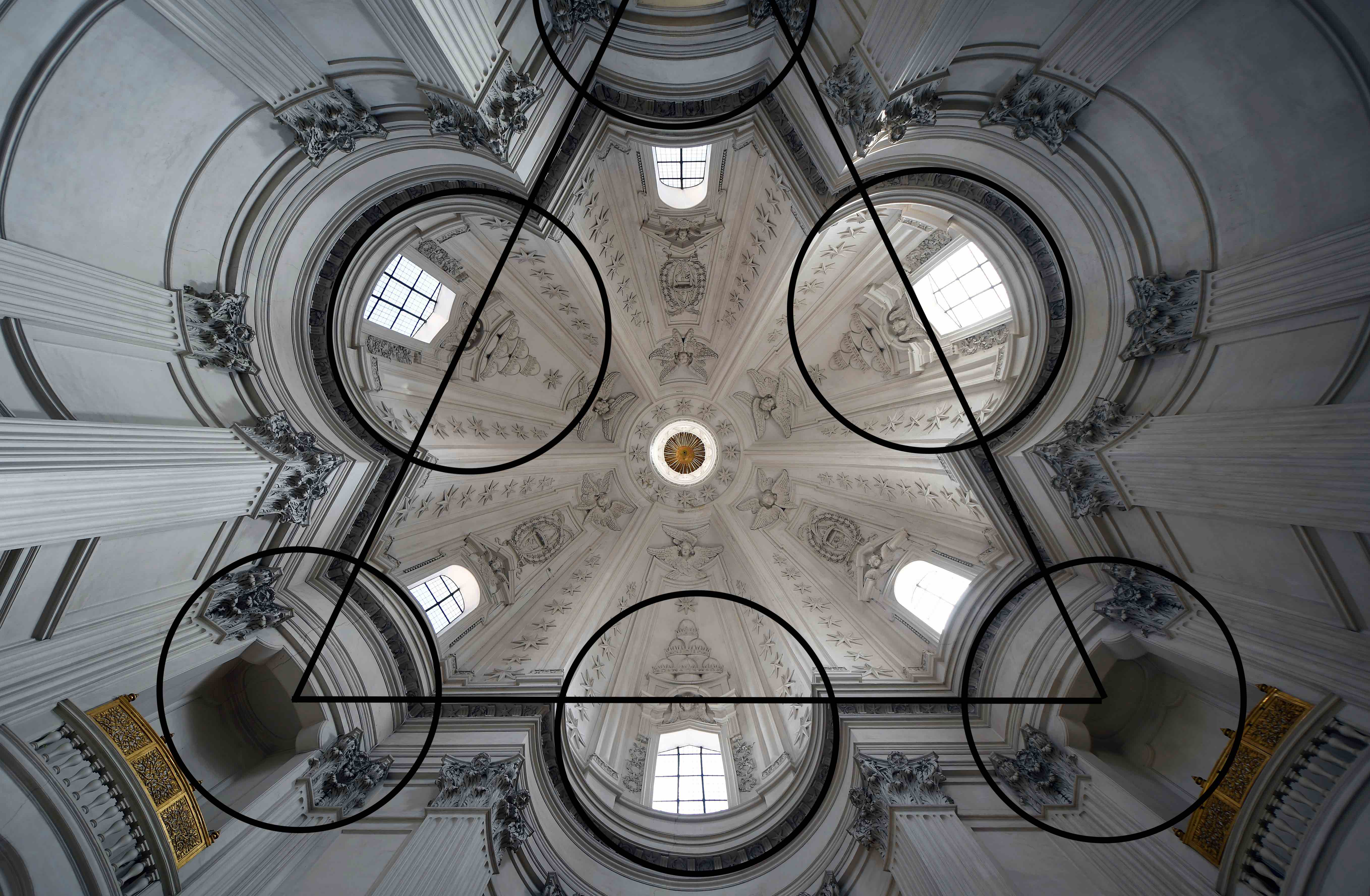
Rooted in Borromini's architectural ingenuity, is his reliance on simple geometric configurations. For example, his triangular bases plans and circular arcs are widespread throughout his works. These perfect shapes, the regular polygons that dominate his design plans are reminiscent of the teachings of contemporary and past scientific innovators. The teachings of Galileo, Kepler, Copernicus, and Euclid, among many others, put forth the notion that these simple perfections of geometry are reflections of the perfection in nature.
Many forms of architecture have been developed as imitations of nature around (Blunt 1979, 47-8). Such is the case for a multitude of Borromini’s contemporaries who derived their architectural designs from the influence of the human body. Often, the verbiage used to describe such architectural designs arises as portions of buildings are referred to as the torso, hands, feet, head, etc. (Hill 2013).
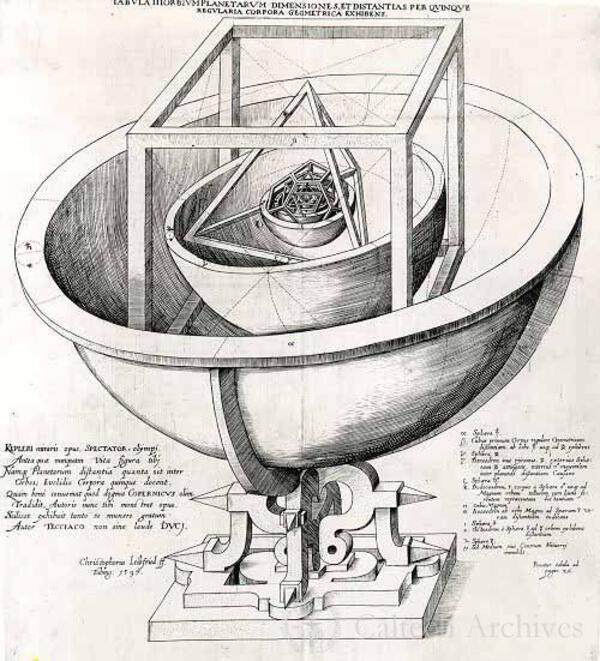
The relationship between architecture and the natural form became much more nuanced when considering the Aristotelian assertion that nature tends towards perfection based on a set of governing laws of the universe – these laws being based in the practical sciences (Blunt 1979, 48). Thus, an innate relationship is conceived between nature and science. Galileo and Kepler alike both made observations of this relationship. The former references this idea in his book, Il Saggiatore (1623) as he discussed the mathematical language with which in nature is written, without understanding the geometric figures around, nature is inconceivable. Kepler similarly materializes this idea in his assertion that God is the divine geometer (Hatch 2014). Continuing with the theme put forth by Aristotle, Kepler maintains that the architecture of nature is based on a set of fundamental geometric principles. Perhaps this is most exemplified in Kepler’s “Model of the Cosmos” in Mysterium Cosmographicum. In this graphical representation of the planetary orbits, Kepler contends that the six known planets must orbit the sun in relation to the five known Platonic solids (cube, tetrahedron, octahedron, dodecahedron, icosahedron), each solid existing between the orbits of two of the planets (Gamwell 2016, 61).
It is apparent that both Kepler and Galileo have overarching frameworks relating to science, God, and the divine architecture of nature. It is this intricate relationship that Borromini expertly expresses in his most famous architectural creations!