Rape of Proserpina
Background
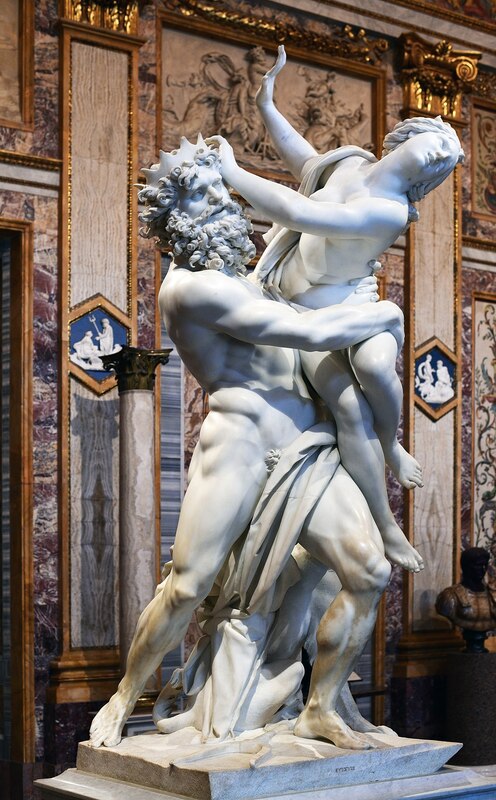
Bernini’s The Rape of Prosperina portrays the abduction of Proserpina, also known as Persephone, who is seized by the god of the underworld Pluto. The work was commissioned by Cardinal Scipione Borghese for his four large-scale sculpture commissions which also included Apollo and Daphne and David. The sculpture was originally going to be placed in the Villa Borghese. [1]
However, Cardinal Scipione Borghese notably decided to give this sculpture to Cardinal Ludovico Ludovisi as a tribute to his enemy. Many scholars have, thus, noted that this was a “poisoned gift” of sorts [2]. The chosen subject matter plays with Ludovisi’s central symbols. The sculpture’s themes also counter Ludovisi’s so-called golden age rule by the sculpture's association with the beginning of a bleak, violent age.
Significance and Analysis
Here, we see again that Bernini bases his work on Ovid’s illustration of the Greek myth. According to the myth, Persephone was once picking flowers with friends and was then violently attacked by Pluto who was madly in love with her. Persephone is depicted afraid, screaming for help and raising her arm against Pluto’s face. Through his impeccable skill with marble, Bernini makes her seem almost weightless as she’s being carried away by Pluto. The tactile depictions of the sculpture are truly remarkable; you can see Pluto’s aggressive mannerism, grabbing her skin.
Bernini does, however, skew away a bit from Ovid’s scriptures in this piece. Bernini adds a third member to the sculpture: Cerberus, the multi-headed dog of Pluto that guards the underworld [3]. The creature sits at the bottom of the composition, portraying the threshold of the underworld.
Overall, Bernini still captures Ovid’s mythological themes of metamorphosis. This sculpture, after all, is an allegory of the changing of the seasons and the transformation of the changing climate. Furthermore, the story illustrates the transformation of Persephone as a woman who must now live two lives– one in the underworld for half the year and the other back at home.
The sculpture also portrays the Baroque theme of memento mori and the ancient theme of death and resurrection [4]. Many scholars argue that this story parallels Christian themes of death and mortality; it could also communicate the tragedy of lust [5]. Bernini, in a way, interpreted this story as a conflict between desperate anguish and lust which is underscored by the contrasting, juxtaposing figures [6].
Indeed, here we see a connection between Christianity and mythology which could further illuminate why we continue to see mythological artworks during the time of the Catholic Reformation. Greek and Roman stories can be used to communicate Christian messages as shown by this work by Bernini.
Comparison: Ruben’s Rape of Proserpina
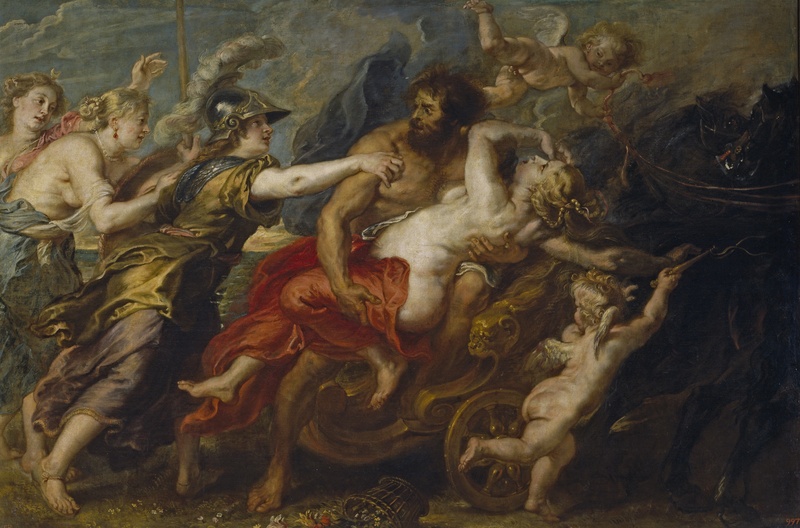
Renditions of the Rape of Proserpina tale have been created throughout the history of art. One of the most famous and most interesting alongside Bernini's work is Peter Paul Ruben’s Rape of Proserpine.
The work shows Pluto grasping Persephone vigorously, reminiscent of Bernini’s work. However, there are additional figures in this image. Minerva, the goddess of war, Venus, and Diana, the goddess of the hunt are together putting up a resistance to stop Pluto [7]. Additionally, there are also cupids seen holding chariot reigns; it’s interpreted that they’re blessing this union and foreshadowing the relationship’s eventual blossoming into love [8]. The presence of the cherubs adds a more playful atmosphere to this, albeit, terrifying scene. [9].
The most evident difference with Bernini’s sculpture is the fact that Bernini only includes Pluto and Persephone: focusing solely on their struggle. Furthermore, Bernini's work also carries more emotional weight. In Ruben’s work, we see Persephone fainting, throwing her hands in a dramatic, artificial fashion. In Bernini’s work, we witness Persephone’s struggle. She attempts to push Pluto away as he clutches into her, vigorously pressing his fingers deep into her thighs [10]. She is shown crying out; Bernini shows her absolute fright by carving Perseophone two cheek tears: an outstanding transformation of stone into flesh that illustrates the absolute horror Persephone is facing. Bernini’s more emotional image underscores more of the themes of the danger of lust than Ruben’s piece especially since many have taken note of the fact that Rubens might possibly be alluding to the couple’s eventual romance.
References
- Strunck, Christina. "The poisoned present. A new reading of Gianlorenzo Bernini's Rape of Proserpina." (2014), 187.
- Strunck, "The poisoned present. A new reading of Gianlorenzo Bernini's Rape of Proserpina," 197.
- Wilkins, Ann Thomas. “Bernini and Ovid: Expanding the Concept of Metamorphosis.” International Journal of the Classical Tradition 6, no. 3 (2000), 397.
- Wilkins, “Bernini and Ovid: Expanding the Concept of Metamorphosis,” 400.
- Wilkins, “Bernini and Ovid: Expanding the Concept of Metamorphosis,” 400.
- Wittkower, Rudolf. Gian Lorenzo Bernini: The Sculptor of the Roman Baroque. London: The Phaidon Press. (1966), 15.
- “The Rape of Proserpine - the Collection.” The Collection - Museo Nacional del Prado. Accessed December 7, 2021.
- “The Rape of Proserpine - the Collection.”
- Barolsky, Paul. Ovid and the Metamorphoses of Modern Art from Botticelli to Picasso. New Haven, Connecticut: Yale University Press, (2014), 197.
- Barolsky, Ovid and the Metamorphoses of Modern Art from Botticelli to Picasso, 78.