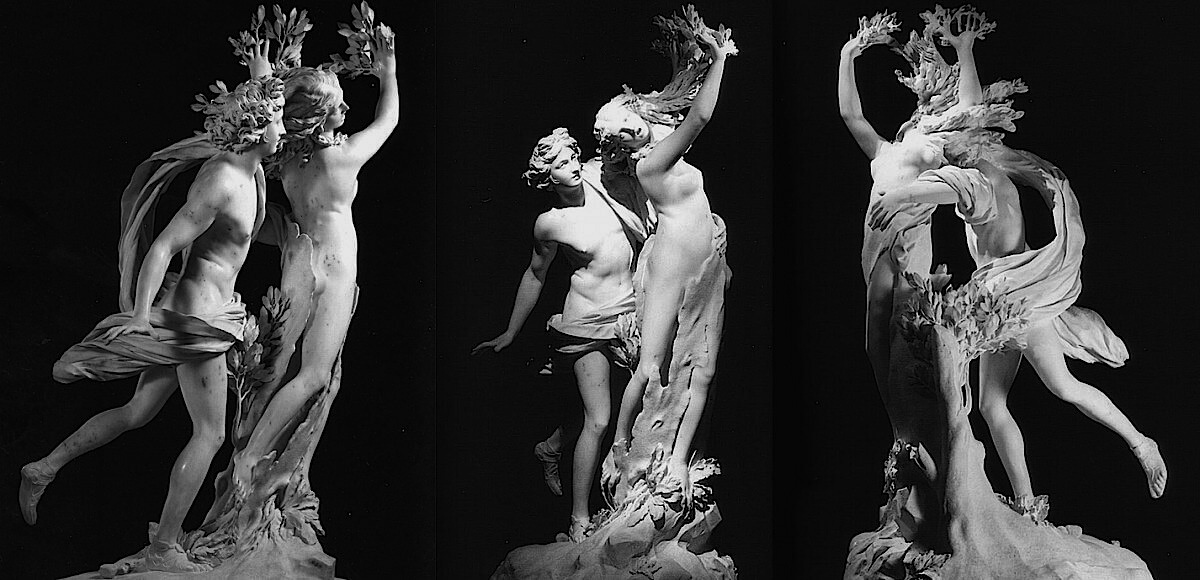
Apollo and Daphne
Background
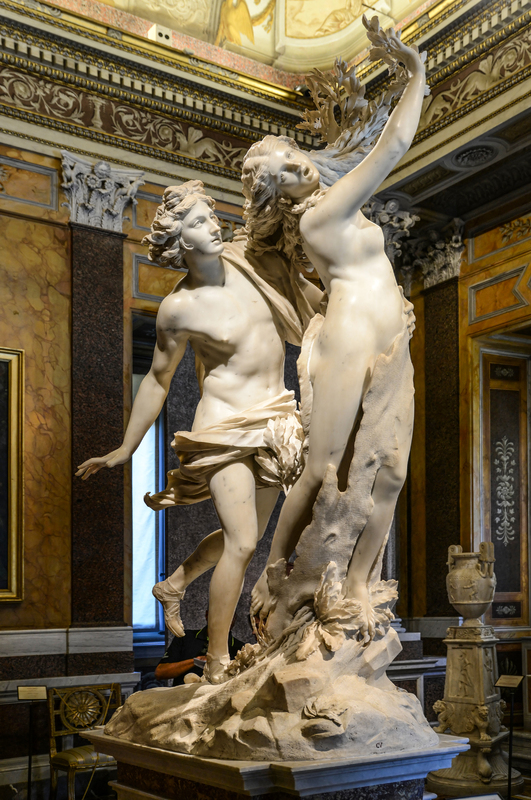
Bernini’s life-sized marble sculpture of Apollo and Daphne is regarded as one of his most powerful and emotional works. The work was commissioned in 1622 by Cardinal Scipione Borghese and was initially placed in his villa. The Apollo and Daphne piece was executed almost simultaneously with Bernini’s David [1]. Apollo and Daphne are considered the most famous of the three Borghese sculptures– Rape of Proserpina and David– due its breathtaking composition and representation of Ovidian metamorphosis.
The work illustrates the Greek myth of the nymph Daphne and her passionate admirer Apollo. According to the myth, Eros (Cupid) launched two arrows against Apollo, making him ardently in love with Daphne, the daughter of the river god Peneus. At every turn, he attempted to pursue her and she would run away from him every time. She begged her father to help her. Peneus thus decided to turn into a laurel tree to save her from Apollo [2].
Significance and Analysis
In Bernini’s rendition of the myth, we see Apollo reaching for her as she transforms into the tree. Bernini closely follows Ovid’s Metamorphoses verses on the Greek Myth to capture the intricacies of this story. Apollo and Daphne illustrate the Ovidian theme of metamorphosis. This is seen with the metamorphosis of Daphne as she transforms into a laurel tree. Bernini shows us this metamorphosis as it’s happening with her fingers and toes narrowing into branches and her curls turning into leaves [3]. Apollo touches the emerging bark as he runs towards her during her transformation. We also witness the transformation of both characters’ emotional states [4]. Apollo is caught between joy and confusion and he first becomes gleeful seeing his lover and then becomes bewildered when he grabs her and touches the bark growing on her. Daphne is shown in a frightened state as illustrated by her open-mouthed scream; however, she will soon emerge as a mute, calm tree, reaching her fully realized form [5].
Moreover, we can see in this piece that Bernini closely followed Ovid’s scriptures of the myth. Ovid in his work dictates that “ the wind-exposed her body, the opposing breezes made her clothes move, and a light breeze made her hair fly behind her…her hair was changed to leaves, her arms to branches.”[6] Bernini beautifully makes Ovid’s poetry come alive through marble. The powerful breeze is illustrated through Apollo’s garment waving in the wind and Daphne’s transforming, blowing hair.
It’s important to note as well that this work was a substitute for Bernini’s Pluto and Persephone sculpture which was gifted to Cardinal Ludovisi [7]. This explains their similar subject matter. They both demonstrate a Greek mythological story of abduction. Most of its themes carry over as a result. Apollo and Daphne like the Rape of Proserpina similarly comments on the sin of lust, underscoring this prevalent Christain theme through a mythological subject matter.
Comparison: Pollaiuolo’s Apollo and Daphne
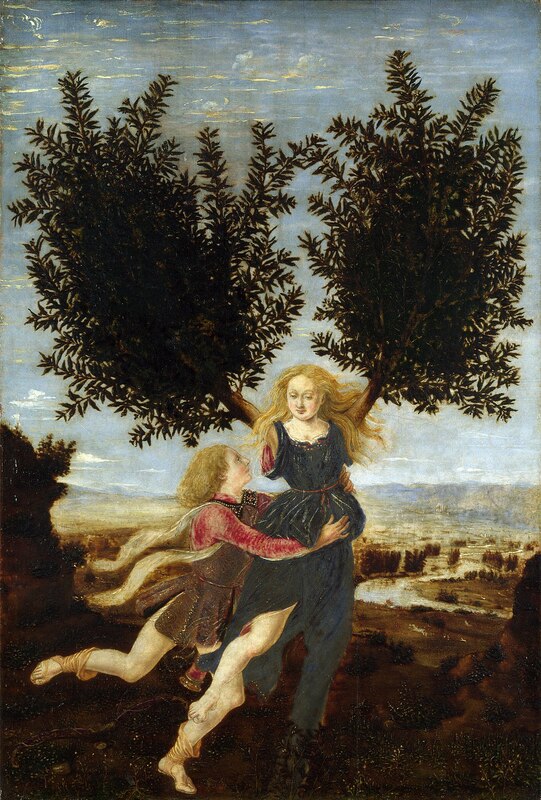
The story of Apollo and Daphne was commonly depicted during the Renaissance and Baroque periods due to the resurgence of Greek classics. Antonio del Pollaiuolo’s Apollo and Daphne is an example of an early Renaissance depiction of this tale. The patronage of the work is still not known; however many scholars suspect that Lorenzo de Medici commissioned this small piece in the late 1460s [8]. This painting by Pollaiuolo offers an unusual depiction of the Ovidian myth that marks a sharp contrast from Bernini’s sculpture. The painting shows Daphne in the center with her arms stretched out, forming into large branches. The branches are so large they seem like two independent, emerging trees [9]. The foliage is so extensive that it stretches throughout the entire space. The way Daphne is positioned during her transformation is also different compared to the way Bernini portrays her. In Pollaiuolo’s work, she is a "Y" formation: a symbol that portrays the critical choice between virtue and vice [10]. The most notable difference, however, is Daphne's body language and expression. Bernini’s Daphne is captured in a state of fright running away mid-transformation as Apollo attempts to pursue her. Pollaiuolo's Daphne, on the other hand, seems aloof [11]. She seems almost at peace with her transformation and appears fully in control.
Another notable difference is the fact that the figures are nude in Bernini's work. This adds to the vulnerability of Daphne, making us feel more sympathy towards her during this terrifying moment. She appears more weak and helpless at this moment compared to Pollaiuolo’s depiction of Daphne who is wearing aristocratic clothes and is standing in a stoic manner. In Pollaiuolo’s piece, one could make the argument that this painting is meant to elicit more sympathy from Apollo who is pleading in sorrow for his love who is transforming into a tree. However, in Bernini’s work, we are clearly meant to empathize with Daphne who is being abducted and crying out for help amidst her inevitable transformation.
References
1. Kenseth, Joy. “Bernini’s Borghese Sculptures: Another View.” The Art Bulletin 63, no. 2 (1981),194.
2 Reid, Jane Davidson. The Oxford Guide to Classical Mythology in the Arts 1300-1990s. 1. Vol. 1. New York: Oxford Univ. Press, (1993), 325.
3.Bacchi, Andrea, and Anna Coliva. Bernini. Milano: Officina Libraria srl, 2017, 16.
4. Wilkins, Ann Thomas. “Bernini and Ovid: Expanding the Concept of Metamorphosis.” International Journal of the Classical Tradition 6, no. 3 (2000), 387.
5. Wilkins, Bernini and Ovid: Expanding the Concept of Metamorphosis,” 387.
6. Wilkins, Bernini and Ovid: Expanding the Concept of Metamorphosis,” 389.
7. Kenseth,“Bernini’s Borghese Sculptures: Another View,” 201.
8. Freedman, Luba. “‘Apollo and Daphne' by Antonio del Pollaiuolo and the Poetry of Lorenzo De' Medici.”Memoirs of the American Academy in Rome 56/57 (2011), 215.
9. Freedman, “‘Apollo and Daphne' by Antonio del Pollaiuolo and the Poetry of Lorenzo De' Medici,” 215.
10. Freedman, “‘Apollo and Daphne' by Antonio del Pollaiuolo and the Poetry of Lorenzo De' Medici,” 215.
11. Barolsky, Paul. Ovid and the Metamorphoses of Modern Art from Botticelli to Picasso. New Haven, Connecticut: Yale University Press (2014), 67.