Neptune and Triton
Background
The breathtaking Neptune and Triton was completed by Bernini in 1622-23. It was commissioned by Alessandro Damascenti-Peretti Montalto. The sculpture was intended to be the focal point of his large fish pond at his villa. [1]
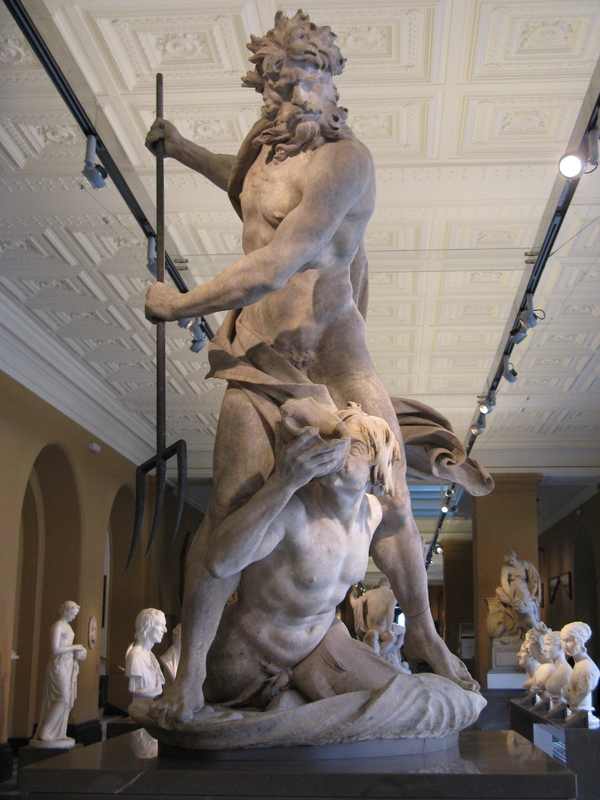
The sculpture is a dynamic piece that portrays the powerful Neptune and Triton. Neptune stands, holding his trident. Below him, we see Triton who blows on his conch to communicate to the four corners of the world. The figures' bodies are curved and have a commanding presence that dominates the space. The muscular figures underscore these gods’ power as they’re taking control of the deadly seas. Bernini portrays their movement as highly energetic which is communicated by the twisting, opposing directions of their two muscular bodies [2]. Neptune’s cloak swirls in a playful motion as well. Many scholars have even pointed out that the end of the cloak takes on the form of a dolphin.
The sculpture is a dynamic piece that portrays the powerful Neptune and Triton. Neptune stands, holding his trident. Below him, we see Triton who blows on his conch to communicate to the four corners of the world. The figures' bodies are curved and have a commanding presence that dominates the space. The muscular figures underscore these gods’ power as they’re taking control of the deadly seas. Bernini portrays their movement as highly energetic which is communicated by the twisting, opposing directions of their two muscular bodies [2]. Neptune’s cloak swirls in a playful motion as well. Many scholars have even pointed out that the end of the cloak takes on the form of a dolphin.
Significance and Analysis
The work closely follows Ovid’s depiction of a Roman myth in which Jupiter vows to destroy life on Earth [3]. He calls out Neptune to create a flood, leading him to strike the earth with his trident and release a deluge. After the flood, Neptune calls Triton to blow his conch as a signal for the seas to calm. The dolphin imagery in the sculpture also harks back to Ovid’s passage in which it states that dolphins were seen "romping in the wood" at the beginning of the flood [4]. Furthermore, this imagery of transforming cloak and flesh further underscores Bernini’s metamorphosis themes. The cloak, in a way, metamorphoses into a marine animal.
Interestingly, it can’t be neglected that this deluge story alludes to the biblical story of the Great Flood [5]. Again we see how many of Bernini’s mythological works connect, in some way, to the biblical themes he would explore in his later religious works.
Interestingly, it can’t be neglected that this deluge story alludes to the biblical story of the Great Flood [5]. Again we see how many of Bernini’s mythological works connect, in some way, to the biblical themes he would explore in his later religious works.
References
1. Wilkins, Ann Thomas. “Bernini and Ovid: Expanding the Concept of Metamorphosis.” International Journal of the Classical Tradition 6, no. 3 (2000), 401.
2. Victoria and Albert Museum, Online Museum. “Bernini's Neptune and Triton.” 'Neptune and Triton' by Gianlorenzo Bernini. Victoria and Albert Museum, Cromwell Road, South Kensington, London.
3. Wilkins, Ann Thomas. “Bernini and Ovid: Expanding the Concept of Metamorphosis.” International Journal of the Classical Tradition 6, no. 3 (2000), 439.
4. Wilkins, “Bernini and Ovid: Expanding the Concept of Metamorphosis," 383.
5. Wilkins, “Bernini and Ovid: Expanding the Concept of Metamorphosis," 405.