The Woman Artist's Self-Portrait
Fontana: Self-Portrait at the Clavichord
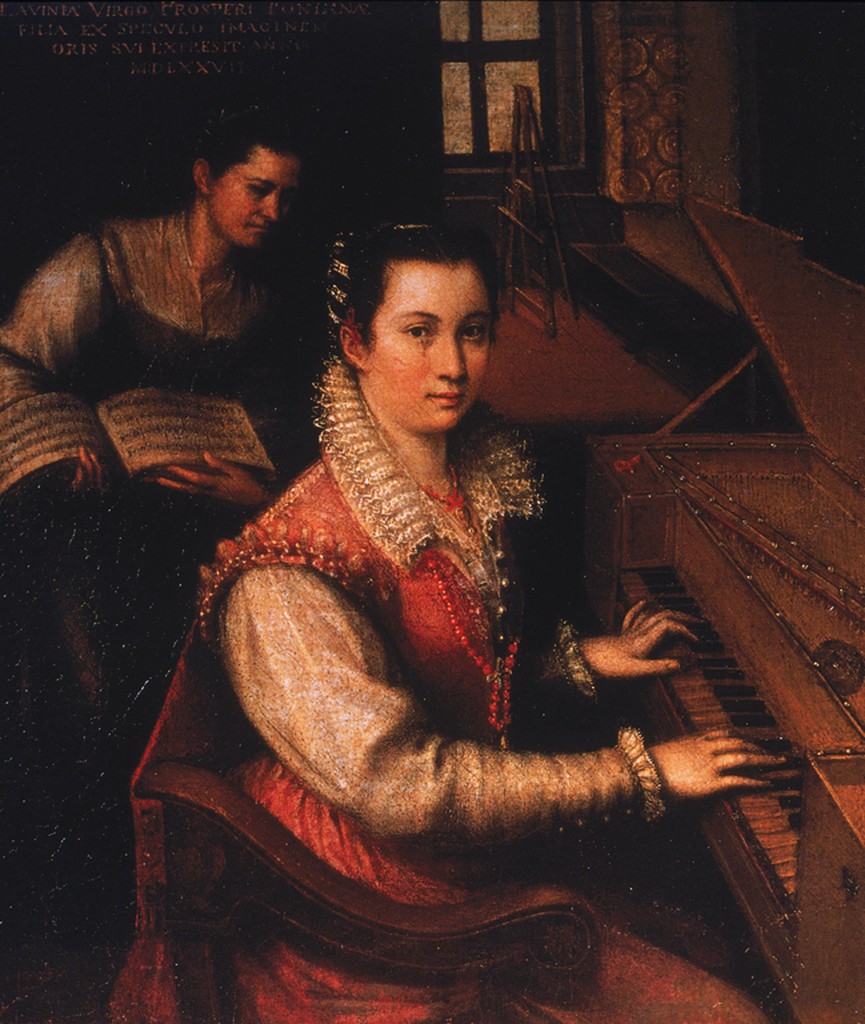
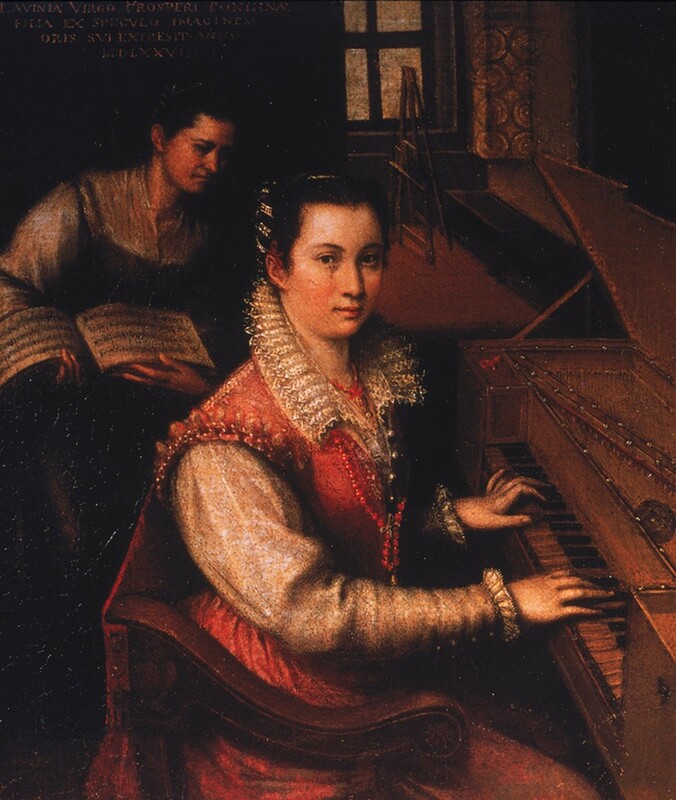
Lavinia Fontana's Self-Portrait at the Clavichord (1577) depicts the artist playing the clavichord, an appropriately cultured activity for a rising noblewoman. The seated Fontana is resplendent in an intricate red gown decorated with jewels and a lace collar. Brightly lit and assertive in the foreground of the image, she looks directly at the viewer and engages with them as she plays. A maidservant enters in the middle ground in a dynamic gesture; she is leaned forward towards Fontana as she holds a book of sheet music. In the background, a small, empty easel makes reference to Fontana's artistic profession. The text in the top left corner names Fontana as the artist, confirms her status as a virgin, and dates the piece.
This portrait was created for Fontana's intended father-in-law, Severo Zappi, and makes several allusions to the marriage and its social implications. Her red dress quotes the traditional Bolognese wedding gowns of the time, and a small red love knot is visible sitting on the clavichord. Her expensive clothing, musical knowledge, and access to servants affirm her well-off social standing [1].
Apart from consideration of the intended audience, Fontana portrays herself as the ideal form of the woman artist at the time: she is both beautiful as a woman and talented in expressing that beauty. She asserts her "gentildonna" status and participates in activities befitting such a status [2]. The inclusion of the easel signifies her ownership of her artistic profession, a growing trend in self-portraiture for artists of the time [1].
Anguissola: Self-Portrait
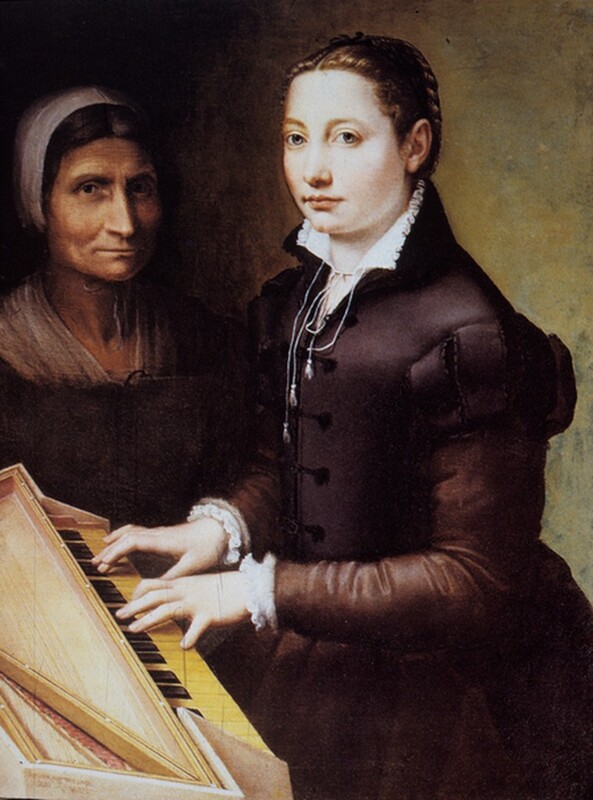
Sofonisba Anguissola's Self-Portrait (1561) depicts the artist seated at a keyboard and accompanied by an older maidservant. Anguissola wears a dark brown, somewhat unembellished gown with a small frilled collar and cuffs. She sits very tall and poised, facing and making eye contact with the viewer, and her face and hands are the brightest points in the image. The maidservant is more dimly lit but still appears very close to the foreground, as if sitting directly beside Anguissola. The figures are set against a nondescript background whose color gradation accentuates the focus to the right of the image, where Anguissola sits.
Like Fontana's portrait, Anguissola's likeness is a testament to her business; in this case, the business was finding patronage in the wake of her training with male artists including Bernardino Campi and Bernardino Gatti [3]. Her painting style evidences some training, with its polished, detail-oriented finish and subtle use of color. Formal training meant that Anguissola had a broader knowledge of contemporary painting standards than Fontana, contributing to a portrait that could be considered more "conventional" compared to others of the day. The plainer, cleaner depiction of the artist implies a professionalism tailored to potential patrons, with no need to make an obvious display of wealth, as Fontana does.
Comparison
Several physical and background elements of these two portraits are almost identical. The primary female figure dominates the foreground as she sits at her instrument, and a female servant supports her as a background character. The artist supports both a female ideal of beauty and the skill needed to properly express that beauty in the art of painting [1]. However, neither is portrayed in the passive manner often seen in women's self-portraits; they are taking part in artistic endeavors, not simply sitting as the subject of beauty to be painted.
The similarity between the portraits suggests an emulation on Fontana's part; she respected Anguissola's art and likely quoted her in the compositional choices of her self-portrait, including the addition of the maidservant and the keyboard [1]. Some historians even consider Fontana's work an improved, more complex evolution of the Anguissola portrait, although the two are stylistically quite different [2].
The most striking difference between the two self-portraits is the overall presentation of the woman in her space. Fontana's portrait sets her in her chambers, well-dressed and inviting interest with the details of her surroundings. She is visibly well-off and is willing to assert her place as both female nobility and artist. The background of Anguissola's portrait is bare, apart from color variation, and Anguissola herself is dressed more plainly and in more neutral colors. These contrasting elements may be a result of the intended recipient for each portrait; Anguissola's place as a courtier likely influenced the poised but not exuberant portrayal of herself, as compared to Fontana's bright, warm, context-laden likeness [3]. Both portraits are selling the positive attributes of the painter, but Fontana's apparent affluence and tonal boldess plays to her familial audience just as Anguissola's cleanliness and professionalism appeal to her courtly sphere; indeed, both know their audience.
References
[1] Bohn, B. (2004), Female self-portraiture in early modern Bologna. Renaissance Studies, 18: 239-286. https://doi.org/10.1111/j.0269-1213.2004.00057.x
[2] McIver, Katherine A. “Lavinia Fontana’s ‘Self-Portrait Making Music.’” Woman’s Art Journal 19, no. 1 (1998): 3–8. https://doi.org/10.2307/1358647.
[3] Wikipedia contributors, "Sofonisba Anguissola," Wikipedia, The Free Encyclopedia, https://en.wikipedia.org/w/index.php?title=Sofonisba_Anguissola&oldid=1047699885 (accessed October 9, 2021).