Representations of Religious Subjects, especially the Holy Family
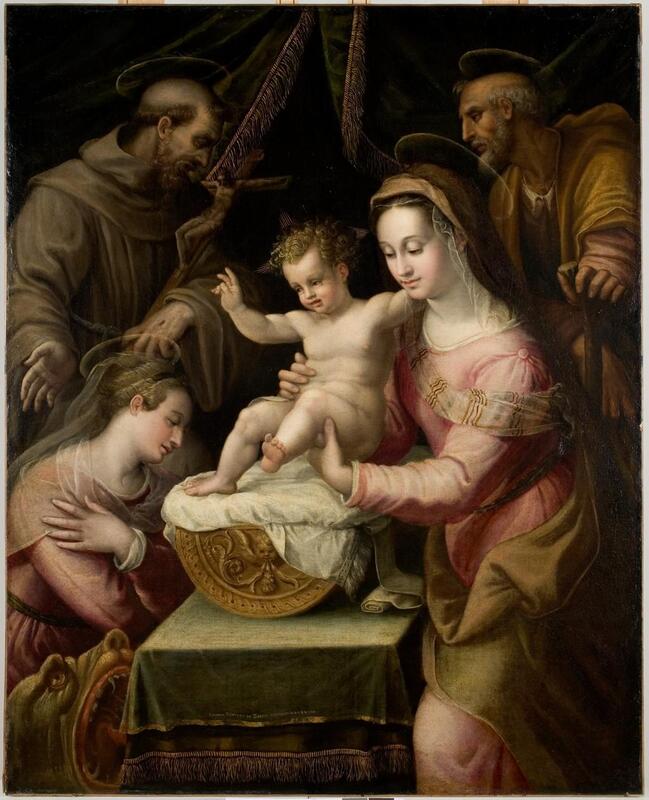
Fontana: Holy Family with Saints Margaret and Peter
This 1578 oil painting depicting the Holy Family is one of multiple works Fontana created of the Holy Family [2]. Her talent for capturing the female form is prominently on display in this work, as she represents Mary from the knees up. Fontana captures Mary in a motherly motion of gently lifting her child from a crib - an action which places Jesus and Mary in the painting’s main source of light. This action invokes the religious theme of Jesus’ resurrection. Note the characteristically Baroque representation of baby Jesus with a plump, clearly defined, and large child. Joseph fades into a background with ornate drapery which extends to connect the Holy family with St. Francis, establishing a vertical axis. This drapery is actually a funeral shroud which increases the painting’s interplay between life and death [2]. The crib resting upon a flat, cloth-covered table also invokes the Catholic celebration of the Eucharist which is a remembrance of Jesus’ sacrifice and worship of his grace. Fontana embraces these themes and masterfully uses one of her primary skills of painting fabrics to unite the symbols.
Following the lines traced by the cloth embroidering, the left half of the painting shows Saints Margaret and Francis admiring the Child. Their presence adds to the juxtaposition of life and death within the painting [2]. St. Margaret is the patron saint of expectant mothers, and Francis is holding a crucifix with visible stigmata - both iconography of Jesus’ death [1]. Fontana continues this juxtaposition artistically, with a bright foreground giving way to the dark background. Fontana successfully sets this painting as an illusion to Nativity scenes with the crib on a table physically separating the Holy Family and followers of the Christ, much as the manger did [2]. However, in keeping with the Baroque style, Jesus is dynamically blessing St. Margaret and not a passive object of subjects’ and the viewer’s gaze.
Fontana elects to primarily reveal the facial expressions of the women and Jesus in the painting, as the men are both only shown with a side profile. The foreground dealing with childbirth could potentially reflect her own preoccupations, as she gave birth twice in the year of this painting’s creation [2], although both children passed away shortly after their birth. Lastly, Fontana’s signature is unmistakably set along the embroidering on the table cover.
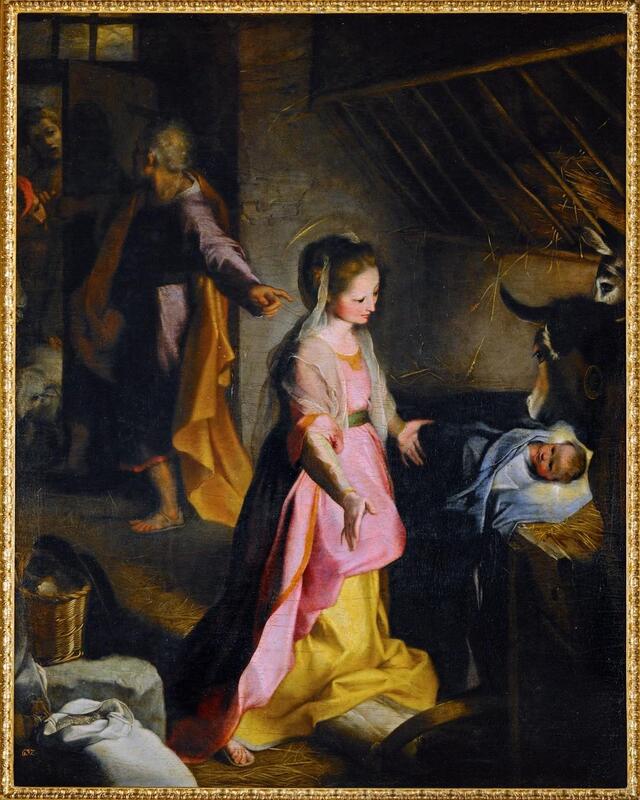
Barocci: The Nativity
About two decades after Fontana’s Holy Family with Saints Margaret and Francis, Federico Barocci produced The Nativity. The composition of this painting is intriguing as the foreground and primary lighting are in the right half of the painting. Mary takes center stage, with bright, almost unreal pink garments and her face is inclined towards her Child, who is meeting her gaze. While The Virgin’s body is open to the viewer, her facial features are not fully revealed, while the viewer can see Jesus’ softly smiling. However, Jesus is a less-active subject, receiving his Mother’s gaze in the crib and immobilized by swaddling. A cow is also in shadow but is in the front of the foreground, closing off the scene.
A distinguishing element of this work is the blend from foreground to background. With a softer lighting gradient, Joseph’s arm points towards Mary and Child, establishing a shallow axis which draws a viewer’s eyes diagonally across the painting [4]. In contrast to many works depicting the Holy Family, Joseph is distanced from his family and his attention is focused on outside forces, indicated by his body and head turned away from the family. Barocci presents an open door at the end of the diagonal axis where Joseph is welcoming shepherds, who are obscured in shadow but curiosity can still be read on their faces. This door invites the viewer to consider the outside world and the significance of the simple Nativity event on the exterior world [4].
Comparison
In terms of commissioning, the patron of Fontana’s Holy Family could not be found, but Francesco Maria II della Rovere, Duke of Urbino, was the patron of Barocci’s work. Francesco was a regular patron of Barocci, and his mother was of the Farnese household [3]. From this, we can expect a high standard and adherence to catechism from works commissioned for the Duke. While it is challenging to appropriately analyze the impact the patron had on the observed work for both artists, the high profile of Barocci’s patron, is, at least in this instance, evidence of a male artisan potentially having better access to financial security. This is of note because Fontana was a remarkable woman artist, and yet the history of patronage of some of her works is not as readily available as her male counterparts.
The other note of comparison of these paintings is their handling of the religious subjects. Both artists attempt to humanize and glorify the Holy Family. Fontana achieves this balance by leveraging her talent in portraying Mary as a woman, with detail in her garments and motherly actions, it becomes immediate that she is a relatable, caring mother. Barocci accomplishes this less with the figures themselves, but with the soft lighting and dynamism of Joseph having other worries, than standing stoically beside his newborn. The artists diverge in their presentation of religious themes. Fontana reliably incorporates Saints and iconography which would have been recognizable as a result of the Council of Trent. Her imagery serves as a more direct messaging to associate the Child with birth and death to remind viewers of the entirety of the miraculous life of Jesus. In contrast, Barocci strikes a less explicit religious meaning, as he invites viewers to a more open contemplation, vis a vis Joseph’s arms uniting relatable people (the shepherds) with the Holy Mother and Child.
References
[1] Britannica, T. Editors of Encyclopaedia. "St. Margaret of Antioch." Encyclopedia Britannica, September 29, 2020. https://www.britannica.com/biography/Saint-Margaret-of-Antioch.
[2] Cheney, Liana. “Lavinia Fontana, Boston ‘Holy Family.’” Woman’s Art Journal 5, no. 1 (1984): 12–15. https://doi.org/10.2307/1357879.
[3] Eiche, Sabine. “Francesco Maria II Della Rovere as a Patron of Architecture and His Villa at Monte Berticchio.” Mitteilungen Des Kunsthistorischen Institutes in Florenz 28, no. 1 (1984): 77–108. http://www.jstor.org/stable/27653129.
[4] Turner, Nicholas. “A Nativity by Barocci at Chatsworth for Paintings in the Prado and Formerly in the Rasini Collection.” Master Drawings 51, no. 2 (2013): 189–94. http://www.jstor.org/stable/43705947.