Bibliography
Annotated Sources
Bohn, B. (2004), Female self-portraiture in early modern Bologna. Renaissance Studies, 18: 239-286. https://doi.org/10.1111/j.0269-1213.2004.00057.x
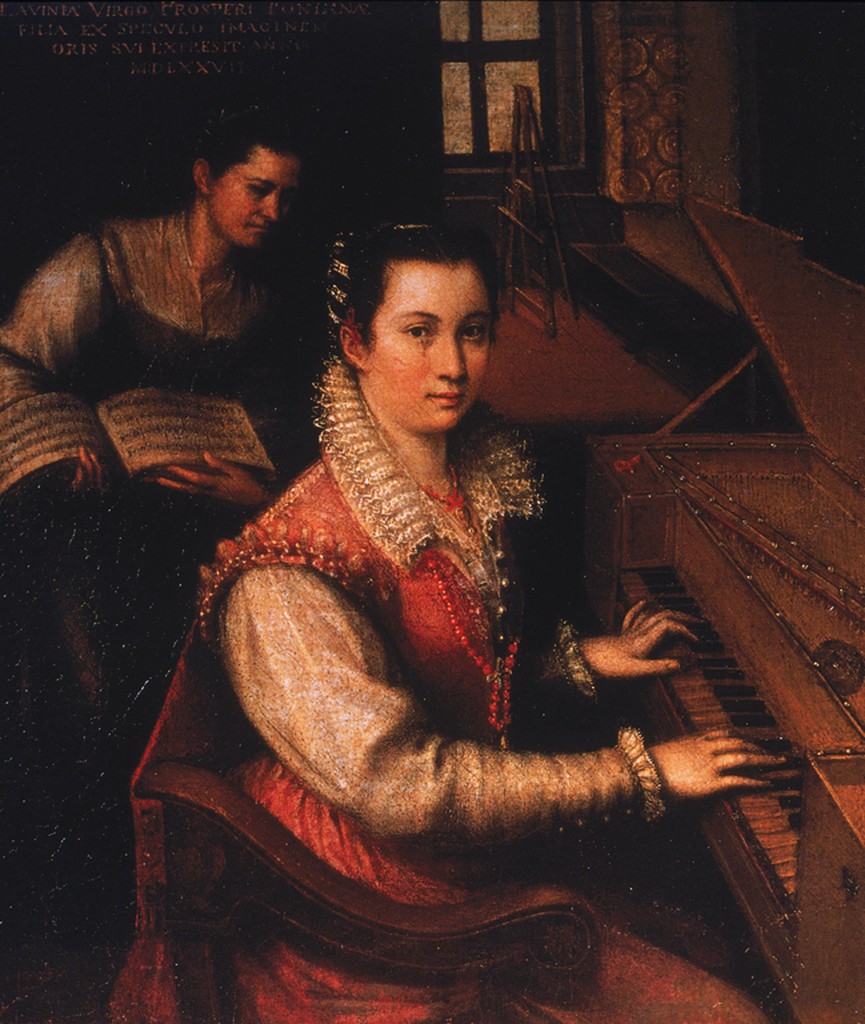
- This source gives a chronological overview of female artists of sixteenth- and seventeenth-century Bologna and their practices regarding self-portraiture. It provides comparisons both between these women’s portraits and between female self-portraits and their male contemporaries. One section of the essay examines Lavinia Fontana’s five self-portraits--four paintings and one drawing--including the Self-Portrait at the Clavichord, referenced here as Self-Portrait at the Keyboard. Bohn expands on the portrait’s background, including its purpose as a self-promotion to Fontana’s future father-in-law and its assertion of the woman as a professional artist.
Buckley, Kat. “Lavinia Fontana: Immortalizing Morality .” Critical Perspectives in Fashion, October 2015. https://www.researchgate.net/profile/Kat-Zagaria/publication/303688203_Lavinia_Fontana_Immortalizing_Morality/links/574d968f08ae82d2c6bde109/Lavinia-Fontana-Immortalizing-Morality.pdf.
- This source focuses on Lavinia Fontana’s expertise on fabric and ornamentation and how Lavinia Fontana’s depicted her patrons, the nobility of Bologna, as they wished to see themselves. Specifically, it argues that by depicting her patron as Venus in Venus and Cupid, Fontana played with the long-standing tradition of classical revivalism in Renaissance art – and thus, depicting Ruini nearly nude, could be permitted. Two major types of evidence are used: first, historical and cultural context on Fontana’s career and Bologna’s nobility in the 16th century; second, case studies of direct comparison between artworks of Fontana and her contemporaries.
Cheney, Liana. “Lavinia Fontana, Boston ‘Holy Family.’” Woman’s Art Journal 5, no. 1 (1984): 12–15. https://doi.org/10.2307/1357879.
- This source was published when Fontana's painting was discovered from a private collection and placed on public display. It analyzed the work in relation to Fontana's other portrayals of the Holy Family, making an argument particularly about the religious themes which are so powerfully represented in the painting. This allowed it to make the case for the importance of the painting in Fontana's career and within religious Baroque art.
McIver, Katherine A. “Lavinia Fontana’s ‘Self-Portrait Making Music.’” Woman’s Art Journal 19, no. 1 (1998): 3–8. https://doi.org/10.2307/1358647.
- This source contrasts Fontana’s Self-Portrait at the Clavichord, here titled Self-Portrait Making Music, with other portraits of her time which featured the artist pictured with musical instruments. Musical instruments included in portraiture relate to the ideals of the figure in a cultured society, in terms of both gender and profession; the standards for artistic and educational merit were high among the nobility of Bologna. Here, Fontana stands out as not only a virtuous, well-educated woman but also as an active participant in her artistic trade and a model for the commodified female self-portrait.
Murphy, Caroline Patricia. “Lavinia Fontana: An Artist and Her Society in Late Sixteenth Century Bologna.” Dissertation, ProQuest LLC, 1996.
- Murphy masterfully follows the painting career of Lavinia Fontana. Specifically, she pays notice to the many influences that shaped Fontana’s career during the turn of the 17th century in Bologna. Murphy utilizes a hypothesis-driven analysis technique where instead of recounting Fontana’s life, she explores what factors allowed for her artistic success to occur. This leads to Murphy’s use of a thematic analysis roadmap instead of traditional chronological narration.
The third chapter provides an astute investigation into a large portion of Fontana’s financial market – the gentildonne Bolognesi or Bolognesi noblewomen. Murphy discusses the many different factors that helped form this clientele base: financial freedom, education, and personal autonomy among others. It is asserted that these factors were unique to Bologna as it was a relatively progressive city at the time in Italy. The author continues that Lavinia relied on this constant demand to fuel her urban-market workshop. Lavinia depended on commissions for her salary and thus these Bolognesi noblewomen were essential to her success as an artist. Murphy comments that Fontana’s prosperity is largely due to societal forces and movements outside of her control – a common motif found in history. Nonetheless, Fontana developed a close relationship with these noblewomen as Murphy further studies.
Murphy's analysis is well-structured and supported. She relies greatly on primary source accounts of Fontana for contextualization of her arguments. Specifically, she quotes from the work of C.C. Malvasia who wrote extensive biographies on many Bolognesi artists including Fontana. This source provides critical contextualization for how Fontana was able to find success solely through commissions.
Sweet, Frederick A. “Venus and Cupid by Luca Cambiaso.” Bulletin of the Art Institute of Chicago (1907-1951) 37, no. 1 (1943): 2–3. https://doi.org/10.2307/4116877.
- This source first provides an overview of the Italian artist Luca Cambiaso’s professional experience and artistic style. It argues that starting with a Raphaelesque early style, Cambiaso peaks his work quality as subdued and highly finished in his middle period. Subsequently, the source provides a thorough formal analysis of Venus and Cupid. It argues that despite the classical formula of the compact composition aiming at creating a three-dimensional feeling, Cambiaso succeeded in depicting a tenderness in the relationship between Venus and Cupid, which indicates the Raphael influence on the artist. Following the discussion on the painting, the source introduces a comparative artwork: a drawing of Venus and Cupid by Cambiaso. Importantly, the source infers that Venus and Cupid belonged in the collection of Emperor Rudolph II or Queen Christina of Sweden before the 18th century. With formal analysis and historical facts as evidence, this source succinctly and significantly highlights the life and merit of the artist Luca Cambiaso.
Turner, Nicholas. “A Nativity by Barocci at Chatsworth for Paintings in the Prado and Formerly in the Rasini Collection.” Master Drawings 51, no. 2 (2013): 189–94. http://www.jstor.org/stable/43705947.
- This source contextualizes the "Nativity" by Barocci with respect to Barocci's process of ideating on Nativity scenes and how this work can serve as an addition to the patron's collection. Notably, this argument references sketches which Barocci made of Nativity scenes prior to creating this painting. The differences between these and the paintings revealed messages which Barocci found important to present or omit in a final version. Furthermore, another work from the patron's collection was presented as a secular analog based on their similarities in lighting, color, and spatial interplay.
Other Sources
Borenius, Tancred. “A Portrait by Lavinia Fontana.” The Burlington Magazine for Connoisseurs 41, no. 232 (1922): 41–40. http://www.jstor.org/stable/861450.
Britannica, T. Editors of Encyclopaedia. "St. Margaret of Antioch." Encyclopedia Britannica, September 29, 2020. https://www.britannica.com/biography/Saint-Margaret-of-Antioch.
Cambiaso, Luca. “Venus and Cupid.” The Art Institute of Chicago. Painting and Sculpture of Europe. Accessed October 9, 2021. https://www.artic.edu/artworks/44816/venus-and-cupid.
Eiche, Sabine. “Francesco Maria II Della Rovere as a Patron of Architecture and His Villa at Monte Berticchio.” Mitteilungen Des Kunsthistorischen Institutes in Florenz 28, no. 1 (1984): 77–108. http://www.jstor.org/stable/27653129.
Figgy Guyver in Culture Digest | 27 AUG 19. (2019, August 27). The five trailblazing galleries that only show women artists. Frieze. Retrieved October 27, 2021, from https://www.frieze.com/article/five-trailblazing-galleries-only-show-women-artists.
Fontana, Lavinia. “Venus and Cupid, 1592 - Lavinia Fontana.” www.wikiart.org, January 1, 1592. https://www.wikiart.org/en/lavinia-fontana/isabella-ruini-as-venus-1592.
Jacob, Frederika H. “Woman’s Capacity to Create: The Unusual Case of Sofonisba Anguissola.” Renaissance Quarterly47, no. 1 (1994): 74–101. https://doi.org/10.2307/2863112.
Murphy, Caroline P. “The Economics of the Woman Artist.” In Italian Women Artists from Renaissance to Baroque, ed. Vera Fortunati et al., 23–30. Milan: Skira, 2007.
New World Encyclopedia contributors, "Venus (mythology)," New World Encyclopedia, , https://www.newworldencyclopedia.org/p/index.php?title=Venus_(mythology)&oldid=993464 (accessed October 27, 2021).
Robin, Diana Maury, and Anne R. Larsen. “Anguissola Sofonisba.” Essay. In Encyclopedia of Women in the Renaissance: Italy, France, and England, 14–18. Santa Barbara, CA: ABC-CLIO, 2007.
"Venus and Cupid." Musee des Beaux-Arts, June 18, 2013. https://mbarouen.fr/en/oeuvres/venus-and-cupid (accessed October 27, 2021).
Wikipedia contributors, "Cupid," Wikipedia, The Free Encyclopedia, https://en.wikipedia.org/w/index.php?title=Cupid&oldid=1052178603 (accessed October 27, 2021).
Wikipedia contributors, "Lavinia Fontana," Wikipedia, The Free Encyclopedia, https://en.wikipedia.org/w/index.php?title=Lavinia_Fontana&oldid=1049531599 (accessed October 9, 2021).
Wikipedia contributors, "Sofonisba Anguissola," Wikipedia, The Free Encyclopedia, https://en.wikipedia.org/w/index.php?title=Sofonisba_Anguissola&oldid=1047699885 (accessed October 9, 2021).