Still Life with Birds and Fruit
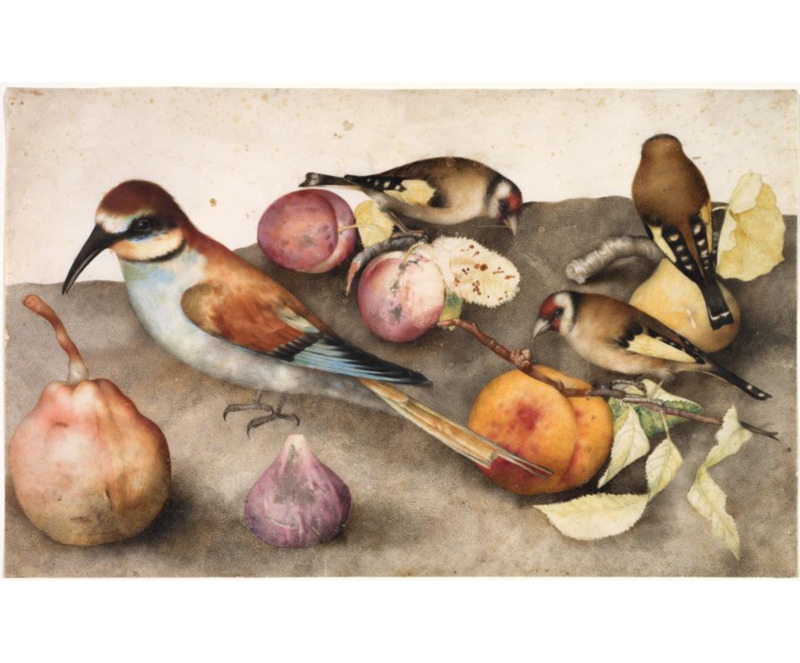
Still Life with Birds and Fruit
Giovanna Garzoni painted this magnificent still-life in 1650, towards the middle/beginning of the latter-half of her career. This painting was originally thought to be created by Jacobo Ligozzi, but is now accurately credited to Garzoni [1]. Art critics believe this work was created for the Medici family, who sponsored much of Garzoni's work and showcased them throughout their villas, and valued paintings including botanical and ornithological subjects [2]. Garzoni's work is an innovative blend of art and science, combining her artistic skills with an understanding of botany [3]. This work contains a bee-eater and three goldfinches exploring and probing various fruits around them, all contained on an earth-toned ground with a plain solid background. The fruits are a pear, a peach, two plums, and a fig. This painting is particularly interesting because it combines aspects of her other works. For example, the fig resembles those from her work "A Plate of Figs" (1655-1662). Mary D. Garrard believes that Garzoni's figs in both works resemble male genitalia in order to highlight the magic of sexual reproduction that is present among humans, animals, and plants [1]. Garzoni's goldfinches exploring the possibilities of eating the fruits resemble the bird in "China Bowl with Figs, a Bird, and Cherries" (1651-1662), who is striking and eating a fig. It is also important to note Garzoni's selection of materials. Her preferred medium was tempera on vellum, and she used vellum with graphite and watercolor in her "Still Life with Birds and Fruit" instead of the traditional oil and canvas, which is the medium of Galizia's "A Crystal Fruit Stand with Peaches, Quinces, and Jasmine". Garzoni's use of vellum allows the work to be more luminous and bright [4]. This makes Garzoni's plants appear more natural and textured. Garzoni's work appears noticeably better-lit than Galizia's, and this reflects the differences between using vellum and canvas.
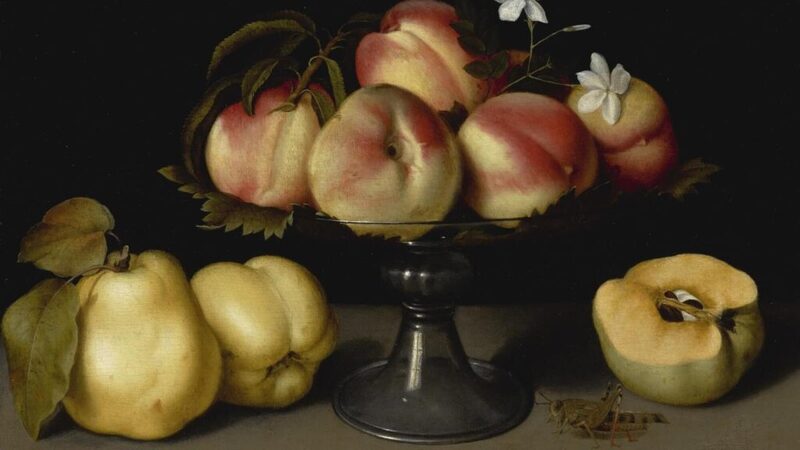
A Crystal Fruit Stand with Peaches, Quinces, and Jasmine
This oil on canvas still life painting is the earliest still life with a clear, concrete creation date, and is Galizia's first signed one [3]. Different sources refer to this painting by slightly different names from the most common name used in the Omeka title, but all have the same meaning. For example, Segal refers to it as "Glass tazza with peaches, jasmine flowers, and apples", while Garrard refers to it as "Peaches on a Stand, with Apples and Jasmine". It depicts peaches and a jasmine flower plant in a glass tazza with vine leaves, and three green apples below, with one being opened with just half remaining. This work represents Fede Galizia's tendencies to place her fruit subjects in glass bowls, with only 1 or 2 varieties of fruit, and placing her viewer on a slightly elevated viewpoint [1]. Galizia is believed to have worked towards efficacy as opposed to variety, desiring to truly hone-in her paintings to achieve intended outcomes. Her attention to detail differentiates her hand from her followers, and is displayed with her intricate use of glazing to create a gentle browning and "greenish aureole" inside the apple [6]. There is a dark background, which is contrasted with the brightness of the white jasmine leaves, and light-shaded surface that the subjects stand on. Galizia includes small discolored spots on the fruit, which are mirrored in Garzoni's works, which signify the decaying of these fruits [1]. Although they contain similar elements of the fruit depictions, Galizia's work lacks the radiant light source and birds of Garzoni's "Still Life with Birds and Fruit".
Mapping Still Life with Birds and Fruit
Giovanna Garzoni worked for the patron Grand Duke Ferdinando II de' Medici and the Medici family in Florence from 1642 to 1651 [1]. She produced Still Life with Birds and Fruit in 1650, and because this was under her tenure with the Medici, this work has been mapped to Florence, Italy. Fede Gallizia's career was encapsulated within Milan and Italy's Lombardy region [5], so her A Crystal Fruit Stand with Peaces, Quinces, and Jasmine is mapped there.
Works Cited
[1] Mary D. Garrard. “The Not-So-Still Lifes of Giovanna Garzoni.” Essay. In "The Immensity of the Universe" in the Art of Giovanna Garzoni, 62-77. Sillabe, 2020.
[2] Tomasi, Lucia Tongiorgi, and Gretchen A. Hirschauer. The Flowering of Florence: Botanical Art for the Medici. Washington (D.C.): National Gallery of Art, 2002.
[3] Harris, Ann Sutherland. “Italian Still Life. New York.” The Burlington Magazine 125, no. 965, August 1983.
[4] “Farewell to Fall with Giovanna Garzoni's Still Lifes.” Italian Ways, December 20, 2018. https://www.italianways.com/farewell-to-fall-with-giovanna-garzonis-still-lifes/.
[5] Galizia, Fede. “A Crystal Fruit Stand with Peaches, Quinces, and Jasmine.” Obelisk Art History. Accessed October 13, 2021. https://arthistoryproject.com/artists/fede-galizia/a-crystal-fruit-stand-with-peaches-quinces-and-jasmine/.
[6] Segal, Sam. “An Early Still Life by Fede Galizia.” The Burlington Magazine 140, no. 1140, March 1998.