Plate of Figs
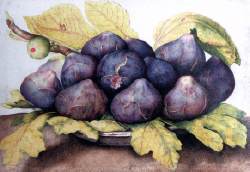
Plate of Figs
Plate of Figs is painted with bodycolor (gouache) on vellum on a 25 x 32.5 cm board. The miniature was created as a part of Garzoni's series Twenty Small Paintings on Vellum for Ferdinando II, Grand Duke of Tuscany. Each painting in the series focuses on a specific fruit or vegetable as its focus. Miniatures from the series are presently on display at the Palazzo Pitti [1].
Garzoni demonstrates mastery of her medium with the dynamic lighting and blending she uses to bring vibrancy to still life. Nicknamed the "illustrious miniaturist" for her technique with tempera on vellum [2], her layering and precise brush strokes create a luminous style. The illustration-style leaves mirror the scientific quality in her botanical images. Utilizing a limited pallet, Garzoni creates a clear focus on the figs compared to other still life pieces of the era. Depicting imperfections like the withering parts of the leaves and the cracks in the figs add an aura of realism and dimension to a misleadingly monotonous subject. The matte finish of gouache adds to the naturalism of the piece: as a water-based medium, gouache inherently carries more natural qualities compared to the more theatrical richness of oil paint.
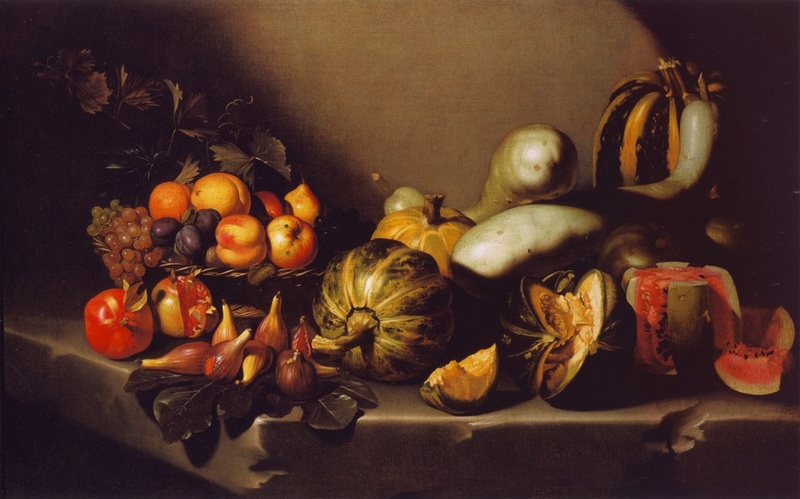
Still Life with Fruit on a Stone Ledge
Still Life with Fruit on a Stone Ledge, oil on a 105 x 84cm canvas dated to around 1603, depicts various fruits including grapes, pomegranates, watermelon, and more sitting atop a stone ledge [3]. The painting is thought to have been created in Caravaggio's personal residence [4].
The painting features Caravaggio's iconic theatrical diagonal lighting, adding a thrust of motion to still objects. Several of the fruits, such as the melons, are sliced and spilling out almost as if they are moving. No single fruit is in focus; instead a variety of fruits in different shapes, sizes, and colors comprise the image. Contrastingly, Garzoni's "Plate of Figs" focuses on a singular produce and embraces the stillness. Caravaggio's use of oil paints allows for strongly pigmented, glossier colors adding a dramatic feel to his painting, while the use of gouache in Garzoni's piece retains a matte finish and utilizes texture from water lends it a more grounded, natural appearance. Similarly, the significantly larger size of Caravaggio's still life adds to its theatrical grandiose feel as compared to Garzoni's miniature. Caravaggio's still life is more representative of themes during the Baroque period at large, while Garzoni's use of medium, painting style, and focus creates a more naturalistic message.
Mapping Plate of Figs
Created for the Grand Duke of Tuscany, Plate of Figs can be linked to Tuscany, Italy. Caravaggio was thought to have created Still Life with Fruit on a Stone Ledge in his personal home which at the time was likely Milan, Italy.
Works Cited
[1] “Giovanna Garzoni (Italian, 1600-1670), a Plate of Figs.” Arader Galleries. Accessed October 14, 2021. https://aradergalleries.com/products/giovanna-garzoni-italian-1600-1670-a-plate-of-figs.
[2] Kren, Emil, and Daniel Marx. Plate of figs by Garzoni, Giovanna. Web Gallery of Art. Accessed October 14, 2021. https://www.wga.hu/html_m/g/garzoni/figs2.html.
[3] “Still Life with Fruit on a Stone Ledge.” Still Life with Fruit on a Stone Ledge by Caravaggio. Caravaggio.net. Accessed October 14, 2021. http://www.caravaggio.net/still-life-with-fruit-on-a-stone-ledge/.
[4] De Groft, Aaron, ed. “Caravaggio Still Life with Fruit on a Stone Ledge.” Papers of the Muscarelle Museum of Art 1 (2010): 1–160.