Sleeping Hermaphroditus
Context
During his early career, Bernini engaged in a variety of restoration projects. He was most likely taught by his father about the restoration process which he also regularly took part in. Restoration projects rose in popularity in 17th century Rome. Antiquities were highly used for decor in galleries, loggia, and gardens [1]. Artists at the time were generally involved in excavation endeavors and judged the quality and significance of the recently discovered classical works.
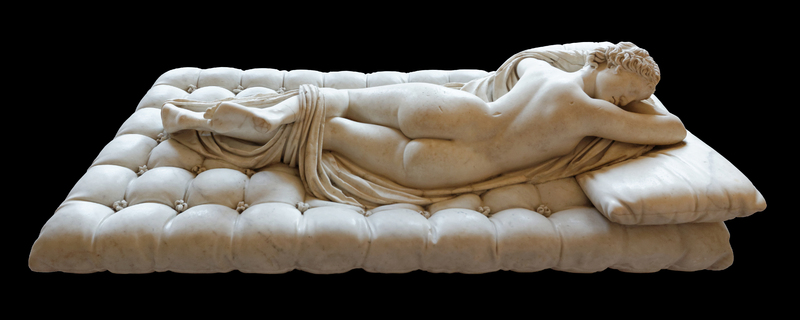
The Sleeping Hermaphroditus sculpture is one of Gian Lorenzo Bernini’s most famous restoration works. It was commissioned by Cardinal Scipione Borghese who not only hired Pietro Bernini before for similar restoration works but also will become one of Bernini’s most important patrons. This Hermaphrodite sculpture was found during the excavations for the construction of the Santa Maria Della Vittoria church in 1609.[2]
Bernini was commissioned in 1620 to restore the piece and to construct the marble mattress underneath the figure. The marble construction of the mattress is breathtaking; its exemplary tactile texture makes this work one of Bernini’s most impressive restoration works.
Mythology
We start the story with Hermaphroditus: the handsome, beautiful son of Hermes and Aphrodite [3]. The beautiful youth attracted the attention of the spring-nymph Salmacis. One day when the beautiful Herermaphorditus was bathing in a pool the nymph found threw himself at him passionately. As she clung to him, the nymph pleaded to the gods that they would never be separated and would be united till the end of time. The gods thus twisted and fused their bodies in their water and they became one: female and male.
This Hermaphroditus or androgyne figure became a popular theme in ancient art; especially during the Hellenistic period and emerged in popularity during the Renaissance and Baroque periods [4].
Significance and Analysis
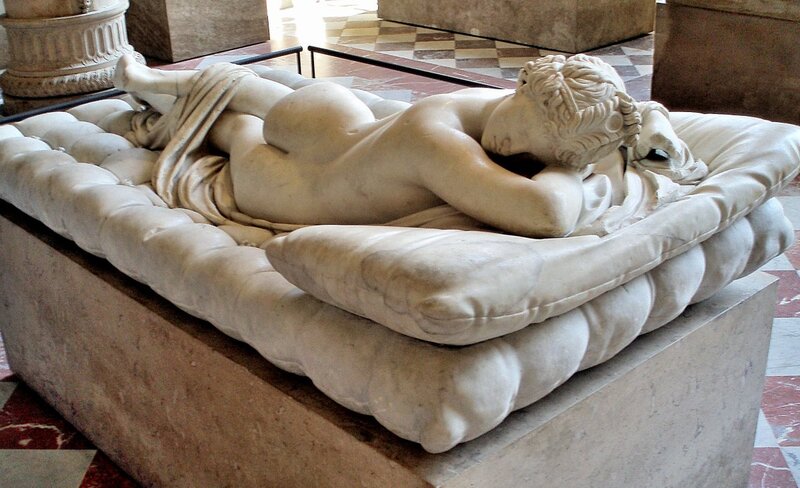
The figure radiates ambiguous seductiveness and intrigue. Hermaphroditus is shown sleeping down but different angles of the piece reveal the figure’s male and female genitalia [5].
Bernini’s addition of the mattress adds to the figure’s alluring nature. Furthermore, it strengthens the audience’s role in observing this piece. The Hermaphroditus story is a story associated with voyeurism and the male gaze. We as the audience member intrude on the naker figure after its dramatic metamorphosis. We observe it for our pleasure in a sense, enforcing this idea of the male gaze. Of course, it’s important to mention this piece’s specific intended audience member: the patron Cardinal Scipione who was remarked by art historian Joy Kenseth as “an enthusiastic collector of paintings and sculpture representing pagan and quite sensual subject matter.” [6]
The Hermaphrodite piece is a clear example of Bernini's early admiration of classical Greek art, specifically those that specifically drew upon Ovid’s metamorphosis and illustrate this universal theme of transformation.
References
- Bacchi, Andrea, and Anna Coliva. Bernini. Milano: Officina Libraria srl (2017), 86.
-
Bernini. “Sleeping Hermaphroditus: Ancient Marble Sculpture from the 2nd AD.” Galerie Borghèse. Borghese Gallery, February 1, 2020.
- Reid, Jane Davidson. The Oxford Guide to Classical Mythology in the Arts 1300-1990s. 1. Vol. 1. New York: Oxford Univ. Press, (1993), 561.
- Reid, Jane Davidson. The Oxford Guide to Classical Mythology in the Arts 1300-1990s. 1. Vol. 1. New York: Oxford Univ. Press, (1993), 561.
- Bacchi, Andrea, and Anna Coliva. Bernini. Milano: Officina Libraria srl (2017), 87.
-
Kenseth, Joy. “Bernini’s Borghese Sculptures: Another View.” The Art Bulletin 63, no. 2 (1981), 195.