A Study of Busts
Bernini's Damned Soul
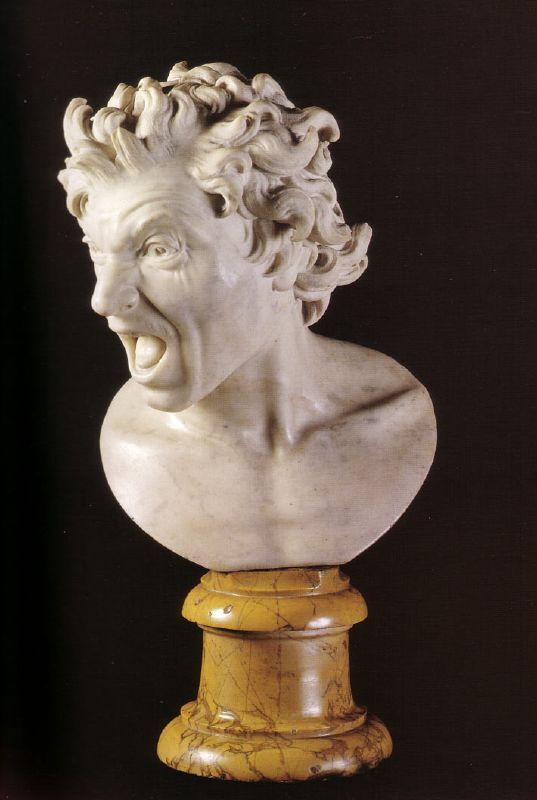
Damned Soul, a marble bust created by Bernini in 1619, depicts a male face with a twisted, painful expression [1]. The eyebrows are deeply arched, the mouth is open revealing a full set of teeth, and the head faces the left as if looking away at something. The bust has unruly hair in large pieces appearing ablaze. Constraining focus to the face, the piece only includes the neck and collarbone of the figue, leaving out the shoulders and chest as is often done in other busts.
Commissioned in conjunction with Blessed Soul, the sculpture is one of Bernini’s early works - he began creating it at 20 years old. With lofty a goal of depicting the human soul in marble, Benini appeals to the human senses. Viewers can almost feel the heat from his flaming hair, hear his screams, and see the pain of the figure depicted. Bernini accomplishes this by capturing a moment of instantaneous motion though the uncomfortable rotation and grimace of the bust. This early work is a reflection of Bernini’s style at large - fleeting motion and emotion are captured eternally though form and figure.
Bernini’s son, Domenico Bernini, wrote that the older Bernini set fire to his leg to understand and capture the agony that would result from the pain. Similarly, some scholars have hypothesized that Bernini inflicted pain on himself in the creation of Damned Soul. Even suspected to potentially be a self-portrait, Damned Soul retains facial features referencing that of Bernini [2].
Damned Soul delineates how while a specific medium served as a tool for Bernini’s art, it did not constrain his intended message. Bernini broke boundaries and conventions of creating busts of restful poses, and captured an emotion that would more typically be captured through painting. His willingness to try an capture the human soul at such a young age is a reflection of his boldness and conviction as an artist. Bernini looked beyond the medium, which ultimately allowed him to “unite visual art”.
[1] “Damned Soul.” Damned Soul by Gian Lorenzo Bernini. Accessed October 18, 2021. http://www.gianlorenzobernini.org/damned-soul/.
[2] Rowland, Ingrid D. “Bernini: He Had the Touch.” The New York Review of Books. NYREV, July 21, 2020. https://www.nybooks.com/articles/2015/06/04/bernini-he-had-touch/.
Bernini's Blessed Soul
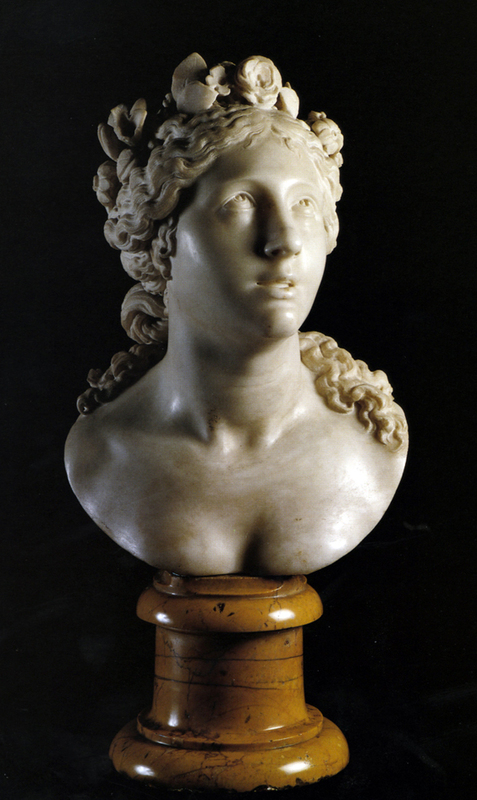
The marble bust Blessed Soul, or Anima Beata, was created in 1619 along with Damned Soul when Bernini was only 20. The piece is thought to have been commissioned by Cardinal Pedro Foix de Montoya [1]. The bust depicts a woman looking up toward heaven with a slightly open mouth with an almost absent expression. She wears a crown of flowers atop her long, curly hair, and the bust, like Damned Soul, cuts off around her collarbone and neck. While Damned Soul captures an intensity of emotion and pain, the woman in Blessed Soul almost appears absent from life, fixated on looking toward heaven. The parted lips and slight head tilt add an aura of innocence to the woman's expression.
While the emotion is far less eminent in Blessed Soul than in Damned Soul, Bernini still captures an instantaneous motion and emotion rather than capturing a figure at rest. With her head tilted, lips parted, and eyes looking upward, the woman looks as though she is about to speak or perhaps ascend to heaven.
Though the purity in her face is clear, the absence of life and emotion almost leaves a negative connotation on going to heaven [2]. The Damned Soul clearly experienced agony, but appears more alive with such intensity of emotion.
Bernini again used sculpture as a media to depict an expression that may have more typically been seen in oil portraiture prior to the Baroque period. Through next examining a portrait of Caravaggio, this connection can be understood. Once again looking beyond a medium’s history and standard uses, Bernini established himself as a visionary almost agnostic to the medium he was working with. His paintings, sculptures, and architecture are connected by their dynamic nature.
[1] “Anima Beata (the Blessed Soul).” Sotheby's. Sotheby's. Accessed October 18, 2021. https://www.sothebys.com/en/buy/auction/2021/tomasso-the-more-a-thing-is-perfect/anima-beata-the-blessed-soul.
[2] Rowland, Ingrid D. “Bernini: He Had the Touch.” The New York Review of Books. NYREV, July 21, 2020. https://www.nybooks.com/articles/2015/06/04/bernini-he-had-touch/.
Caravaggio's Boy with a Basket of Fruit
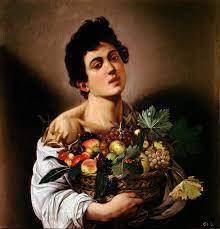
Caravaggios painting, Boy with a Basket of Fruit, is dated to early in his career from roughly 1593 to 1595. The painting is done in oil on a 70 by 67 cm canvas, and is a part of the Galleria Borghese in Rome [1]. Caravaggio created the painting early in his career during his still life exploration, and was originally for the Cavaliere d’Arpino, but was later taken by Scipione Borghese. During this time, Caravaggio arrived in Rome and was connected to Cardinal Francesco Maria del Monte, his first significant Patron.
The painting features a boy, thought to be modeled by the painter Mario Minniti, at the age of 16 [2]. He faces his body toward the right, but looks out toward the viewer. With his head tilted up and his mouth slightly agape, the boy shows a look of peace. The facial expression is reminiscient of Bernini’s Blessed Soul bust with a satisfied, relaxed look and slightly open mouth. In Boy with a Basket of Fruit, the boy tilts over with his tunic falling off the shoulders. His tunic carries folds and fluidity, emulating the classically Baroque fluidity. The basket he holds is overfilled with a variety of fruits that spill out of the sides. Accompanying these physical characteristics of the painting with his loose expression, Caravaggio has created motion and fluidity in a seemingly “still life.”
Accompanying this motion with dramatic lighting and bold colors, Caravaggio has created a painting carrying themes characteristic of the Italian Baroque painting movement. This portrait serves as a benchmark for themes in Baroque oil portraiture, and comparing it to Bernini's busts allows us to understand how Bernini encapsulated movements from Baroque portraits to sculpture. As is demonstrated by Damned Soul and Blessed Soul, Bernini was able to translate these themes to the seemingly frigid medium of sculpture. Damned Soul is depicted amidst agony, and Blessed Soul seems lifted to ascend to heaven - these dynamics, similar to the dynamics Caravaggio presents in painting, are used by Bernini to spearhead the Baroque sculpture movement.
[1] “Boy with a Basket of Fruit by Caravaggio.” Web Gallery of Art. Web Gallery of Art. Accessed December 2, 2021. https://www.wga.hu/html_m/c/caravagg/01/03boy_fr.html.
[2] “Boy with a Basket of Fruit by Caravaggio.” Galerie Borghèse, August 2, 2019. https://borghese.gallery/collection/paintings/boy-with-a-basket-of-fruit.html.
Fortini's Bust of a Nobleman in Armour
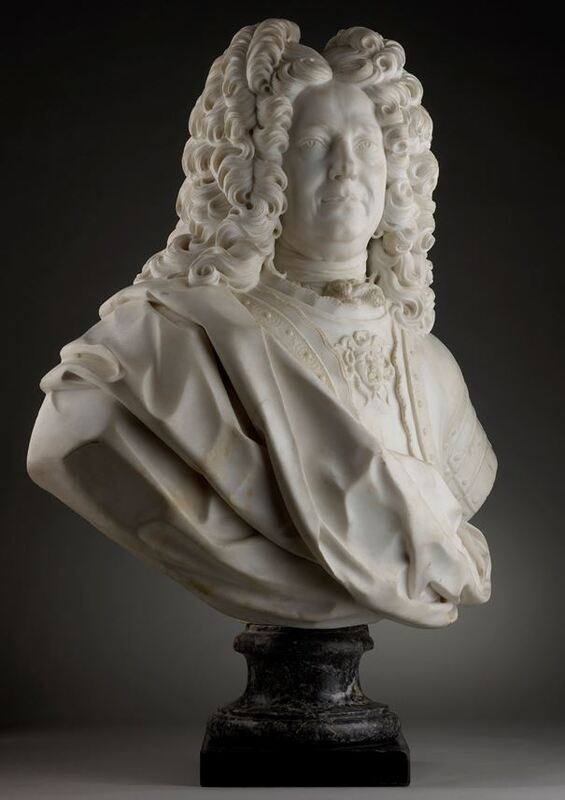
Sculptor Giovacchino Fortini carved Bust of a Nobleman in Armour in 1700. The bust is done in white marble, and currently belongs to a private collection [1].
Fortini, a Florentine sculptor, was renowned for his busts that marked a design shift from the late Baroque period in Italy. His characteristic style of clean cut shadows and bright marble create an aura of sophistication to his work.
In Bust of a Nobleman in Armour, the model wears elegant looking armor, complete with a medusa emblem and cloth draping diagonally. He wears a wig with symmetric curls resting around his head and shoulders. The nobleman, who appears to be an adult, carries a restful expression and looks out to the audience denoting his high stature and experience in a humble manner. His posture is completely upright.
Fortini’s bust shows a more typical use of the medium during the renaissance and the Baroque periods [2]. The bust is used to show distinguished figures at rest as a preservation of their power and legacy in society. Comparing this bust to Bernini’s Damned Soul and Blessed Soul conveys how Bernini’s unconventional use of sculpture at the time show his ability to stay medium-agnostic while establishing his artistic lens.
Bernini uses busts outside of their more conventional purpose as shown by Fortini. Instead of depicting a person of high stature at rest, he captures motion, tension, and uncertainty in Blessed Soul and Damned Soul. Departing from the typical upright composition, Bernini embraces rotation. Even in Bernini’s bust comissions, such as the bust of Cardinal Scipione Borghnese, he shows motion through slight tilts and rotations, folds in fabric, and expression as a vehicle for showing power, intelligence and legacy. He takes these dynamic traits that are seen in portraits like Caravaggio’s Boy with a Basket of Fruit and boldly brings them to busts.
[1] “Bust of a Nobleman in Armour Giovacchino Fortini (1670 ...” The British Antique Dealers' Association. BADA. Accessed December 2, 2021. https://www.bada.org/object/bust-nobleman-armour-giovacchino-fortini-1670-1736.
[2] Warwick, Genevieve. “Bernini (1598–1680): Sculpting Sainthood.” Studies: An Irish Quarterly Review 104, no. 416 (2015): 444–55. http://www.jstor.org/stable/24640794.