Fontana delle Tartarughe
Dublin Core
Title
Fontana delle Tartarughe
Description
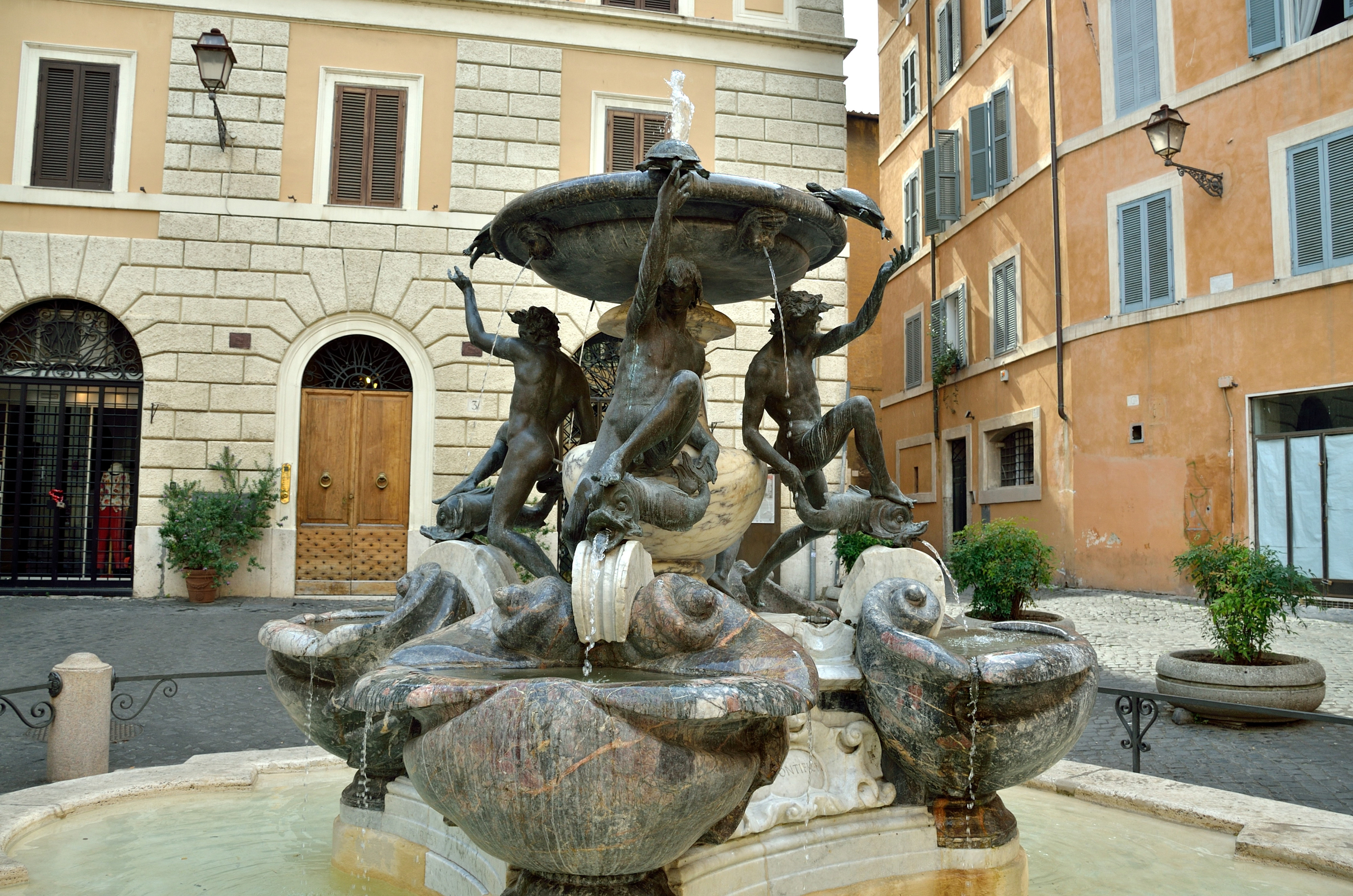
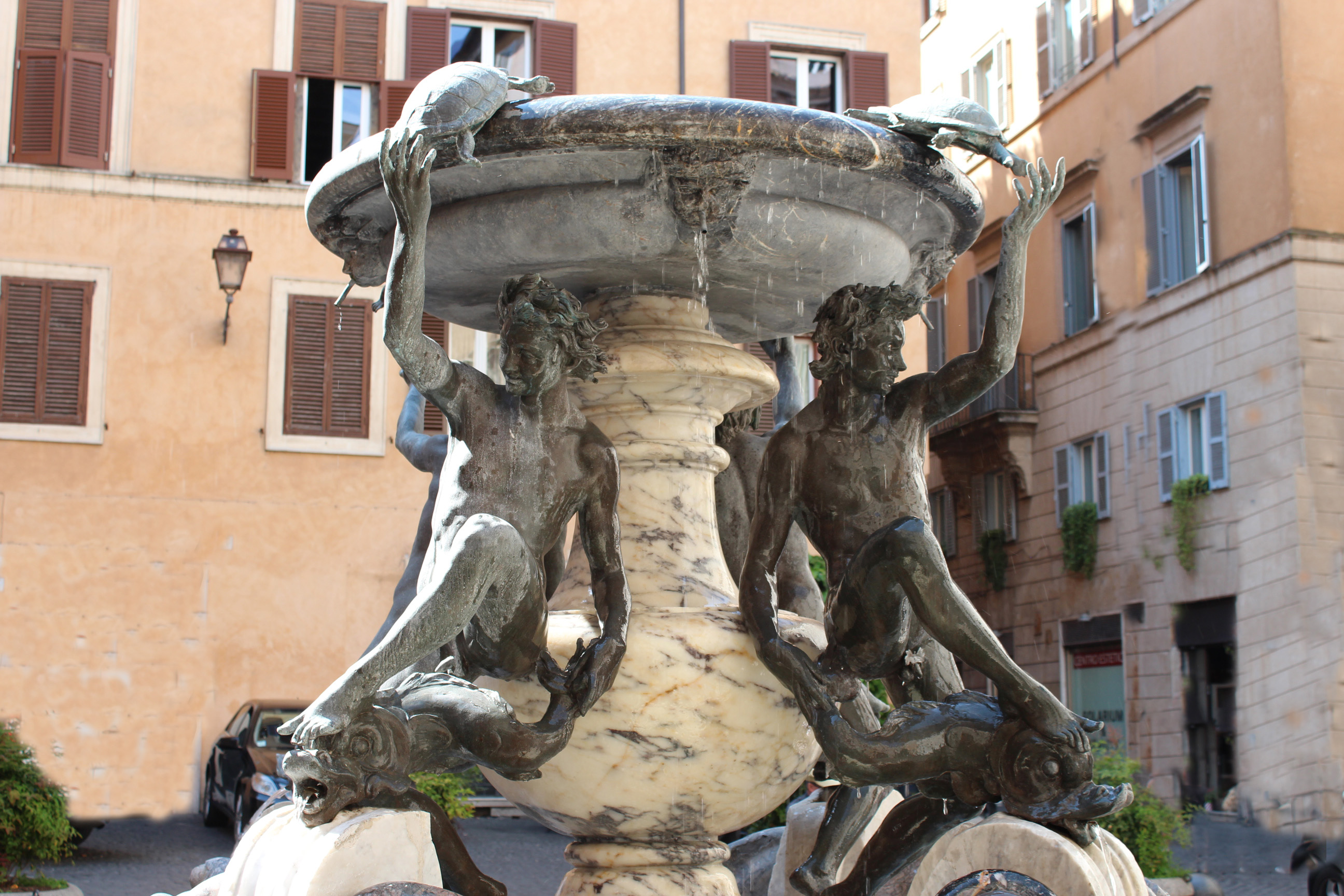
The Fontana delle Tartarughe is famous for the turtles that adorn the fountain. Yet these were not a part of the original design, but added later into the fountain. With water from the Acqua Vergine, the fountain was made to bring water to the people. Designed by Giacomo della Porta and Taddeo Landini, the fountain came into fruition in 1585. Unlike many of the other fountains discussed, the Fontana delle Tartarughe was not commissioned by the papacy, but rather by a private patron. Located in the aptly named Piazza Mattei, the fountain was commissioned by Muzio Mattei.
The fountain itself consists of a large basin that rests atop a central pillar. This basin appears to be held up by four bronze statues of men, yet the statues do not touch the bottom of the basin. Landini was the sculptor behind the four statues. The four men have an arm stretched upwards to give the appearance they are reaching for the basin. In the original design, there were no turtles, but nowadays a turtle can be spotted climbing into the basin from each man’s hands. Each man rests his foot atop the head of a dolphin, where water spews from their mouths. The water collects in four small pools held in granite at the base of the dolphins, before cascading over the edge of these smaller basins into the large base of the fountain.
The fountain comes rich with legend. One tale states that Mattei ordered the fountain to be built in a single night in order to impress the father of a woman he wished to marry. The father approves, as he is impressed by the grandiose act. This fountain is extremely important to analyze, as it was not commissioned by a Pope. As a piece of private commission, it exists outside the realm of the papacy and thus outside of the Catholic reign. However, the Mattei were still Catholics and thus religion may have impacted the foundation of the fountain. Also, the fountain most likely represents the power of the Mattei family. As one of the only families with a grandiose fountain commissioned by them, the fountain represents their grand power and their strength. While seemingly a simple fountain, the fountain holds many meanings.
Creator
Giacomo della Porta
Taddeo Landini
Taddeo Landini
Source
Connors, Joseph. Alliance and Enmity in Roman Baroque Urbanism. Rome, Italy: Bibliotheca Hertziana, 1989.
The Fountains of Rome, 1986. https://fod-infobase-com.proxy.lib.duke.edu/p_ViewVideo.aspx?xtid=2150.
Pulvers, Marvin. Roman Fountains: 2000 Fountains in Rome: A Complete Collection. Rome, Italy: L'Erma di Bretschneider, 2002.
Respighi, Ottorino, Tadaaki Otaka, and Patrick Thomas. CD. The Fountains of Rome. BBC Music Magazine, n.d.
Togstad, Anne Kristine. “Fontana Delle Tartarughe : The Iconography of a Roman Fountain.” University of Oslo, 2005.
Publisher
Muzio Mattei
Date
1585
Contributor
Jacob Carnes
Format
Bronze and travertine
Type
Fountain
Coverage
Piazza Mattei, Rome, Italy
Files
Collection
Citation
Giacomo della Porta
Taddeo Landini, “Fontana delle Tartarughe,” ARTHIST 256 - Italian Baroque Art - Fall 2021, accessed October 22, 2026, https://baroque.dahvc.org/fall-2021/items/show/315.