Fontana dei Quattro Fiumi
Dublin Core
Title
Fontana dei Quattro Fiumi
Description
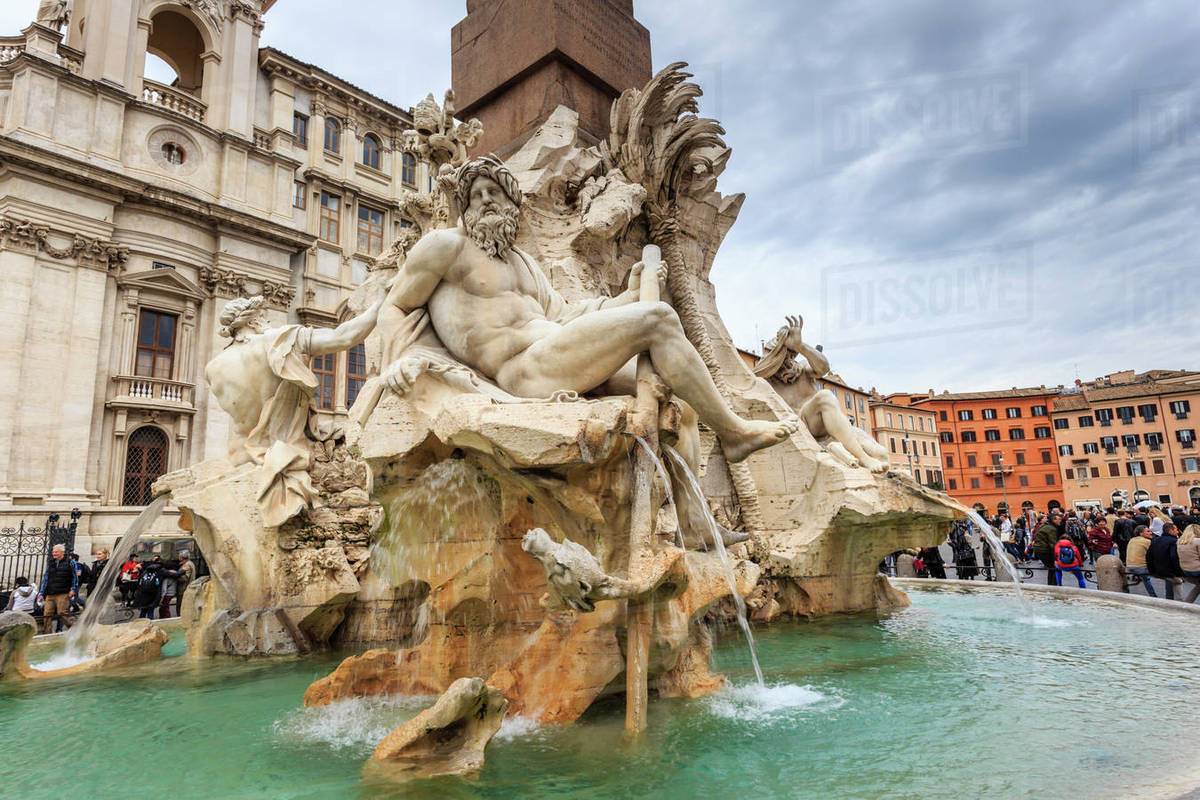
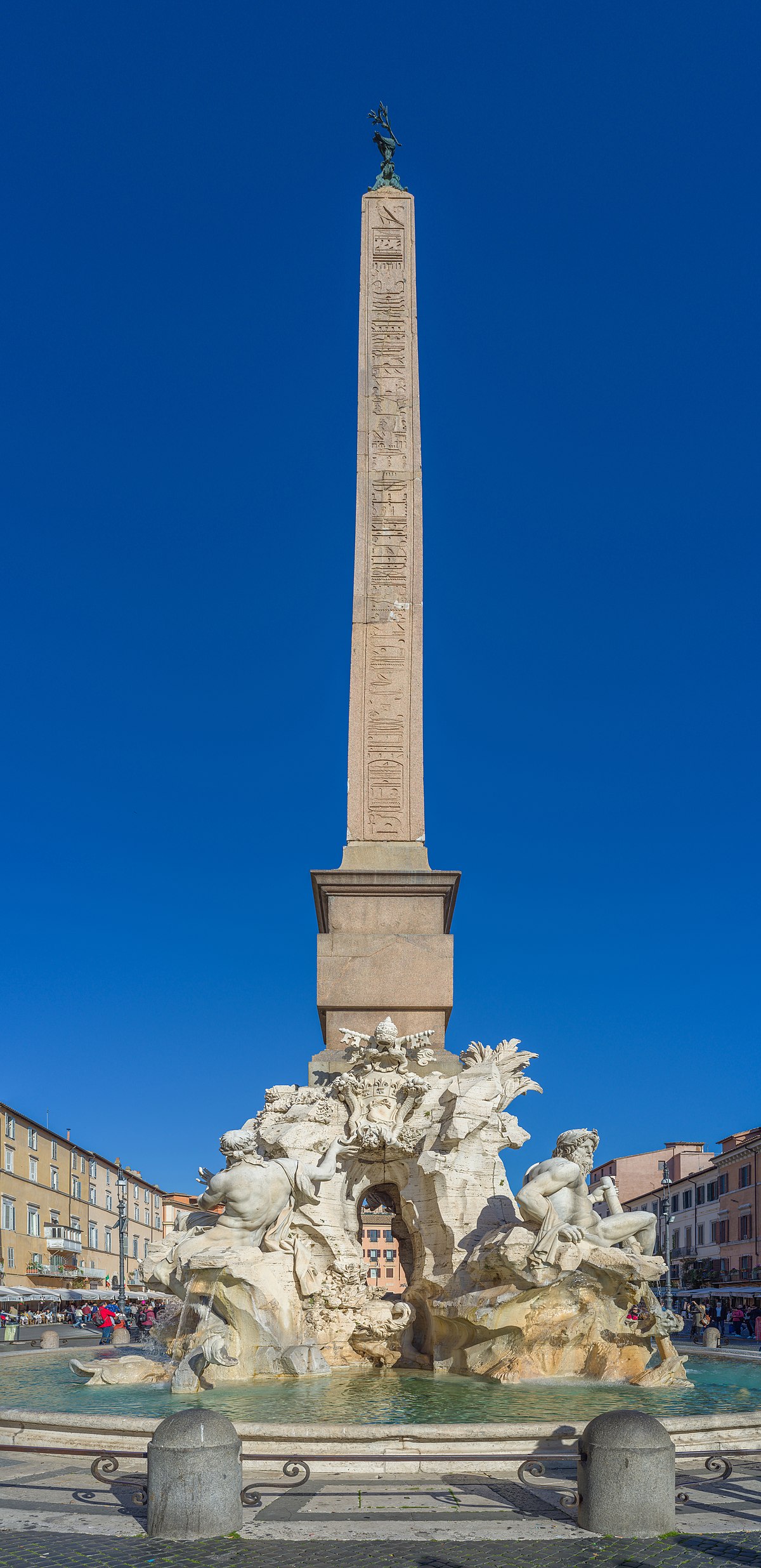
The Fontana dei Quattro Fiumi has a long and laborious past, involving a competition for the construction of the fountain. The fountain resides in the Piazza Navona, flanked by two other fountains, including the Fontana del Moro. The fountain was finished in 1651, built by Gian Lorenzo Bernini after a long struggle. Commissioned by Pope Innocent X, this fountain needed to be grandiose in order to assert the power of the papacy. Fountains are easy art pieces for asserting the power of the papacy as they are publicly accessible and thus readily able to be viewed by all. Pope Innocent commissioned Borromini to complete the water works so that a fountain may go in the center of the piazza. Borromini suggested a fountain representing four rivers and four continents, and thus Innocent created a competition for the design of this fountain.
Many artists were invited to participate in this competition, including Borromini, yet Bernini was not. Family dynamics and past patronage created issues between the papacy and Bernini, and thus Bernini was not in favor of the Pope. Bernini, however, managed to secure the commission. There are two stories on how this happened. One is that a friend of Bernini with connections to the papal family had Bernini’s design model placed so that the Pope would be forced to see it. The other story is that Bernini presented a silver model of his design to Innocent X’s sister-in-law, provoking such discussion that the Pope had to have Bernini design it.
The fountain is composed of four allegorical figures representing four continents and four rivers: the Nile for Africa, the Danube for Europe, the Ganges for Asia, and the Plata for the Americas. Additionally, the design of the fountain contains mythical and real creatures around the base that fit into each of the continents they represent. Each of the figures is positioned in such a way that represents aspects of their respective continents. The fountain statuary intertwines with itself and creates magnificent archways in a way that makes the whole fountain look impossible. To top it all off, the top of the fountain holds an Egyptian obelisk that towers into the sky.
The fountain is important for Roman culture for many reasons. Piazza Navona is atop of the Stadium of Domitian, an ancient Roman stadium. For this reason, the fountains here had to be grandiose and reflect the power of the Roman Empire. As the central fountain in the piazza, the Fontana dei Quattro Fiumi had to impose itself on the landscape. This is accomplished with the obelisk that dominates the piazza. The fountain takes influence from many other designs. The grandiose level of the fountain is also Pope Innocent X’s way of establishing himself as an important Pope; to not be lost under a giant sea of famous papal heads.
Creator
Gian Lorenzo Bernini
Source
Connors, Joseph. Alliance and Enmity in Roman Baroque Urbanism. Rome, Italy: Bibliotheca Hertziana, 1989.
Dickerson, C.D, Anthony Sigel, and Ian Wardropper. Bernini: Sculpting in Clay. New York, NY: The Metropolitan Museum of Art, 2012.
The Fountains of Rome, 1986. https://fod-infobase-com.proxy.lib.duke.edu/p_ViewVideo.aspx?xtid=2150.
Morrissey, Jake. The Genius in the Design: Bernini, Borromini, and the Rivalry That Transformed Rome. New York, NY: Harper Perennial, 2006.
Pulvers, Marvin. Roman Fountains: 2000 Fountains in Rome: A Complete Collection. Rome, Italy: L'Erma di Bretschneider, 2002.
Respighi, Ottorino, Tadaaki Otaka, and Patrick Thomas. CD. The Fountains of Rome. BBC Music Magazine, n.d.
Publisher
Pope Innocent X
Date
1651
Contributor
Jacob Carnes
Format
Granite
Type
Fountain
Coverage
Piazza Navona, Rome, Italy
Files
Citation
Gian Lorenzo Bernini, “Fontana dei Quattro Fiumi,” ARTHIST 256 - Italian Baroque Art - Fall 2021, accessed October 22, 2026, https://baroque.dahvc.org/fall-2021/items/show/314.