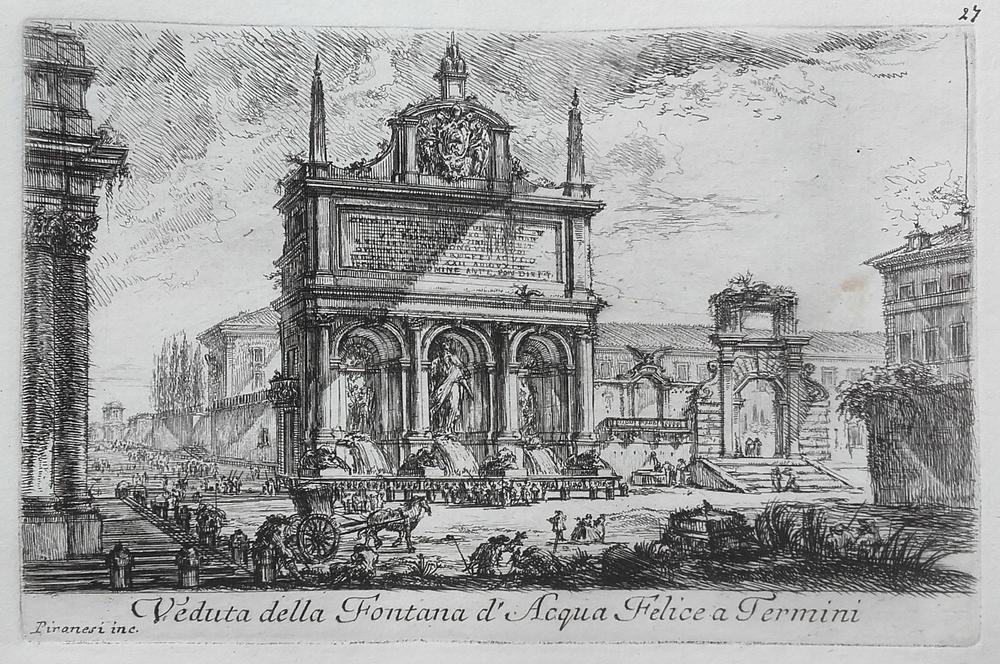
Fontana dell'Acqua Felice
Dublin Core
Title
Fontana dell'Acqua Felice
Description
During the papacies of Pope Pius IV (1559-1565) and Gregory XIII (1575-1585) it was clear that the current water supply, which was primarily from Acqua Vergine (Rome's oldest functioning aqueduct), was insufficient to support expanding Rome's growing demands. Pius IV failed to repair Acqua Vergine because the project proved to be significantly more costly and consuming than Pius IV expected [1] Gregory XIII made plans to construct a new aqueduct, but expenses and technical difficulties proved too much [2].
Pope Sixtus V came to power and revived Gregory's plan. The new aqueduct was named Acqua Felice after Sixtus' original name (Felice). The construction enlisted 2,000 men daily and sometimes as many as 4,000 men. Conflict within its leadership and design makes this construction process even more interesting. Initially, Matteo Bartolini da Città di Castello was the primary architect, but when some existing technical assumptions were proven false (some remaining from Gregory XIII's papacy), Matteo's legitimacy for this project was questioned. 1586 was a year of revisions, and Matteo was replaced by Giovanni Fontana, the brother of Domenico Fontana, who was Sixtus V's personal architect. The terminal fountain was ultimately dedicated in the Piazza delle Terme on June 15, 1587. The Acqua Felice provided the first new supply of water to the Romans since gothic invaders destroyed Roman aqueducts [2].
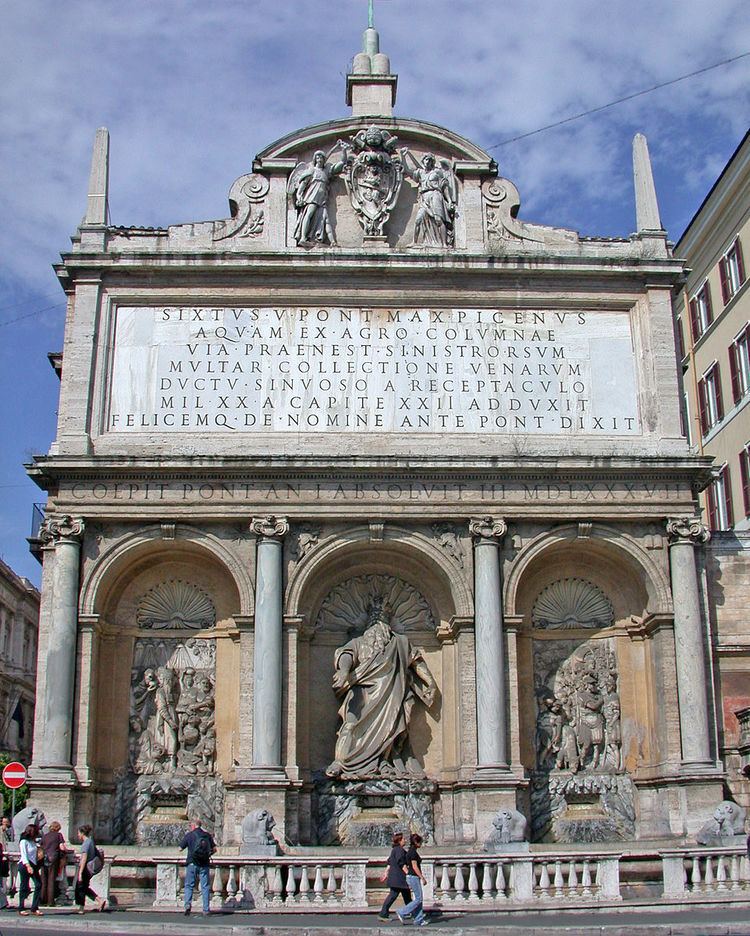
The Fontana Felice, the terminal wall, is constructed like a triumphal arch and depicts papal emblems, alluding to the overcoming of difficulties that was achieved by Sixtus and Imperial Rome as well. Moses is shown in the central part, striking a rock to release water, and this alludes to Sixtus. The attic inscription resembles a message hailing a great conquest.
This aqueduct and wall fountain was placed in the Piazza delle Terme, and established the corner that Pius IV had historically made a visually impressive presence. This made the Quirinal more appealing, luring citizens away from the Tiber River, where they previously went for water. In addition, the aqueduct surfaced on land west of the S. Maria degli Angeli line and bordering the Via Pia Landmarks like the Fontana and Acqua Felice contributed to Sixtus V's master plan of transforming Rome into a transparent city full of movement with articulated spatial cues [2].
Creator
Pope Sixtus V was the leader, and the designers were Matteo Bartolini da Città di Castello (who was removed), and Giovanni Fontana.
Source
[1] Long, Pamela O. Engineering the Eternal City: Infrastructure, Topography, and the Culture of Knowledge in Late Sixteenth-Century Rome. Chicago: University of Chicago Press, 2018.
[2] Marder, Tod A. “Sixtus V and the Quirinal.” Journal of the Society of Architectural Historians 37, no. 4 (1978): 283–94. https://doi.org/10.2307/989245.
[3] Burroughs, Charles. “Opacity and Transparence: Networks and Enclaves in the Rome of Sixtus V.” Res: Anthropology and aesthetics 41 (2002): 56–71. https://doi.org/10.1086/resv41n1ms20167556.
Publisher
Pope Sixtus V
Date
Planning and construction is generally believed to have been 1585-1588, and Tod A. Marder points to June 15, 1587 as the dedication date.
Contributor
Cameron DeChurch
Rights
This is a structure that anyone can view
Format
The aqueduct's reach is 15 miles (24 km).
Language
The inscription is in Latin.
Type
Aqueduct and Structure (Arches with Statues)
Coverage
Piazza delle Terme, Rome, Italy
Files
Collection
Citation
Pope Sixtus V was the leader, and the designers were Matteo Bartolini da Città di Castello (who was removed), and Giovanni Fontana. , “Fontana dell'Acqua Felice,” ARTHIST 256 - Italian Baroque Art - Fall 2021, accessed October 22, 2026, https://baroque.dahvc.org/fall-2021/items/show/251.