Pope Sixtus V
Dublin Core
Title
Pope Sixtus V
Description
This collection explores the extent to which Pope Sixtus V (born Felice Peretti Montalto) transformed Rome into a Baroque city. In the middle of the sixteenth century, Rome was still very much an ancient city with poor infrastructure. As the sixteenth century came to a close, Rome has undergone immense transformation, with the rebuilding and construction of churches, palaces, roads, aqueducts, and more. Although he was not the only pope involved in this transformation, Pope Sixtus V stands out as a key figure. Sixtus V was nothing short of a visionary, whose body of work highlights his innovative urban planning as head of the Catholic Church (1585-1590).
In order to truly evaluate Sixtus V's impact, this exhibit pays note to context. Late sixteenth-century Rome's most powerful figure was its governing pope. Since each pope came from his own family and had unique interests and backgrounds, the changes made during a particular papacy heavily reflect the desires of that particular pope. Thus, this exhibit examines Sixtus V's predecessors and successors. Popes before him such as Sixtus IV, Julius III, Paul IV, Pius IV, Pius V, and Gregory XIII did not concentrate their efforts on urban design to the extent that Sixtus V did. Although they were focused on important issues such as wars, reformation, enforcing decrees from the Council of Trent, and the education of the clergy, their impact on Rome is not highlighted as much through urban structures and design. Popes after him such as Urban VII (1623-1644) seem to be inspired by Sixtus V, putting more emphasis on art patronage.
Sixtus V still impacts Rome today through the lasting impact of his urban planning. This exhibition showcases Sixtus V's design of the city and analyzes his different mediums for reshaping Rome. This exhibit explores Sixtus V's remodeling of the streets, his building of the fountain Fontana Felice, the Lateran Palace, the Dome of Saint Peter's, the Vatican Library, his financing of the Pontine Marshes, and his moving of obelisks into key piazzas and streets.
Creator
Pope Sixtus V
Source
Long, Pamela O. Engineering the Eternal City: Infrastructure, Topography, and the Culture of Knowledge in Late Sixteenth-Century Rome. Chicago: University of Chicago Press, 2018.
Publisher
Pope Sixtus V
Date
2021
Contributor
Cameron DeChurch
Collection Items
Fontana dell'Acqua Felice
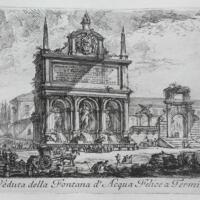
During the papacies of Pope Pius IV (1559-1565) and Gregory XIII (1575-1585) it was clear that the current water supply, which was primarily from Acqua Vergine (Rome's oldest functioning aqueduct), was insufficient to support expanding Rome's growing…
St. Peter's Square Obelisk
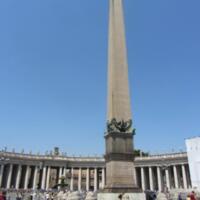
The obelisk was located in Alexandria, Egypt, until 41 C.E. when Emperor Caligula ordered it be transported across the Mediterranean to Rome. It was erected in the Vatican region and remained south of the basilica in front of two ancient cylindrical…
Pope Sixtus V's Rebuilding of the Lateran Palace
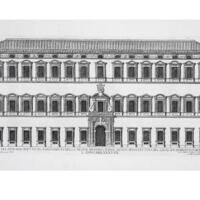
When Pope Sixtus V was elected to the papacy in 1585, he immediately set out to rebuild the Lateran Palace [1]. Pope Sixtus V consulted with his personal architect, Domenico Fontana, who deemed the Patriarchium Lateranense to be "old buildings” with…
Bibliography
“Amidst the Crowds in St Peter's Square, Stands Ancient Egypt.” Archaeology Travel, August 26, 2020. https://archaeology-travel.com/street/vatican-obelisk-in-st-peters-square/.
Boorsch, Suzanne. “The Building of the Vatican: The Papacy and…
Lateran Obelisk
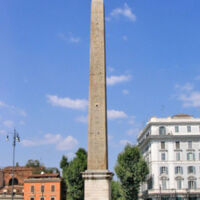
The Lateran obelisk is the tallest obelisk in the world, standing at 32 meters and weighing 522 tons [1]. It is made of red granite, potentially from the same quarry that was used for the obelisk in St. Peter's Square [2]. It was the only single…
Flaminian Obelisk
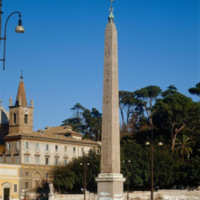
The Flaminian Obelisk was originally established by pharaoh Seti I at Heliopolis, around 1300 BC, standing almost 24 meters high and weighing 235 tons. His son Ramses II finished the monument by adding hieroglyphs. Augustus re-erected it in Campus…
Dome of St Peter's Basilica
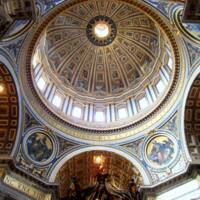
After Rome was sacked in 846, the old St Peter’s was continuously refurbished and repaired. Pope Nicholas V (1447-1455) began the first new construction. Nicholas V worked with architect Alberti, who wanted to remake the city with St. Peter’s as its…
Re-claiming the Pontine Marshes
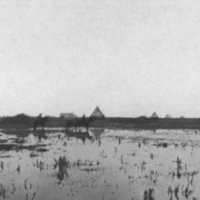
Pope Sixtus V’s work on reshaping Rome extended beyond its city walls. Sixtus V drained the Pontine Marshes, malarial wetlands, located south of Rome along the Appian way and connecting to the Terracina [1]. The Pontine Marshes are low-lying plains…
Addition to Vatican Library
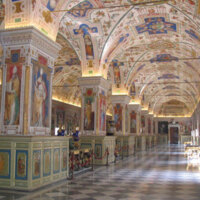
A critical component to Sixtus V’s legacy is his construction of a new Vatican Library [1]. The Vatican libraries date to the 15th century, and grew in significance as the Popes moved from the Lateran Palace to the Vatican. In 1588, Pope Sixtus V…
Addition to Apostolic Palace
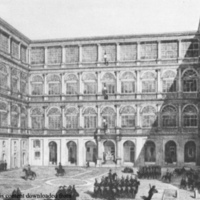
While exploring the Apostolic, or Vatican Palace, it is important to note that it was not actually inhabited by the popes until Pope Innocent III built a papal residence near St. Peter’s in the late twelfth century [1]. The Popes re-established their…