Esther and Ahasuerus
Dublin Core
Title
Esther and Ahasuerus
Subject
Religion/Mythology
Description
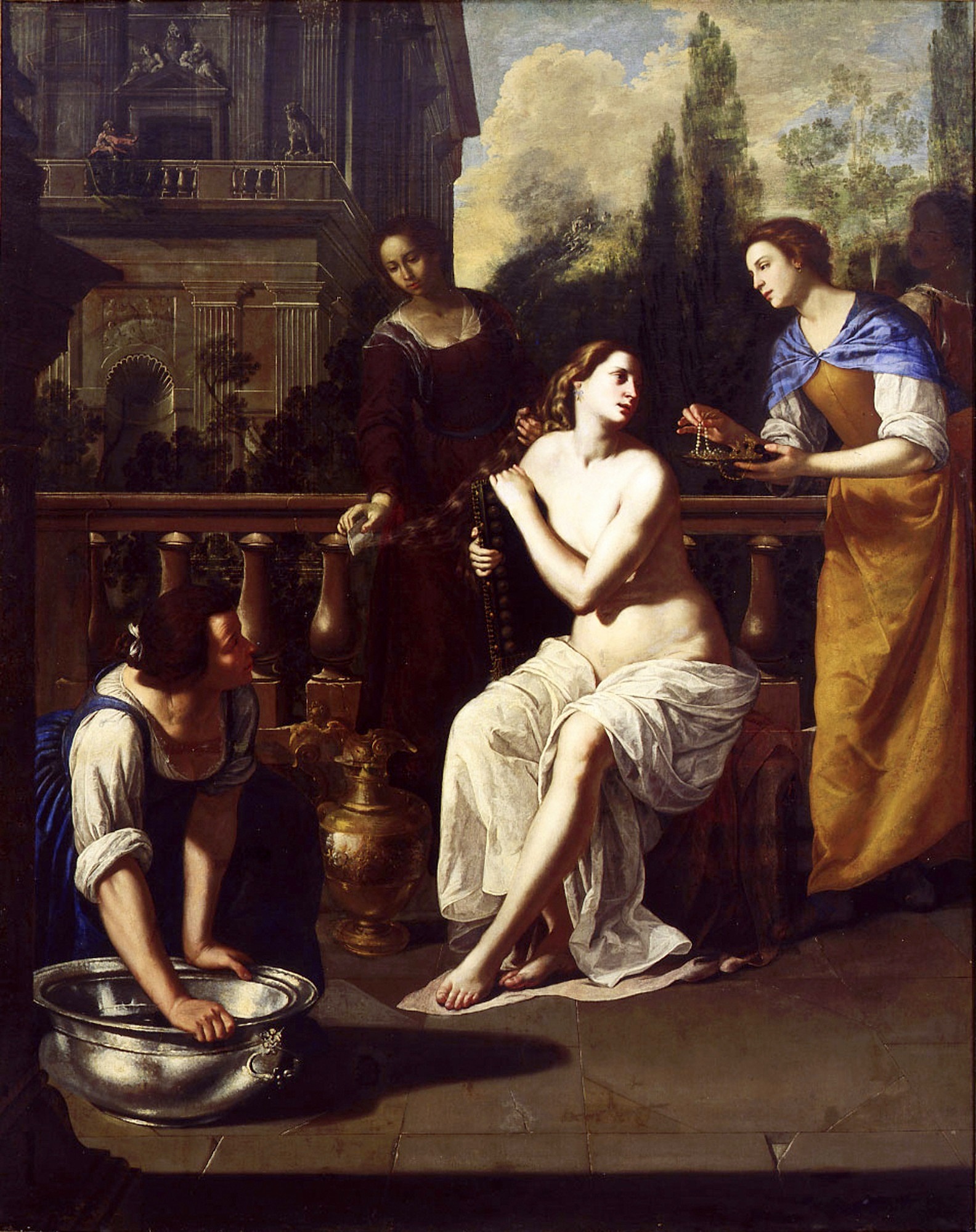
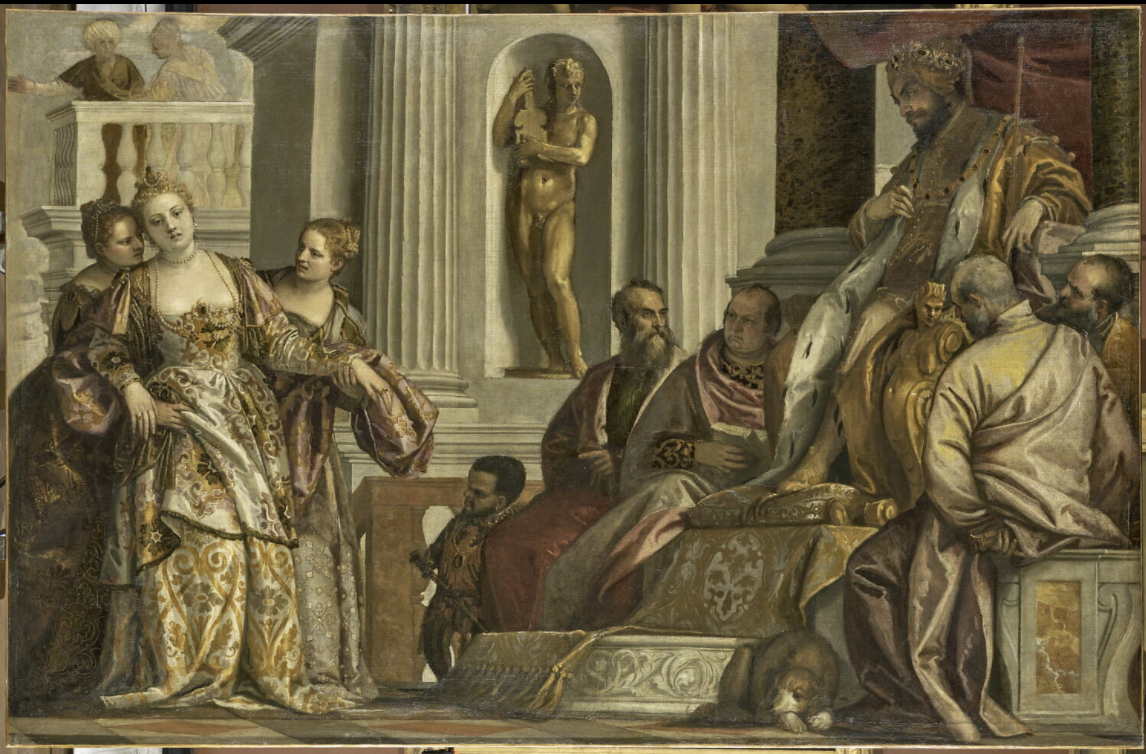
Considered one of the most notable late Renaissance masters, Veronese’s Esther and Ahasuerus illustrates both the Old Testament story and his mastery of large-scale compositions set amidst the grandiose backdrop of Venetian architecture [1]. Although, this piece in particular seems to stray from his usual landscapes, as Veronese is typically known for his achievements as a colorist (seen in pieces such as Crowning of Esther (1556), or The Wedding at Cana (1563), as he rendered fluid tones and chiaroscuro techniques to capture lush scenes [2]. Here, however, the scene seems to be encrusted in gold, overlaid with a mustard hue, a color fit for the regal throne room of the King of Persia, Ahasuerus. The biblical story says that Ahasuerus’ new queen, Esther, was secretly a jew. After the King ordered for a massacre of all jews in the Persian empire, Esther illegally rushed before him, risking her life in an attempt to save her people. In this painting, we are caught in the midst of this moment. On the left, Esther’s worrisome expression seems to emanate throughout her body, as she rests slightly limp against the figure of her maiden. On the right, Ahasuerus sits tall on his throne, covered in gold-toned cloth and embellished in various jewels. The men who are seated on benches that flank the dais are levels lower than the King, asserting his superiority. Some exchange glances with one another while others stare in a disapproving manner at the Queen. The subtle foreshortening effect that Veronese is known to employ is visible here, particularly in Esther’s form, as she is the only figure facing toward the spectator, although she looks at the ground within the frame. Artemisia Gentileschi later created a very similar rendition of this scene around 1630, likely influenced by the work of Veronese [3]. It is important to note the different manner in which she portrays the King. Veronese falls in line with the conventional depiction of the story where Ahasuerus is shown in a staunch, unyielding posture. Artemisia strays from this image, showing him to wear extravagant garments that cover him in a disorganized manner. During the period, this garb was most heavily associated with comedic, theatrical characters [4], placing Esther in a superior position as a ruler, and by extension, placing all women in this position as well. Despite the influence Veronese had on Gentileschi in creating Esther before Ahasuerus, her rendition has undoubtedly become more important in the vein of art history.
1. “Paolo Veronese Paintings, Bio, Ideas.” The Art Story. Accessed October 13, 2021. https://www.theartstory.org/artist/veronese-paolo/.
2. Art Story, ““Paolo Veronese Paintings, Bio, Ideas.”
3. Metmuseum.org. Accessed October 13, 2021. https://www.metmuseum.org/art/collection/search/436453.
4. Locker, Jesse. Artemisia Gentileschi: The Language of Painting. New Haven: Yale University Press, 2015.
Creator
Paolo Caliari, dit Veronese (Verona,1528 - Venice, 1588)
Benedetto Caliari (Verona, 1538 - Verona, 1598)
School of Italy
Benedetto Caliari (Verona, 1538 - Verona, 1598)
School of Italy
Source
Metmuseum.org. Accessed October 13, 2021. https://www.metmuseum.org/art/collection/search/436453.
Paolo Caliari, dit Veronese, Benedetto Caliari, and Italie. “Esther Et Assuérus.” Musée du Louvre, September 13, 2021. https://collections.louvre.fr/en/ark:/53355/cl010061270.
“Paolo Veronese Paintings, Bio, Ideas.” The Art Story. Accessed October 13, 2021. https://www.theartstory.org/artist/veronese-paolo/.
Publisher
Patron: Louis XIV, King of France
Commissioner/Archaeologist: Everhard Jabach
Commissioner/Archaeologist: Everhard Jabach
Date
C. 1500-1600
Contributor
Rebecca Boss
Rights
© 2019 RMN-Grand Palais (Louvre museum) / Adrien Didierjean
Relation
Title: Esther before Ahasuerus
Artist: Artemisia Gentileschi (Italian, born Rome 1593–died Naples 1654 or later)
Medium: Oil on canvas
Dimensions: 82 in. × 8 ft. 11 3/4 in. (208.3 × 273.7 cm)
Classification: Paintings
Credit Line: Gift of Elinor Dorrance Ingersoll, 1969
Accession Number: 69.281
Artist: Artemisia Gentileschi (Italian, born Rome 1593–died Naples 1654 or later)
Medium: Oil on canvas
Dimensions: 82 in. × 8 ft. 11 3/4 in. (208.3 × 273.7 cm)
Classification: Paintings
Credit Line: Gift of Elinor Dorrance Ingersoll, 1969
Accession Number: 69.281
Format
Oil on Canvas
206 × 334 cm
Measured without accessory
206 × 334 cm
Measured without accessory
Type
Painting
Coverage
Currently at the Musée du Louvre, Paris
Department of Paintings
On Display in Gallery 711, Aile Denon, Level 1
Owned by the State of France
Department of Paintings
On Display in Gallery 711, Aile Denon, Level 1
Owned by the State of France
Files
Citation
Paolo Caliari, dit Veronese (Verona,1528 - Venice, 1588)
Benedetto Caliari (Verona, 1538 - Verona, 1598)
School of Italy , “Esther and Ahasuerus,” ARTHIST 256 - Italian Baroque Art - Fall 2021, accessed October 22, 2026, https://baroque.dahvc.org/fall-2021/items/show/237.