Fontana del Tritone
Dublin Core
Title
Fontana del Tritone
Description
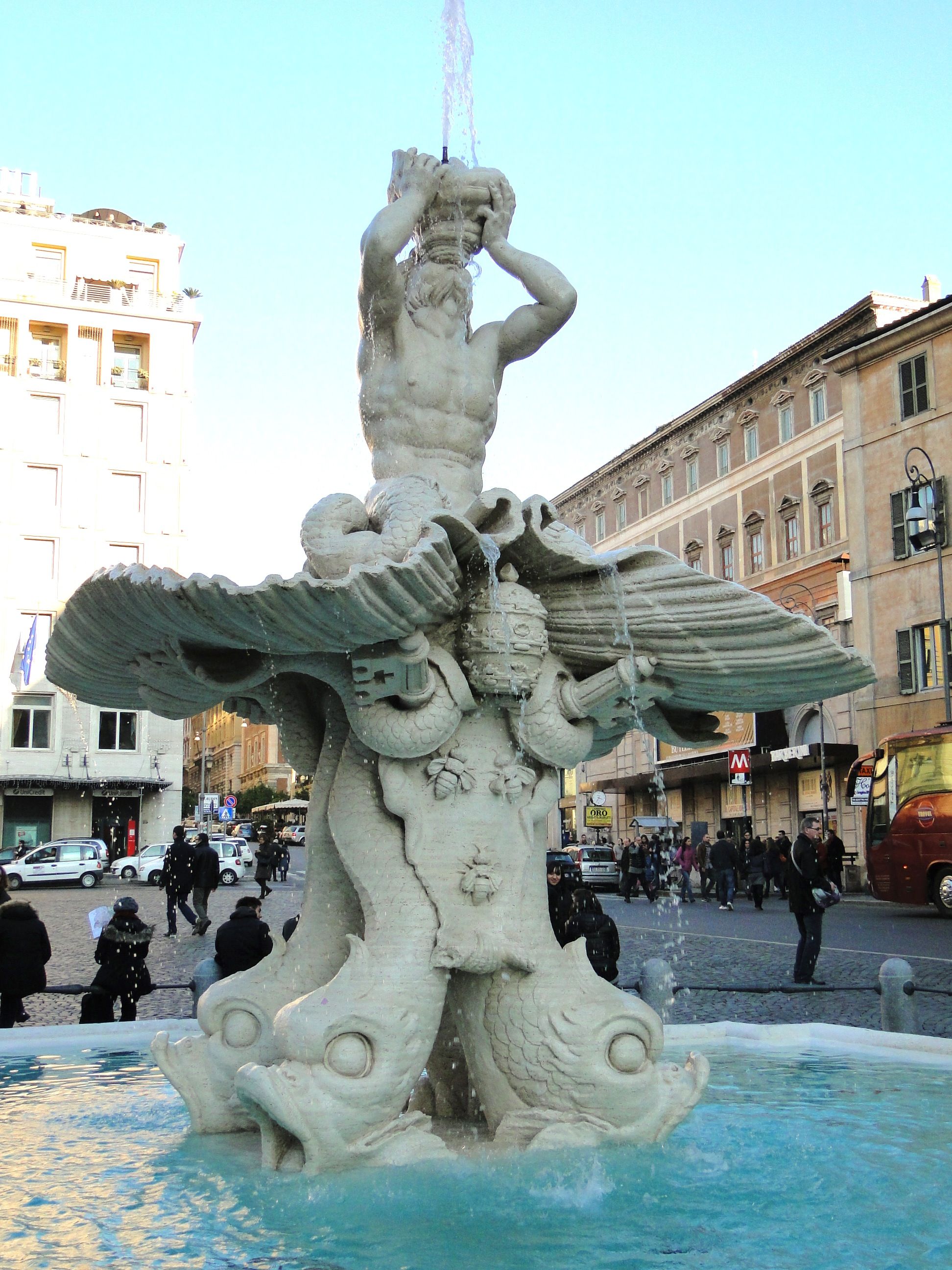
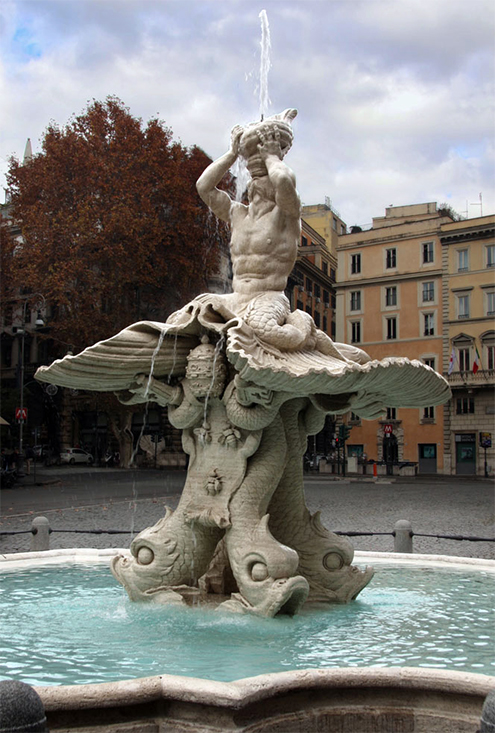
The Fontana del Tritone stands in the middle of the Piazza Barberini. This fountain takes water from the Acqua Felice in order to create this beautiful and powerful piece of art. The fountain was commissioned by Pope Urban VIII, and was the last commissioned piece that Gian Lorenzo Bernini was to accomplish for the Pope before the Pope’s death in 1644. The fountain was completed between 1642 and 1643, in homage to the Barberini family of which Pope Urban VIII was a member. The fountain was built to provide water from the aqueduct to the people as well, with an innovative twist. The free-standing design of the fountain was relatively new to the city scape and thus altered the focal landscape of Rome.
The fountain rises into the sky with the god Triton sitting atop of it in a merman state. He is blowing a conch shell with water spouting from the conch into the basin below them. He is held up by dolphins, with which lie the papal keys and the Barberini family bees. This piece pays great homage to Pope Urban VIII and his family, as they were frequent patrons for Bernini. This iconic fountain of Rome creates quite the visual spectacle as water sprays skywards from the conch and the viewers’ eyes are drawn up to the massive figure of Triton resting on a shell.
Overtime, the context of the Fontana del Tritone has been greatly altered. At the time of construction, it was surrounded by many buildings with fewer floors, so that it was seen as a grandiose display of power, and from far away. Nowadays, there are many taller buildings that surround the piazza and tower over the fountain. Yet, the fountain is still seen as an impressive Baroque display. The fountain has undergone many restorations since its establishment in the piazza. One such restoration occurred in 1932, when the workers revealed the original statue from underneath so many layers of grime that citizens believed the statue to be a replica.
The Fontana del Tritone greatly conversed with its landscape and the other fountains in nearby areas. The fountain has been argued to be a commentary on the victory of the Thirty Years’ War and Catholic dominance. Additionally, the fountain is paying homage to the life of Urban VIII, with the symbol of a god representing the immortality of Urban VIII and the Barberini’s legacy on Rome and the world. While this may be an interesting choice as it is not a Christian symbol, it can represent the dominance of Rome and reinvigorate the power of the Roman Empire.
Creator
Gian Lorenzo Bernini
Source
Connors, Joseph. Alliance and Enmity in Roman Baroque Urbanism. Rome, Italy: Bibliotheca Hertziana, 1989.
“Fontana Del Tritone.” Fontana del Tritone by Gian Lorenzo Bernini. Accessed October 13, 2021. http://www.gianlorenzobernini.org/fontana-del-tritone/.
The Fountains of Rome, 1986. https://fod-infobase-com.proxy.lib.duke.edu/p_ViewVideo.aspx?xtid=2150.
Gray, Gustave Le, and Firmin-Eugène Le Dien. “Bernini’s Triton Fountain, Ca. 1852–53.” City of the Soul, 2016, 102–4. https://doi.org/10.2307/j.ctv1xx9k9w.36.
Pulvers, Marvin. Roman Fountains: 2000 Fountains in Rome: A Complete Collection. Rome, Italy: L'Erma di Bretschneider, 2002.
Respighi, Ottorino, Tadaaki Otaka, and Patrick Thomas. CD. The Fountains of Rome. BBC Music Magazine, n.d.
Publisher
Pope Urban VIII
Date
1643
Contributor
Jacob Carnes
Format
Travertine
Type
Fountain
Coverage
Rome, Italy
Files
Collection
Citation
Gian Lorenzo Bernini, “Fontana del Tritone,” ARTHIST 256 - Italian Baroque Art - Fall 2021, accessed October 22, 2026, https://baroque.dahvc.org/fall-2021/items/show/236.