Browse Items (149 total)
Sort by:
Apollo and Daphne
Three different black and white pictures of Bernini's "Apollo and Daphne" sculpture. Bernini’s life-sized marble sculpture of “Apollo and Daphne” is regarded as one of his most powerful and emotional works. The work was commissioned in 1622 by…
Les femmes illustres, ou, Les harangues heroïques
French philosopher Madeleine de Scudéry was a prolific writer. Her novels and books were published under her brother’s name. She embraced philosophical dialogue as a means to explore questions of gender, sexuality, education, and power. Scudéry was…
Primavera
Botticelli's "Primavera" painting depicts nine mythological figures most notably the nymph Chloris who is portrayed before and after her transformation into the spring goddess Flora.
St. Michael Vanquishing Satan
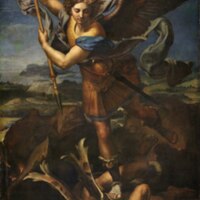
St. Michael Vanquishing Satan is created by the Italian High Renaissance artist Raphael. The painting was commissioned by Pope Leo X. In the painting, the archangel Michael standing on top of Satan's back with his right foot, while holding a spear in…
Fontana dell'Acqua Felice
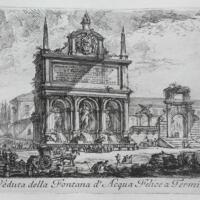
During the papacies of Pope Pius IV (1559-1565) and Gregory XIII (1575-1585) it was clear that the current water supply, which was primarily from Acqua Vergine (Rome's oldest functioning aqueduct), was insufficient to support expanding Rome's growing…
Addition to Apostolic Palace
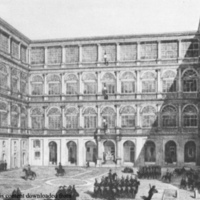
While exploring the Apostolic, or Vatican Palace, it is important to note that it was not actually inhabited by the popes until Pope Innocent III built a papal residence near St. Peter’s in the late twelfth century [1]. The Popes re-established their…
Pope Sixtus V's Rebuilding of the Lateran Palace
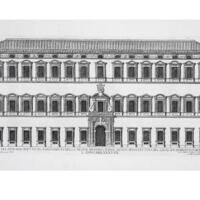
When Pope Sixtus V was elected to the papacy in 1585, he immediately set out to rebuild the Lateran Palace [1]. Pope Sixtus V consulted with his personal architect, Domenico Fontana, who deemed the Patriarchium Lateranense to be "old buildings” with…
St. Peter's Square Obelisk
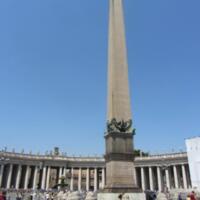
The obelisk was located in Alexandria, Egypt, until 41 C.E. when Emperor Caligula ordered it be transported across the Mediterranean to Rome. It was erected in the Vatican region and remained south of the basilica in front of two ancient cylindrical…