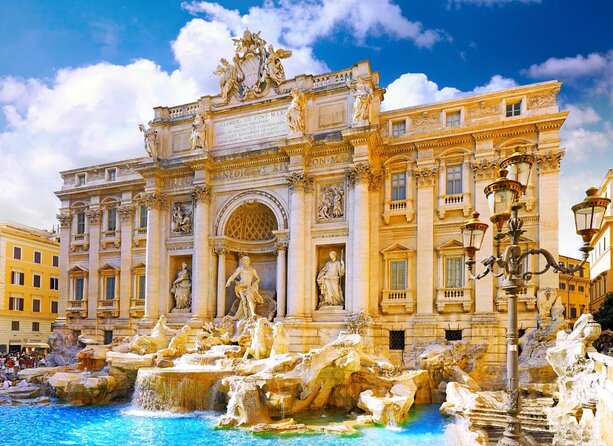
Fontana di Trevi
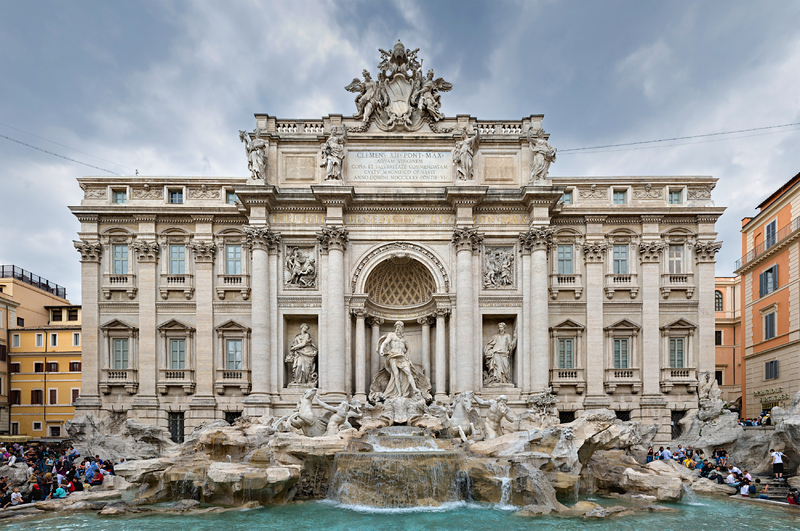
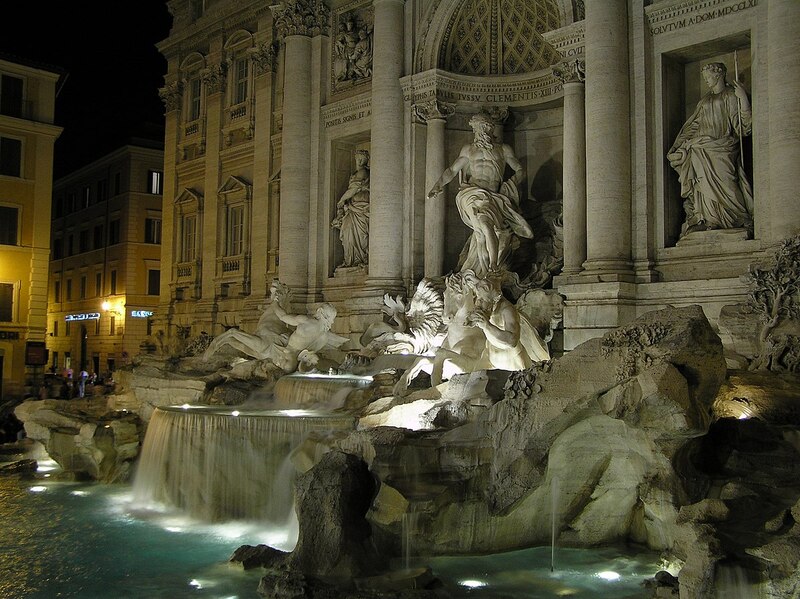
The Trevi Fountain was originally commissioned in 1629 by Pope Urban VIII to replace an older fountain on the same spot. This fountain was commissioned to Gian Lorenzo Bernini, yet was left unfinished as Pope Urban VIII died in 1644. The fountain was ordered for this spot, as water from the Acqua Vergine came to an end at this location. The fountain remained unfinished until Pope Clement XII commissioned Nicola Salvi to create the new fountain in 1732. Salvi died before being able to finish the fountain and Giuseppe Panini became the ultimate architect to work on the fountain, ultimately finishing the project in 1762. The Trevi Fountain rests on the intersection of three streets and takes its name from “Tre Vie” meaning three ways.
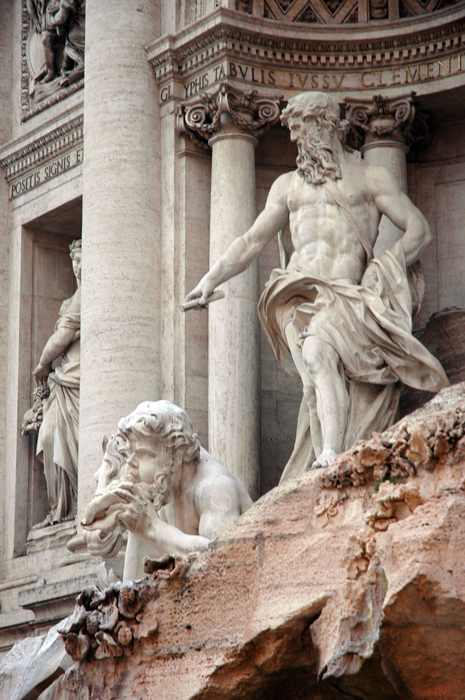
The fountain itself is remarkable in design. The central piece of Neptune/Oceanus was created by Pietro Bracci and stands impressively over the Piazza. He is atop a chariot pulled by sea horses and two figures of Tritons accompany him. Additionally, he is accompanied by the personifications of Abundance and Health.
The Trevi Fountain stands proudly as an icon for the city of Rome and for all of Italy. The impressive fountain goes through 2,823,800 cubic feet of water everyday, roughly equivalent to 21,123,490 gallons of water, which is enough to fill 32 olympic sized swimming pools. In 2014-2015, it underwent a major period of reconstruction with funding from the brand Fendi in order to preserve the fountain. The Trevi Fountain is such a powerful iconography of the city, that it has its own myth that surrounds it. If you throw one coin into the fountain you will return to Rome, two coins means you return and find love, and three coins means you return, find love, and marry. All of the coins thrown into the fountain are donated to charity.
This fountain is incredibly important for Roman life. As a central point of the city, it served as a gathering place, thus drawing in large crowds to the area. The history of the fountain is much debated, with limited documentation and differing ideas on whose ideas were actually used for the fountain. Analyzing the history of the Trevi Fountain is important, as this provides examples of how the fountain was constructed and on what basis. There was a competition for the design of the fountain, showing a desire for only the best to be represented. The Trevi Fountain was finished quite late and thus needed to create something unique that was unprecedented. Thus, Salvi chose a grandiose scale in which to create his fountain, allowing for a new centerpiece to be given to Rome. In relation to other fountains, the Trevi Fountain is on a much larger scale and thus is imposing.