Dublin Core
Title
Flaminian Obelisk
Description
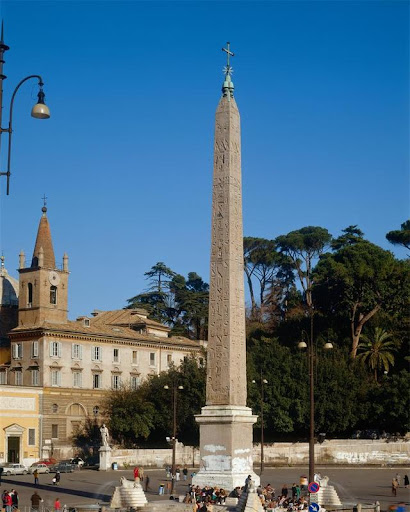
The Flaminian Obelisk was originally established by pharaoh Seti I at Heliopolis, around 1300 BC, standing almost 24 meters high and weighing 235 tons. His son Ramses II finished the monument by adding hieroglyphs. Augustus re-erected it in Campus Martius, in the Circus Flaminius [1]. Augustus had the hieroglyphs translated to Greek for propaganda purposes, there is little relation to the original inscription and it instead focuses on his relation to the patron Apollo.
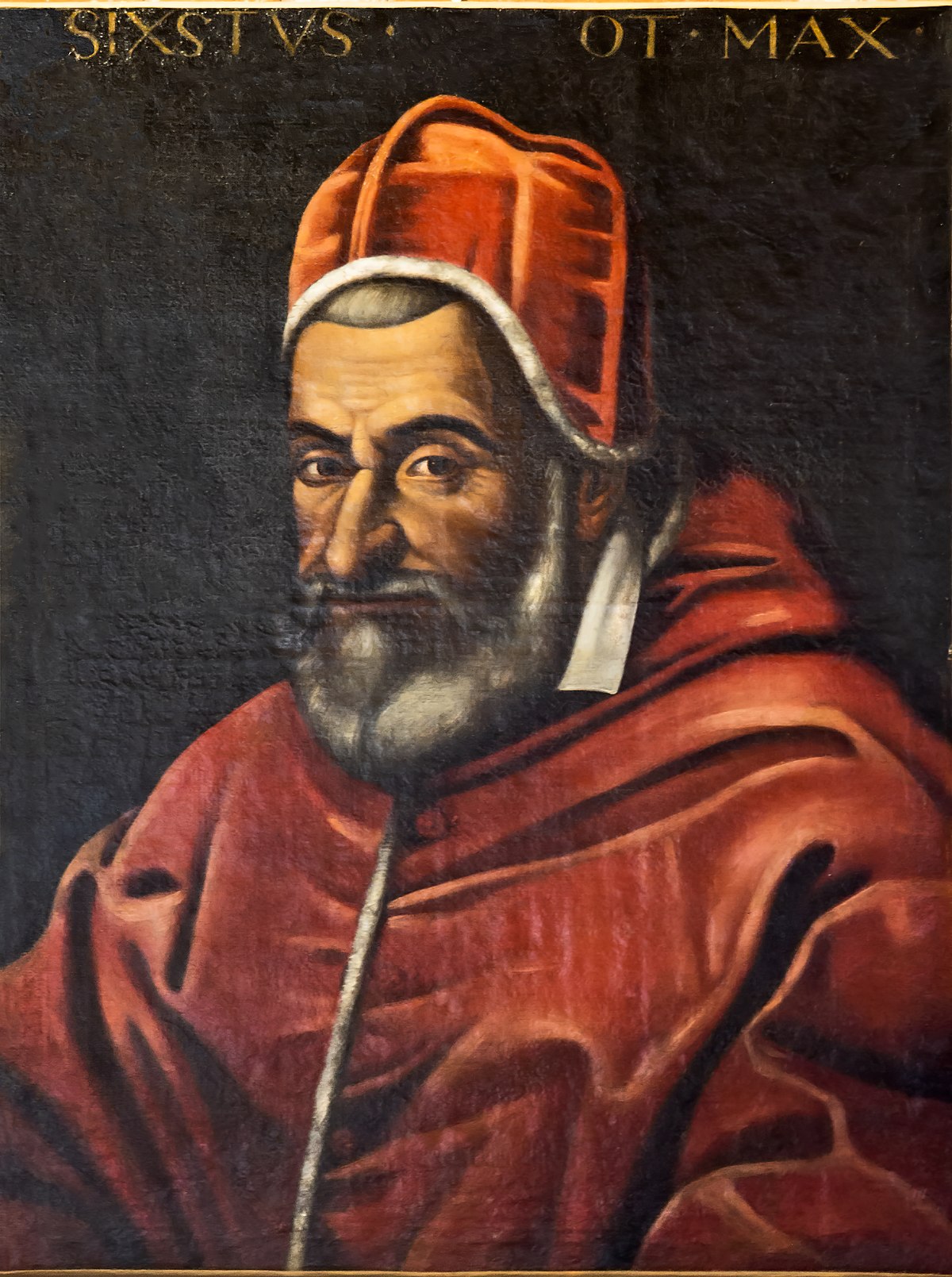
Sixtus conducted a search in 1586 and the Aswan granite obelisk was found in 1587 in the Circus Maximus [2]. This obelisk was also broken into three pieces when it was found [3]. Sixtus V decided to place the Flaminian Obelisk in Piazza del Popolo, because it is a centerpiece of one of the city's main roads from which 3 key roads branched off. The damaged part of the obelisk's bottom shaft was removed and placed on a separate pedestal, along with Augustus' inscription [1].
The Flaminian obelisk is actually just the third of four obelisks relocated by Sixtus V. The fourth was moved in the same year (1587) by Sixtus V and reconstructed at the Santa Maria Maggiore, a focal point of Sixtus V’s new Rome. This fourth obelisk is known as the Esquilino obelisk, for its location in the Piazza dell’Esquilino [4]. It marked the basilica, the starting point of the Via Felice, and signaled the entrance to Sixtus V’s Villa Montalto [3].
Pope Sixtus V’s obelisks defined a new Christian urbanism [3]. Rome contained countless ancient monuments and relics, but struggled to abandon its past and develop as a new city. Pope Sixtus played to the strengths of Rome by not abandoning, but rather using its ancient history to revitalize and reshape the city in a more modern light. Pilgrims and visitors were attracted to the city largely due to its history, and they were enamored by the city's religious significance and impressed by Rome’s advancements, all while maintaining appreciation for its old history.
Creator
Pope Sixtus V
Source
[1] Sorek, Susan. The Emperors' Needles: Egyptian Obelisks and Rome. Exeter: Bristol Phoenix Press, 2010.
[2] Claridge, Amanda. Rome: An Oxford Archaeological Guide. Oxford: Oxford Univ. Press, 2010.
[3] Long, Pamela O. Engineering the Eternal City: Infrastructure, Topography, and the Culture of Knowledge in Late Sixteenth-Century Rome. Chicago: University of Chicago Press, 2018.
[4] Nagase, Hiroyuki. “Esquilino Obelisk.” Esquilino obelisk, August 11, 2014. http://www.obelisks.org/en/esquilino.htm.
Publisher
Pope Sixtus V
Date
1586-1589
Contributor
Cameron DeChurch
Rights
This is a structure that anyone can see.
Format
This obelisk is 24 meters tall and weighs 235 tons.
Type
Egyptian obelisk
Coverage
Piazza del Popolo, Rome, Italy