Fontana del Moro
Dublin Core
Title
Fontana del Moro
Description
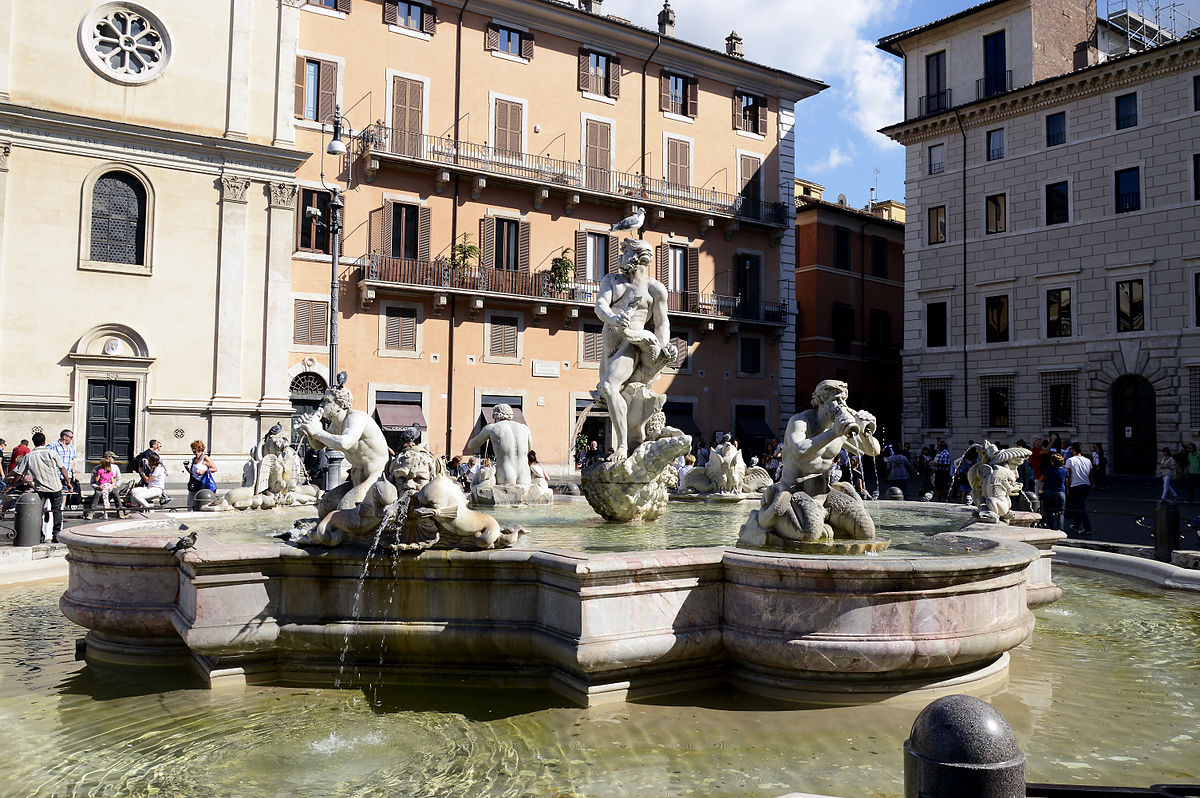
Located on the opposite side of the Piazza Navona as the Fontana del Nettuno, the Fontana del Moro creates a highly interesting dialogue. The Fontana del Moro, while not as famous as the central Fontana dei Quattro Fiumi in the Piazza Navona, manages to create an important story to be read across the piazza. Built by Giacomo della Porta in 1575, the fountain served as a relatively simple sculpture. The second fountain built in the Piazza Navona, the Fontana del Moro served to directly mimic the Fontana del Nettuno. Commissioned by Pope Gregory XIII, the fountain was relatively simple upon its initial creation.
Consisting of a smaller basin atop a large basin, the fountain created a beautiful sense of flow. The basins are crafted from pietra santa, which is the same marble used in the doorway of Saint Peter’s. The fountain, similar to the Fontana del Nettuno, is much larger horizontally than it is vertically. These two fountains thus contrast the obelisk that towers over the piazza in the Fontana dei Quattro Fiumi. Four faces sit atop the wall of the upper basin, each flanked by fish and dolphins, spewing water from the top basin into the lower one. The upper basin also consists of four tritons, blowing into seashells causing water to spew out of them. These four tritons were created by disciples of della Porta including Egidio Della Riviera, Taddeo Landini, Simone Moschini and Giacobbe Silla Longhi. The central figure of the fountain is what earned the fountain its name. It was added later, in 1653, by Bernini to create a more dynamic sculpture. The figure is said to represent an additional triton from Africa that is wrestling with a dolphin.
The Fontana del Moro most likely had its addition of the central figure to counteract the grandiose Fontana dei Quattro Fiumi that was built just two years prior. All three of these fountains create dialogue that brings the viewer's eyes to the center and to the towering Fontana dei Quattro Fiumi. Each fountain has a distinctive role in this. The Fontana del Moro was established to counterbalance the piazza with the Fontana del Nettuno. The fountains were built to be relatively simple, yet decorative and magnificent in their simplicity. Only later on were each of the central figures added to the fountains. At times of the city’s history, the fountains were used as watering troughs for horses, along with providing water to the people. The fountains have always been important in their roles, with a range of purposes over history, most of them overlapping and intertwining. The Fontana del Moro remains an impressive fountain as it was in its foundation, establishing a sense of authority over the area and recalling the great triumphs of the Roman Empire through allusions to mythology.
Creator
Giacomo della Porta
Gian Lorenzo Bernini
Gian Lorenzo Bernini
Source
Bianco, Marcella. “Il Legame Tra Piazza Fontana e Il ‘Golpe Borghese’ Nelle Recenti Indagini Giudiziarie.” Studi Storici 41, no. 1 (2000): 37–60.
Connors, Joseph. Alliance and Enmity in Roman Baroque Urbanism. Rome, Italy: Bibliotheca Hertziana, 1989.
The Fountains of Rome, 1986. https://fod-infobase-com.proxy.lib.duke.edu/p_ViewVideo.aspx?xtid=2150.
Pulvers, Marvin. Roman Fountains: 2000 Fountains in Rome: A Complete Collection. Rome, Italy: L'Erma di Bretschneider, 2002.
Respighi, Ottorino, Tadaaki Otaka, and Patrick Thomas. CD. The Fountains of Rome. BBC Music Magazine, n.d.
Zucker, Paul. “Space and Movement in High Baroque City Planning.” Journal of the Society of Architectural Historians 14, no. 1 (1955): 8–13. https://doi.org/10.2307/987716.
Publisher
Pope Gregory XIII
Date
1575
Contributor
Jacob Carnes
Format
Pietra Santa and marble
Type
Fountain
Coverage
Piazza Navona, Rome, Italy
Files

Collection
Citation
Giacomo della Porta
Gian Lorenzo Bernini, “Fontana del Moro,” ARTHIST 256 - Italian Baroque Art - Fall 2021, accessed October 22, 2026, https://baroque.dahvc.org/fall-2021/items/show/353.