Venus and Cupid
Dublin Core
Title
Venus and Cupid
Description
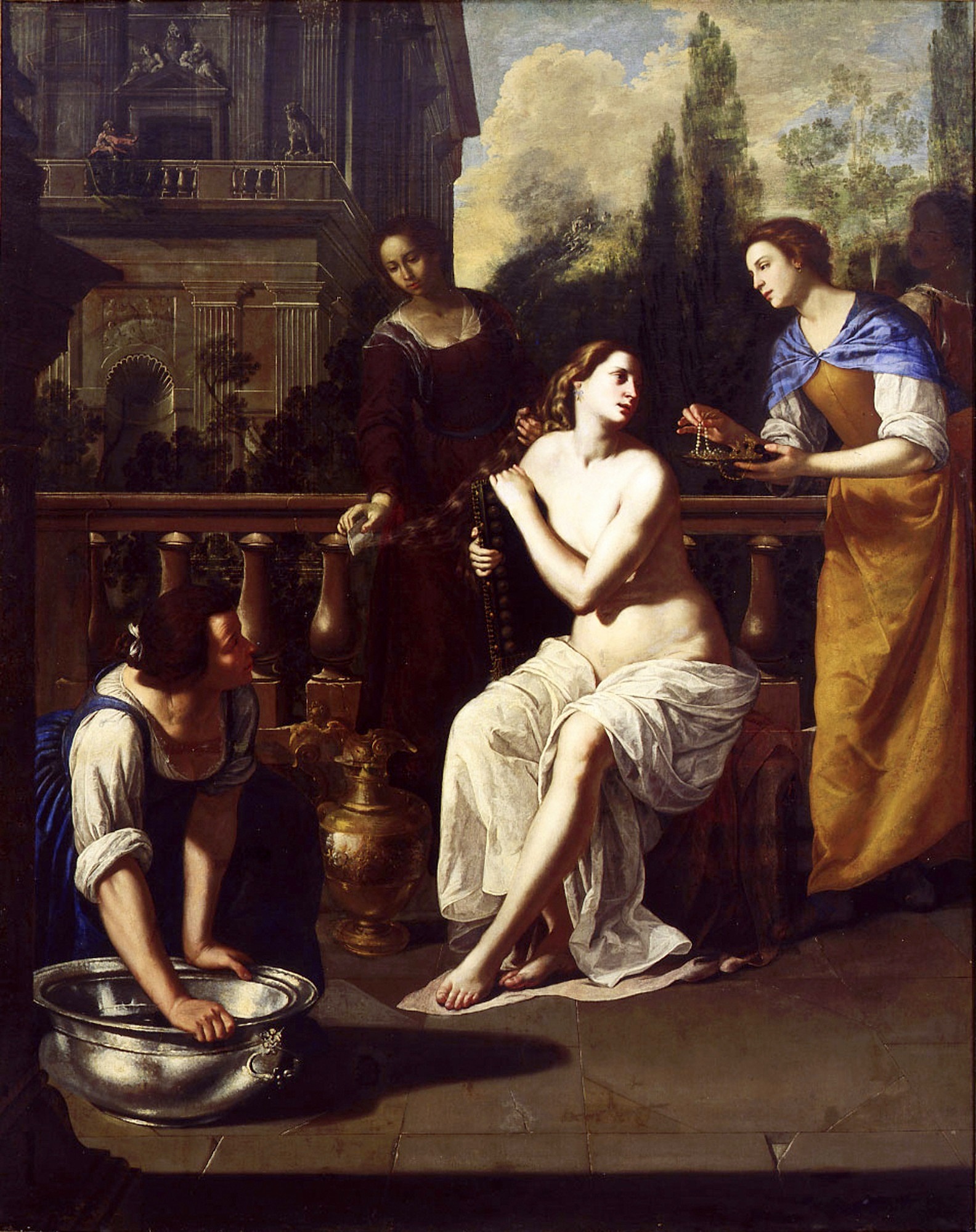
This is a portrait of Isabella Ruini as Venus. A transparent veil stitched with gold thread of extraordinary delicacy reveals the marmoreal body of this Venus with a slender throat and delicate features, brought out to their best advantage by jewelry of incredible sumptuousness. Cupid, hiding in the back and holding Venus' hand, is looking gently at Venus.
In classical mythology, Cupid is the god of desire, erotic love, attraction, and affection. He is often portrayed as the son of the love goddess Venus and the god of war Mars. Cupid is usually shown amusing himself with adult play. He is often depicted with his mother Venus, playing a horn. Venus, the goddess of sexuality, became a popular subject of painting and sculpture during the Renaissance period in Europe. As a "classical" figure, nudity was her natural state, so it was socially acceptable to depict her unclothed. Throughout history, many famous artists have depicted Venus and Cupid together on their canvas, including Artemisia Gentileschi, Lorenzo Lotto, and Pontormo.
This painting is a disguised portrait, a method of depicting the most prominent courtiers designed to glorify the aristocrat concerned. In this manner, women are portrayed in bust format, with idealized bodies depicted in the image of Diana or, as in this case, Venus. The subject here is probably a lady of the Ruini family, as suggested by a sketch of a similar-looking model by Cristoforo dell’Altissimo, conserved at the Pitti Palace in Florence. It may have been an engagement portrait sent to the future husband. According to Buckley, by depicting her patron as Venus, Fontana played with the long-standing tradition of classical revivalism in Renaissance art, so depicting Ruini nearly nude could be permitted.
Creator
Fontana, Lavinia
Source
Buckley, Kat. “Lavinia Fontana: Immortalizing Morality .” Critical Perspectives in Fashion, October 2015. https://www.researchgate.net/profile/Kat-Zagaria/publication/303688203_Lavinia_Fontana_Immortalizing_Morality/links/574d968f08ae82d2c6bde109/Lavinia-Fontana-Immortalizing-Morality.pdf.
- This source focuses on Lavinia Fontana’s expertise on fabric and ornamentation and how Lavinia Fontana’s depicted her patrons, the nobility of Bologna, as they wished to see themselves. Specifically, it argues that by depicting her patron as Venus in Venus and Cupid, Fontana played with the long-standing tradition of classical revivalism in Renaissance art – and thus, depicting Ruini nearly nude, could be permitted. Two major types of evidence are used: first, historical and cultural context on Fontana’s career and Bologna’s nobility in the 16th century; second, case studies of direct comparison between artworks of Fontana and her contemporaries.
- This source focuses on Lavinia Fontana’s expertise on fabric and ornamentation and how Lavinia Fontana’s depicted her patrons, the nobility of Bologna, as they wished to see themselves. Specifically, it argues that by depicting her patron as Venus in Venus and Cupid, Fontana played with the long-standing tradition of classical revivalism in Renaissance art – and thus, depicting Ruini nearly nude, could be permitted. Two major types of evidence are used: first, historical and cultural context on Fontana’s career and Bologna’s nobility in the 16th century; second, case studies of direct comparison between artworks of Fontana and her contemporaries.
Publisher
Fontana, Lavinia. “Venus and Cupid, 1592 - Lavinia Fontana.” www.wikiart.org, January 1, 1592. https://www.wikiart.org/en/lavinia-fontana/isabella-ruini-as-venus-1592.
Date
1592
Contributor
Jenny Chen
Rights
This artwork is in public domain in its country of origin and other countries and areas where the copyright term is the author's life plus 70 years or less. If you are a copyright owner of this artwork, or his/hers legal representative, and you do not agree that this artwork is public domain, please let us know wikipaintings@gmail.com
WikiArt.org allows unlimited copying, distributing and displaying of the images of public domain artworks. Artworks protected by copyright are supposed to be used only for contemplation. Images of that type of artworks are prohibited for copying, printing, or any kind of reproducing and communicating to public since these activities may be considered copyright infringement.
WikiArt.org allows unlimited copying, distributing and displaying of the images of public domain artworks. Artworks protected by copyright are supposed to be used only for contemplation. Images of that type of artworks are prohibited for copying, printing, or any kind of reproducing and communicating to public since these activities may be considered copyright infringement.
Format
Oil on canvas, 75*60cm
Type
Painting
Coverage
Musée des Beaux-Arts de Rouen, Rouen, France
Files

Collection
Citation
Fontana, Lavinia, “Venus and Cupid,” ARTHIST 256 - Italian Baroque Art - Fall 2021, accessed October 22, 2026, https://baroque.dahvc.org/fall-2021/items/show/214.