

Dublin Core
Title
Fontana dell'Acqua Felice
Description
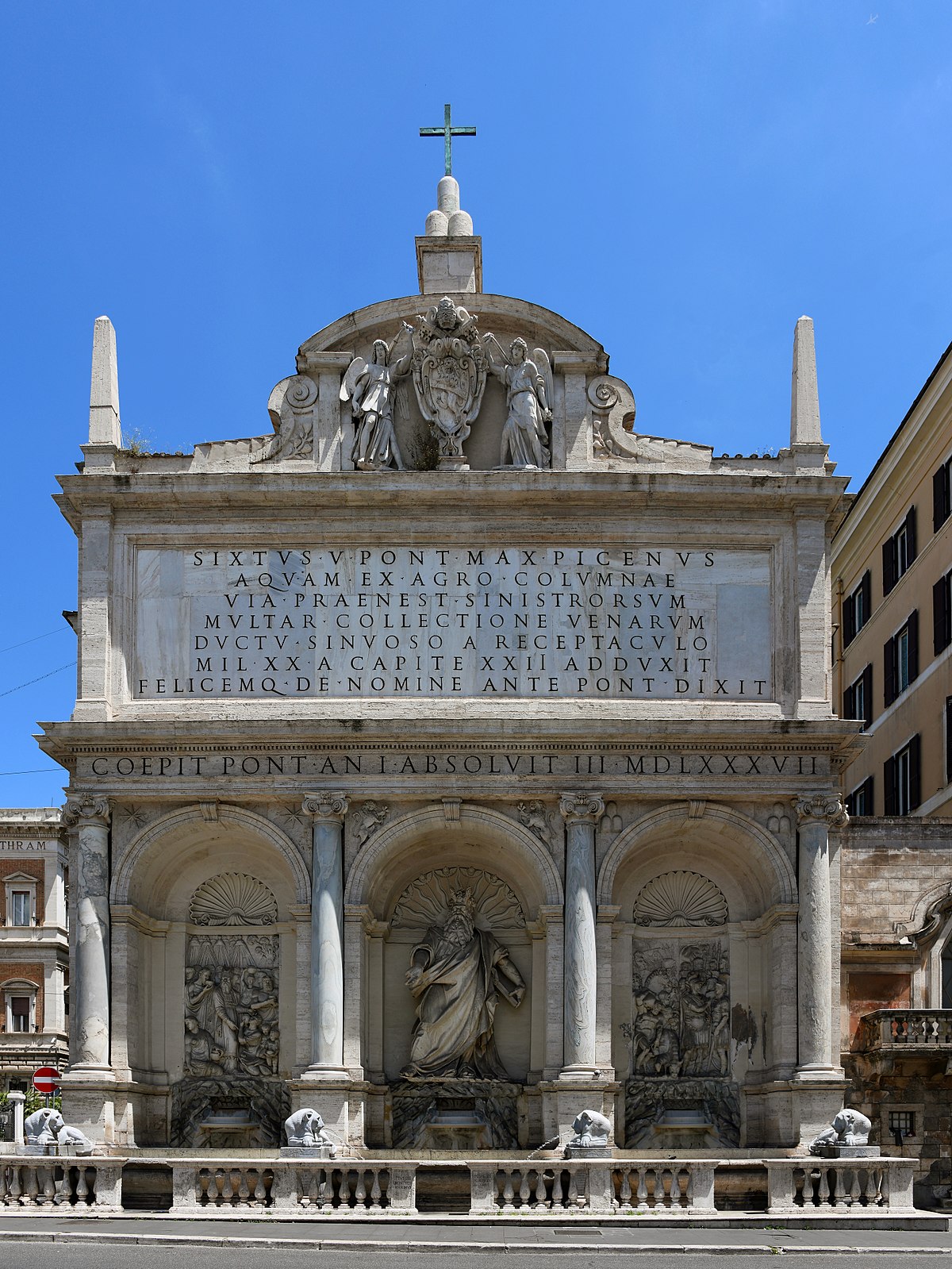
The Fontana dell’Acqua Felice was revolutionary at its creation. It marks the terminal point of the Acqua Felice, restored by Pope Sixtus V. Originally the Acqua Alessandrina, the aqueduct was renamed by Pope Sixtus V after its restoration. At the time, the only water source for many of Rome’s citizens was the water from the Acqua Vergine. Thus, in Sixtus V’s many alterations to the city, he restored the Acqua Felice and commissioned the Fontana dell’Acqua Felice. The construction of the aqueduct took multiple efforts, as there were many problems upon initial attempts. The fountain was constructed in 1587 by Domenico Fontana. The large fountain celebrates the transportation of water and the role of Sixtus V.
The fountain itself is also called the Fountain of Moses due to the statue in the middle. The fountain consists of three equally sized archways inset into a wall. This fountain has a large basin at the bottom to collect the water, along with three smaller basins attached to the wall in between the three arches, from which the water pours. Above this smaller basin in the middle niche stands a towering statue of Moses created by Leonardo Sormani and Prospero da Brescia. Known for his biblical role of parting the red sea and striking a rock to enable the flow of water, Moses appears to be doing the latter, making the water appear. On the side niches, there are two etchings. They are believed to be either biblical in nature or relating to ancient Roman times and the founding of the Acqua Alessandrina.
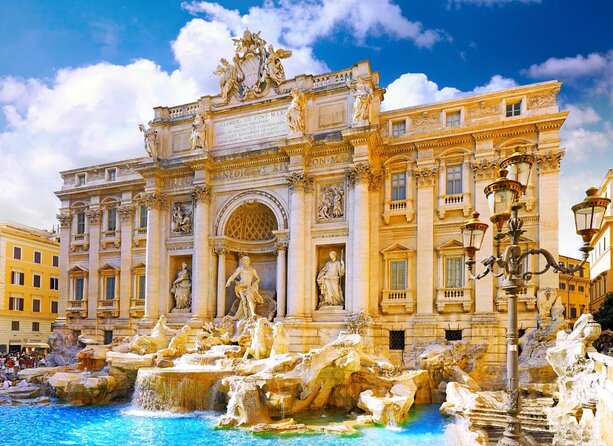
The Fontana dell’Acqua Felice highlights the power of the pope in many ways. Above the fountain there is an inscription dedicated to Sixtus V and the work he did. Not only did he commission the fountain, creating a magnificent spectacle and a piece of pride for the Catholic church, he also brought water to the people. In establishing the Acqua Felice, Pope Sixtus V exercised his power to help the Roman citizens that were without an easy water source. This fountain is a very important fountain. It created a standard that inspired the Fontana dell’Acqua Paola and the Fontana di Trevi. Both of these fountains harness the same styles and similar architecture as seen in the Fontana dell’Acqua Felice. This fountain takes a classical style and revamps it to fit in the Baroque era, with Christian imagery. Besides simply being a source of water for people, showing off the power of the pope, spreading Catholicism, and inspiring future churches, the Fontana dell’Acqua Felice also created a landmark for Rome. The fountain is massive, standing tall over the road in front of it. Surrounded by churches and modern political buildings, it is likely this church was placed in a highly populated area with moderate affluence.
Creator
Domenico Fontana
Source
Connors, Joseph. Alliance and Enmity in Roman Baroque Urbanism. Rome, Italy: Bibliotheca Hertziana, 1989.
Dennis, Kimberly. “Camilla Peretti, Sixtus V, and the Construction of Peretti Family Identity in Counter-Reformation Rome.” The Sixteenth Century Journal 43, no. 1 (2012): 71–101.
The Fountains of Rome, 1986. https://fod-infobase-com.proxy.lib.duke.edu/p_ViewVideo.aspx?xtid=2150.
Pulvers, Marvin. Roman Fountains: 2000 Fountains in Rome: A Complete Collection. Rome, Italy: L'Erma di Bretschneider, 2002.
Respighi, Ottorino, Tadaaki Otaka, and Patrick Thomas. CD. The Fountains of Rome. BBC Music Magazine, n.d.
Zucker, Paul. “Space and Movement in High Baroque City Planning.” Journal of the Society of Architectural Historians 14, no. 1 (1955): 8–13. https://doi.org/10.2307/987716.
Publisher
Pope Sixtus V
Date
1587
Contributor
Jacob Carnes
Format
Granite and stone
Type
Fountain
Coverage
Rome, Italy