Giovanna Garzoni's Work and Comparison Pieces
Dublin Core
Title
Giovanna Garzoni's Work and Comparison Pieces
Description
Introduction:
Giovanna Garzoni was born in 1600 in Ascoli Piceno of the Marche region of Italy. She is best known for her still life pieces, with which she became famous and renowned. She was one of the pioneers for women into the still life genre, and as such stood out greatly. Many of her still life works allude to sexual reproduction and genitalia, and are considered to have pro-feminist messages. Garzoni’s still life paintings resemble those of artists such as Fede Galizia (1578-1630) and she is thought to have been potentially influenced by Jacopo Ligozzi, but Garzoni’s works stand out for her inclusion of lively animals, insects, and variety in her inclusion of fruit subjects. Garzoni includes a wide variety of fruits, ranging from figs to apples to peaches to citrons. She married her husband, Tiberio Tinelli, but soon after, had their marriage annulled. Travelling across much of Europe, Garzoni gained inspiration from the various sights she witnessed. She settled for a while to be a painter for the Medici family where she was assured her art was to be appreciated. Her drawings were frequently showcased throughout the Medici villas. Garzoni moved around and produced notable works in Italy, Spain, and France. Giovanna eventually died in 1670, but not before establishing herself as an artist and inspiring other female artists to work with still life pieces.
Giovanna Garzoni was born in 1600 in Ascoli Piceno of the Marche region of Italy. She is best known for her still life pieces, with which she became famous and renowned. She was one of the pioneers for women into the still life genre, and as such stood out greatly. Many of her still life works allude to sexual reproduction and genitalia, and are considered to have pro-feminist messages. Garzoni’s still life paintings resemble those of artists such as Fede Galizia (1578-1630) and she is thought to have been potentially influenced by Jacopo Ligozzi, but Garzoni’s works stand out for her inclusion of lively animals, insects, and variety in her inclusion of fruit subjects. Garzoni includes a wide variety of fruits, ranging from figs to apples to peaches to citrons. She married her husband, Tiberio Tinelli, but soon after, had their marriage annulled. Travelling across much of Europe, Garzoni gained inspiration from the various sights she witnessed. She settled for a while to be a painter for the Medici family where she was assured her art was to be appreciated. Her drawings were frequently showcased throughout the Medici villas. Garzoni moved around and produced notable works in Italy, Spain, and France. Giovanna eventually died in 1670, but not before establishing herself as an artist and inspiring other female artists to work with still life pieces.
Contributor
Cameron DeChurch, Meena Gudapati, Jacob Carnes, Kayla Marr
Collection Items
Dog with a Biscuit and a Chinese Cup
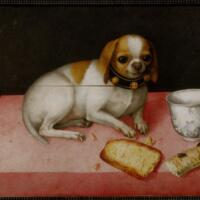
Dog with a Biscuit and a Chinese Cup was painted by Giovanna Garzoni in 1648. The work is a tempera painting on vellum that measures 27.5 x 39.5 centimeters [1]. Between the years 1642 to 1651, Garzoni worked as a court artist for the Medici Grand…
Self-portrait as Apollo
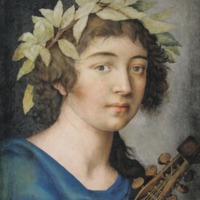
Giovanna Garzoni's Self-portrait as Apollo. Signed on the instrument: “Giovanna Garzoni F”
Dish with Decoration of Oxen and Cherry Blossoms
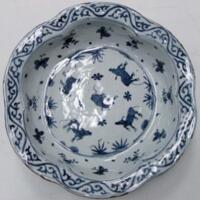
Dish with Decoration of Oxen and Cherry Blossoms relates to Giovanna Garzoni’s Dog with a Biscuit and a Chinese Cup as an example of the type of ceramic ware that Garzoni came into contact with and depicted in her artwork. As a court artist for the…
Piante Varie
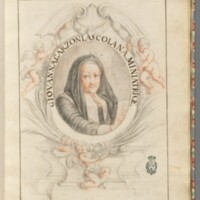
This is a collection of drawings of various plants all done by Garzoni (1650). Known for her still-life pieces, Garzoni hones in on the individual plant, examining shape and form of real plant anatomy. This book contains 50 different plants that…
Flora, ouero, Cultura di fiori
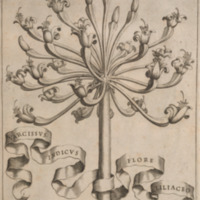
Anna Maria Vaiani is another female artist who did floral designs. In Giovanni Battista Ferrari’s piece on gardening, Flora, ouero, Cultura di fiori, (1638) Vaiani etched many of the floral designs. Like Garzoni, her designs played on anatomy of…
The Protofeminist Insects of Giovanna Garzoni and Maria Sibylla Merian
Giovanna Garzoni and Maria Sibylla Merian lived two unusual lives for female artists at the time. Both of them left their husbands and both are renowned for their work in still lifes. Yet this article argues that their most powerful connector is how…
Still Life with Birds and Fruit
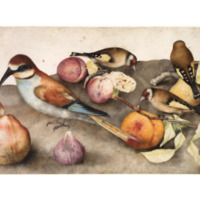
Giovanna Garzoni painted this magnificent still-life in 1650, towards the middle/beginning of the latter-half of her career. This painting was originally thought to be created by Jacobo Ligozzi, but is now accurately credited to Garzoni [1]. Art…
A Crystal Fruit Stand with Peaches, Quinces, and Jasmine
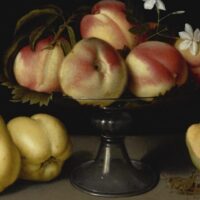
This oil on canvas still life painting is the earliest still life with a clear, concrete creation date, and is Galizia's first signed one [1]. Different sources refer to this painting by slightly different names from the most common name used in the…
Annotated Bibliography Entry: "The Not-So-Still Lifes of Giovanna Garzoni" by Mary D. Garrard

Garrard D., Mary. “The Not-So-Still Lifes of Giovanna Garzoni.” Essay. In "The Immensity of the Universe" in the Art of Giovanna Garzoni, 62-77. Sillabe, 2020.
Mary D. Garrard's essay within Sheila Barker's catalogue discusses the work of…
Mary D. Garrard's essay within Sheila Barker's catalogue discusses the work of…
Barker, Sheila, and Sheila Barker. “The Universe of Giovanna Garzoni. Art, Mobility, and the Global Turn in the Geographical Imaginary.” Essay. In "The Immensity of the Universe" in the Art of Giovanna Garzoni, 16–29. Sillabe, 2020.
Sheila Barker’s essay, “The Universe of Giovanna Garzoni. Art, Mobility, and the Global Turn in the Geographical Imaginary” provides an examination of the influences that shaped Giovanna Garzoni’s life, career, and art. Barker argues that Garzoni’s…